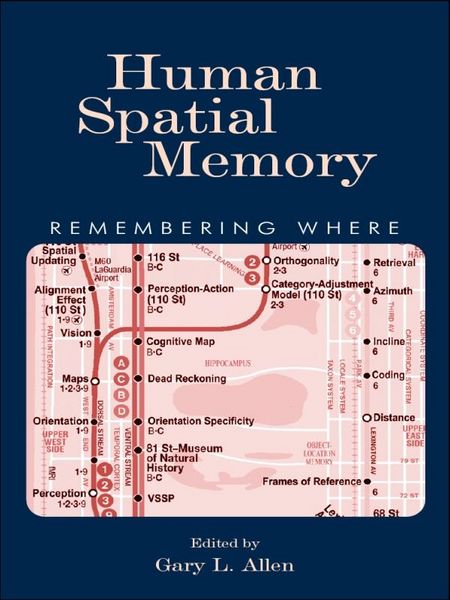
Human Spatial Memory Remembering Where
-
- Einzelkauf Download ausgewählt
-
Sprache:Englisch
-
eBook Format:ePUB
- PDF 76,49 €
- ePUB 76,49 € ausgewählt
76,49 €
inkl. gesetzl. MwSt.Beschreibung
Produktdetails
Format
ePUB
Kopierschutz
Ja
Family Sharing
Nein
Text-to-Speech
Ja
Erscheinungsdatum
12.04.2004
Herausgeber
Gary L. AllenVerlag
Taylor & Francis eBooksSeitenzahl
368 (Printausgabe)
Dateigröße
3351 KB
Sprache
Englisch
EAN
9781135635121
The chapters in Human Spatial Memory: Remembering Where present a fascinating picture of an everyday aspect of mental life that is as intriguing to people outside of academia as it is to scientists studying human cognition and behavior. The questions are as old as the study of mind itself: How do we remember where objects are located? How do we remember where we are in relation to other places? What is the origin and developmental course of spatial memory? What neural structures are involved in remembering where? How do we come to understand scaled-down versions of places as symbolic representations of actual places? Although the questions are old, some of the answers-in-progress are new, thanks to some innovative theorizing, solid experimental work, and revealing applications of new technologies, such as virtual environments and brain imaging techniques.
This volume includes a variety of theoretical, empirical, and methodological advances that invite readers to make their own novel connections between theory and research. Scholars who study spatial cognition can benefit from examining the latest from well-established experts, as well as milestone contributions from early-career researchers. This combination provides the reader with a sense of past, present, and future in terms of spatial memory research. Just as important, however, is the value of the volume as a touchstone resource for researchers who study perception, memory, or cognition but who are not concerned primarily with the spatial domain. All readers may find the fact that this volume violates the trend toward an ever-narrowing specialization refreshing. Chapters from cognitive psychologists are alongside chapters by developmentalists and neuroscientists; results from field studies are just pages away from those based on fMRI during observation of virtual displays. Thus, the book invites integrative examination across disciplines, research areas, and methodological approaches.
Kundinnen und Kunden meinen
Verfassen Sie die erste Bewertung zu diesem Artikel
Helfen Sie anderen Kund*innen durch Ihre Meinung
Kurze Frage zu unserer Seite
Vielen Dank für dein Feedback
Wir nutzen dein Feedback, um unsere Produktseiten zu verbessern. Bitte habe Verständnis, dass wir dir keine Rückmeldung geben können. Falls du Kontakt mit uns aufnehmen möchtest, kannst du dich aber gerne an unseren Kund*innenservice wenden.
zum Kundenservice