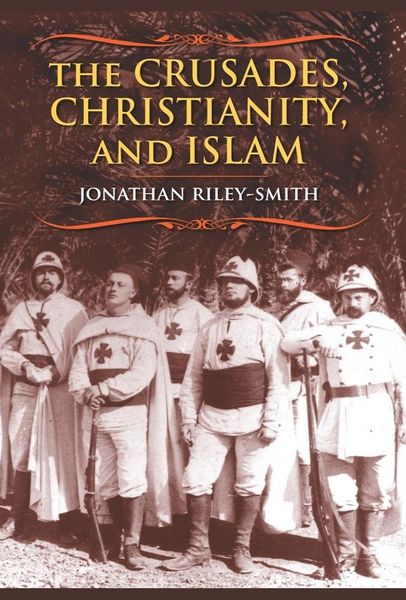
The Crusades, Christianity, and Islam
-
- Einzelkauf Download ausgewählt
-
Sprache:Englisch
24,99 €
inkl. gesetzl. MwSt.Beschreibung
Produktdetails
Format
ePUB
Kopierschutz
Nein
Family Sharing
Nein
Text-to-Speech
Ja
Erscheinungsdatum
30.09.2008
Verlag
Columbia University PressSeitenzahl
136 (Printausgabe)
Dateigröße
16712 KB
Sprache
Englisch
EAN
9780231517942
The Crusades were penitential war-pilgrimages fought in the Levant and the eastern Mediterranean, as well as in North Africa, Spain, Portugal, Poland, the Baltic region, Hungary, the Balkans, and Western Europe. Beginning in the eleventh century and ending as late as the eighteenth, these holy wars were waged against Muslims and other enemies of the Church, enlisting generations of laymen and laywomen to fight for the sake of Christendom.
Crusading features prominently in today's religio-political hostilities, yet the perceptions of these wars held by Arab nationalists, pan-Islamists, and many in the West have been deeply distorted by the language and imagery of nineteenth-century European imperialism. With this book, Jonathan Riley-Smith returns to the actual story of the Crusades, explaining why and where they were fought and how deeply their narratives and symbolism became embedded in popular Catholic thought and devotional life.
From this history, Riley-Smith traces the legacy of the Crusades into modern times, specifically within the attitudes of European imperialists and colonialists and within the beliefs of twentieth-century Muslims. Europeans fashioned an interpretation of the Crusades from the writings of Walter Scott and a French contemporary, Joseph-François Michaud. Scott portrayed Islamic societies as forward-thinking, while casting Christian crusaders as culturally backward and often morally corrupt. Michaud, in contrast, glorified crusading, and his followers used its imagery to illuminate imperial adventures.
These depictions have had a profound influence on contemporary Western opinion, as well as on Muslim attitudes toward their past and present. Whether regarded as a valid expression of Christianity's divine enterprise or condemned as a weapon of empire, crusading has been a powerful rhetorical tool for centuries. In order to understand the preoccupations of Islamist jihadis and the character of Western discourse on the Middle East, Riley-Smith argues, we must understand how images of crusading were formed in the nineteenth and twentieth centuries.
Noch keine Bewertungen vorhanden
Verfassen Sie die erste Bewertung zu diesem Artikel
Helfen Sie anderen Kundinnen und Kunden durch Ihre Meinung.
Kurze Frage zu unserer Seite
Vielen Dank für dein Feedback
Wir nutzen dein Feedback, um unsere Produktseiten zu verbessern. Bitte habe Verständnis, dass wir dir keine Rückmeldung geben können. Falls du Kontakt mit uns aufnehmen möchtest, kannst du dich aber gerne an unseren Kund*innenservice wenden.
zum Kundenservice