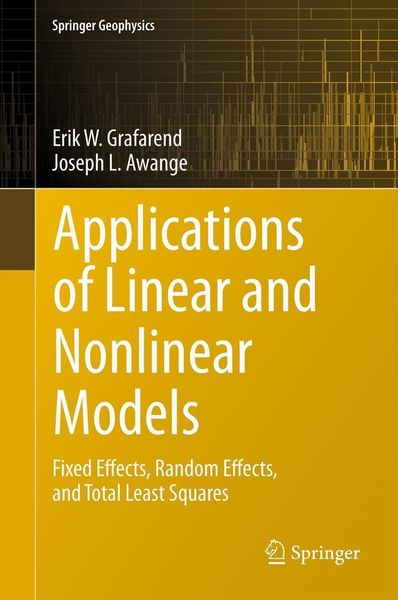
Applications of Linear and Nonlinear Models Fixed Effects, Random Effects, and Total Least Squares
-
- Hardcover
- Taschenbuch
- eBook ausgewählt
-
Form:Einzelkauf Download
-
Sprache:Englisch
-
Verlag:Springer
223,63 €
inkl. gesetzl. MwSt.Beschreibung
Produktdetails
Format
Kopierschutz
Nein
Family Sharing
Nein
Text-to-Speech
Nein
Erscheinungsdatum
15.08.2012
Verlag
SpringerSeitenzahl
1016 (Printausgabe)
Dateigröße
12121 KB
Sprache
Englisch
EAN
9783642222412
Here we present a nearly complete treatment of the Grand Universe of linear and weakly nonlinear regression models within the first 8 chapters. Our point of view is both an algebraic view as well as a stochastic one. For example, there is an equivalent lemma between a best, linear uniformly unbiased estimation (BLUUE) in a Gauss-Markov model and a least squares solution (LESS) in a system of linear equations. While BLUUE is a stochastic regression model, LESS is an algebraic solution. In the first six chapters we concentrate on underdetermined and overdeterimined linear systems as well as systems with a datum defect. We review estimators/algebraic solutions of type MINOLESS, BLIMBE, BLUMBE, BLUUE, BIQUE, BLE, BIQUE and Total Least Squares. The highlight is the simultaneous determination of the first moment and the second central moment of a probability distribution in an inhomogeneous multilinear estimation by the so called E-D correspondence as well as its Bayes design. In addition, we discuss continuous networks versus discrete networks, use of Grassmann-Pluecker coordinates, criterion matrices of type Taylor-Karman as well as FUZZY sets. Chapter seven is a speciality in the treatment of an overdetermined system of nonlinear equations on curved manifolds. The von Mises-Fisher distribution is characteristic for circular or (hyper) spherical data. Our last chapter eight is devoted to probabilistic regression, the special Gauss-Markov model with random effects leading to estimators of type BLIP and VIP including Bayesian estimation.
A great part of the work is presented in four Appendices. Appendix A is a treatment, of tensor algebra, namely linear algebra, matrix algebra and multilinear algebra. Appendix B is devoted to sampling distributions and their use in terms of confidence intervals and confidence regions. Appendix C reviews the elementary notions of statistics, namely random events and stochastic processes. Appendix D introduces the basics of Groebner basis algebra, its careful definition, the Buchberger Algorithm, especially the C. F. Gauss combinatorial algorithm.
Noch keine Bewertungen vorhanden
Verfassen Sie die erste Bewertung zu diesem Artikel
Helfen Sie anderen Kundinnen und Kunden durch Ihre Meinung.
Kurze Frage zu unserer Seite
Vielen Dank für dein Feedback
Wir nutzen dein Feedback, um unsere Produktseiten zu verbessern. Bitte habe Verständnis, dass wir dir keine Rückmeldung geben können. Falls du Kontakt mit uns aufnehmen möchtest, kannst du dich aber gerne an unseren Kund*innenservice wenden.
zum Kundenservice