KI-Beratung Beta

Produktbild: Character Evidence
Band 11

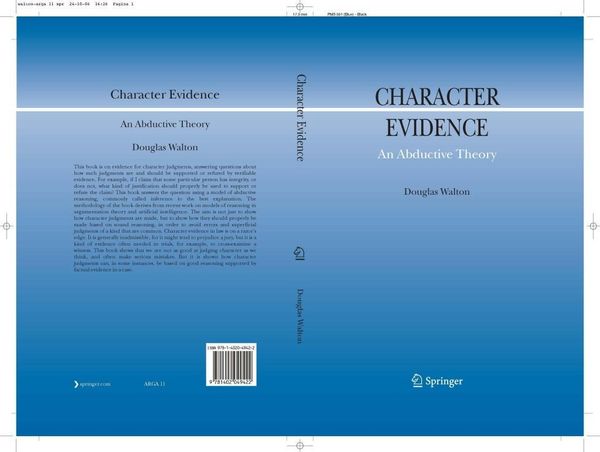
Character Evidence An Abductive Theory

Aus der Reihe Argumentation Library

96,29 €

inkl. gesetzl. MwSt.

Beschreibung

The theory in the book is based on the latest research in argumentation theory, and especially on new applications of artificial intelligence (AI) to legal argumentation. The methodology of the book derives from recent work in argumentation theory and AI in which forms of reasoning other than deductive...

Beschreibung

The theory in the book is based on the latest research in argumentation theory, and especially on new applications of artificial intelligence (AI) to legal argumentation. The methodology of the book derives from recent work in argumentation theory and AI in which forms of reasoning other than deductive and inductive have been the focus of much investigation. The aim is not just to show how character judgments are made, but to show how they should properly be made based on sound reasoning, in order to avoid certain fallacies, errors and superficial judgments of a kind that are common. The book is about character judgments, but centrally about the kind of logical reasoning and evidence that should properly be used to support or question such judgments. According to the new theory put forward in this book, such evidence is based on a kind of multi-agent simulative reasoning in which one agent is able to explain the actions of another by understanding the situation confronted by the other,and recreating the plan adopted by the other. According to the theory, one agent can reach reasoned conclusions about the presumed character properties of another, using plan recognition and ar- mentation schemes representing stereotypical forms of reasoning. We use character evidence every day in reasoning, as in the inference, "He has a certain character trait, so that is evidence he is the one who carried out this particular action".

Produktdetails

Format

PDF

Kopierschutz

Nein

Family Sharing

Nein

Text-to-Speech

Nein

Produktdetails

Format

PDF

Format

eBooks im PDF-Format haben eine festgelegte Seitengröße und eignen sich daher nur bedingt zum Lesen auf einem tolino eReader oder Smartphone. Für den vollen Lesegenuss empfehlen wir Ihnen bei PDF-eBooks die Verwendung eines Tablets oder Computers.

Kopierschutz

Nein

Kopierschutz

Dieses eBook können Sie uneingeschränkt auf allen Geräten der tolino Familie, allen sonstigen eReadern und am PC lesen. Das eBook ist nicht kopiergeschützt und kann ein personalisiertes Wasserzeichen enthalten. Weitere Hinweise zum Lesen von eBooks mit einem personalisierten Wasserzeichen finden Sie unter Hilfe/Downloads.

Family Sharing

Nein

Family Sharing

Mit Family Sharing können Sie eBooks innerhalb Ihrer Familie (max. sechs Mitglieder im gleichen Haushalt) teilen. Sie entscheiden selbst, welches Buch Sie mit welchem Familienmitglied teilen möchten. Auch das parallele Lesen durch verschiedene Familienmitglieder ist durch Family Sharing möglich. Um eBooks zu teilen oder geteilt zu bekommen, muss jedes Familienmitglied ein Konto bei Thalia oder einem anderen tolino-Buchhändler haben. Weitere Informationen finden Sie unter Hilfe/Family-Sharing.

Text-to-Speech

Nein

Text-to-Speech

Bedeutet Ihnen Stimme mehr als Text? Mit der Funktion Text-to-Speech können Sie sich im tolino webReader und in der aktuellen Thalia – Lesen & Hören App das eBook vorlesen lassen. Weitere Informationen finden Sie unter Hilfe/Text-to-Speech.

Erscheinungsdatum

10.11.2006

Verlag Springer Netherlands
Seitenzahl

240 (Printausgabe)

Dateigröße

987 KB

Sprache

Englisch

EAN

9781402049439

Barrierefreiheit
  • keine Information zur Barrierefreiheit bekannt

Noch keine Bewertungen vorhanden

Verfassen Sie die erste Bewertung zu diesem Artikel

Helfen Sie anderen Kundinnen und Kunden durch Ihre Meinung.

Kundinnen und Kunden meinen

Bewertungen (0)

Weitere Artikel findest du in

  • Produktbild: Character Evidence
  • Acknowledgments. 1. The Problem of Character Evidence. 1.1. Individual Worth and Respect for Character. 1.2. Ruling on Relevance of Character Evidence in Trials. 1.3. Problem of the Two-sided Nature of Character Evidence in Law. 1.4. Innuendo and Attacks on Character. 1.5. Character Assassination and Panegyric Discourse. 1.6. Reputation and Character. 1.7. Character Attacks and Ad Hominem Arguments. 1.8. A Problem of Reasoning and Evidence. 1.9. Character Properties in Law and Ethics. 1.10. Character Evidence in Law and Artificial Intelligence. 2. Defining and Judging Character. 2.1. Bias and Character. 2.2. Habit, Propensity and Motive. 2.3. Agents, Practical Reasoning and Character. 2.4. Character as the Property of an Agent. 2.5. Evaluating Witness Testimony. 2.6. The Structure of Abductive Reasoning. 2.7. Character as an Interpersonal Notion. 2.8. Evidence for Character Judgments. 2.9. Drawing Conclusions by Abductive Reasoning from Data. 2.10. Differentiating Character, Motive and Bias. 3. Integrity and Hypocrisy. 3.1. The Three Central Characteristics of Integrity. 3.2. Judging a Person's Integrity. 3.3. Commitment and Integrity. 3.4. A Case Where a Person's Integrity is in Doubt. 3.5. Living Up to a Commitment. 3.6. Integrity and Living Up to a Commitment . 3.7. Character Attack Based on Alleged Hypocrisy. 3.8. Evaluation of the Alleged Hypocrisy Case. 3.9. Evidence for Judgments of Integrity and Hypocrisy.3.10. The Defeasibility of Character Judgments. 4. Simulative Reasoning and Plan Recognition. 4.1. Collingwood's Theory of Reenactment. 4.2. Simulative and Autoepistemic Reasoning. 4.3. Strategic Use of Simulative Reasoning. 4.4. Scripts and Stories. 4.5. Simulative Practical Reasoning. 4.6. Plan Recognition. 4.7. Characteristics of Simulative Practical Reasoning. 4.8. Combination of Simulative and Abductive Reasoning. 4.9. Abstraction and Chaining. 4.10. Defeasible Reasoning. 5. Multi-Agent Dialogue. 5.1. Plausible Reasoning. 5.2. Plan Recognition and Dialogue. 5.3. Sources of Dialogue Evidence. 5.4. Commitment in Dialogue. 5.5. Legal Evidence and Examination Dialogue. 5.6. Examination Dialogue and Conversational Postulates. 5.7. A Dialectical Theory of Explanation. 5.8. A Dialectical Argumentation Scheme for Abduction. 5.9. Abductive Evidence for Courage Judgments. 5.10. Abductive Evidence for Integrity Judgments.
    6. A Multi-Agent System for Character Evidence. 6.1. Character-Based Inferences. 6.2. Inferences Linking Evidence to Character. 6.3. Generalizations and Fallacies. 6.4. Character-Based Evidence Contrasted to Other Evidence. 6.5. Argumentation Schemes. 6.6. Ad Hominem Arguments. 6.7. Plan Recognition and Practical Inconsistency. 6.8. Simulative Reasoning in Ad Hominem Arguments. 6.9. The PFARD Multi-Agent Dialogue System. 6.10. Summary of the Method. Bibliography.