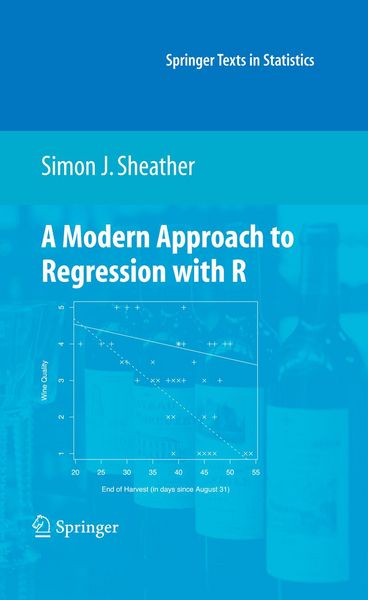
Produktbild: A Modern Approach to Regression with R

A Modern Approach to Regression with R

69,54 €

inkl. gesetzl. MwSt.

Beschreibung

Produktdetails

Format

PDF

Kopierschutz

Nein

Family Sharing

Nein

Text-to-Speech

Nein

Erscheinungsdatum

27.02.2009

Verlag

Springer New York

Seitenzahl

393 (Printausgabe)

Dateigröße

10796 KB

Sprache

Englisch

EAN

9780387096087

Beschreibung

Rezension

“This book fills an important niche in the regression textbook by providing a data-centered approach strong on graphics. …I am particularly interested in teaching regression to undergraduates, and I used this book one term in an introduction to applied regression course. …It is a book I will use again. …Graduate students in particular will find the balance between applications and theory useful, and the minimal amount of formulae used means the book should be useful for students from a variety of disciplines. The well-motivated homework problems are interesting and sufficiently complex that students at all levels will be able to learn something from them.” (Journal of Statistical Software, March 2010, Vo. 33, Book Review 3)

Simon Sheather, A Modern Approach to Regression With R 978-0-387-09607-0

“The author states that this book focuses on tools and techniques for building regression models using real-world data and assessing their validity. A key theme throughout the book is that it makes sense to base inferences or conclusions only on valid models. The primary focus is on examining statistical and graphical methods for assessing whether or not the model upon which one desires to draw inferences is valid. … the examples…will have appeal to the students due to the variety of the techniques motivated by the datasets. The author has included numerous graphs and descriptions with associated flow charts to assist the student in ’visualizing’ the process one should take when modeling data using regression models. I found that the book was …very readable and that the graphics were …useful in the analysis of the problem under consideration. The book is also the ’right size’ with enough but not too much content. Personally, I was pleased not to see the voluminous R code that ’litters’ many of the books that are ‘with R.’ I was also pleased that some of the characteristic R output has been minimized and reformatted to improve the appearance of the text. …One of the aspects I found most appealing is that which is not found in the book. The supplementary material given on the author’s webpage is potentially very useful. The R code that was used to create the graphs and output in the book is provided in a separate document. This supplement will be very useful to the student who is learning R. In addition, there are similar documents that use SAS and STATA. I have found that having code to address a specific statistical problem is a very effective way for a student to learn a statistical software package. The author’s supplementary material using all three packages will provide an effective means for a student to learn multiple software packages without having to spend valuable classroom time and instructor supervision.” (The American Statistician, August 2010, Vol. 64, No. 3)

Zitat

"This book fills an important niche in the regression textbook by providing a data-centered approach strong on graphics. ...I am particularly interested in teaching regression to undergraduates, and I used this book one term in an introduction to applied regression course. ...It is a book I will use again. ...Graduate students in particular will find the balance between applications and theory useful, and the minimal amount of formulae used means the book should be useful for students from a variety of disciplines. The well-motivated homework problems are interesting and sufficiently complex that students at all levels will be able to learn something from them." (Journal of Statistical Software, March 2010, Vo. 33, Book Review 3)
Simon Sheather, A Modern Approach to Regression With R 978-0-387-09607-0
"The author states that this book focuses on tools and techniques for building regression models using real-world data and assessing their validity. A key theme throughout the book is that it makes sense to base inferences or conclusions only on valid models. The primary focus is on examining statistical and graphical methods for assessing whether or not the model upon which one desires to draw inferences is valid. ... the examples...will have appeal to the students due to the variety of the techniques motivated by the datasets. The author has included numerous graphs and descriptions with associated flow charts to assist the student in 'visualizing' the process one should take when modeling data using regression models. I found that the book was ...very readable and that the graphics were ...useful in the analysis of the problem under consideration. The book is also the 'right size' with enough but not too much content. Personally, I was pleased not to see the voluminous R code that 'litters' many of the books that are 'with R.' I was also pleased that some of the characteristic R output has been minimized and reformatted to improve the appearance of the text. ...One of the aspects I found most appealing is that which is not found in the book. The supplementary material given on the author's webpage is potentially very useful. The R code that was used to create the graphs and output in the book is provided in a separate document. This supplement will be very useful to the student who is learning R. In addition, there are similar documents that use SAS and STATA. I have found that having code to address a specific statistical problem is a very effective way for a student to learn a statistical software package. The author's supplementary material using all three packages will provide an effective means for a student to learn multiple software packages without having to spend valuable classroom time and instructor supervision." (The American Statistician, August 2010, Vol. 64, No. 3)

Produktdetails

Format

PDF

eBooks im PDF-Format haben eine festgelegte Seitengröße und eignen sich daher nur bedingt zum Lesen auf einem tolino eReader oder Smartphone. Für den vollen Lesegenuss empfehlen wir Ihnen bei PDF-eBooks die Verwendung eines Tablets oder Computers.

Kopierschutz

Nein

Dieses eBook können Sie uneingeschränkt auf allen Geräten der tolino Familie, allen sonstigen eReadern und am PC lesen. Das eBook ist nicht kopiergeschützt und kann ein personalisiertes Wasserzeichen enthalten. Weitere Hinweise zum Lesen von eBooks mit einem personalisierten Wasserzeichen finden Sie unter Hilfe/Downloads.

Family Sharing

Nein

Mit Family Sharing können Sie eBooks innerhalb Ihrer Familie (max. sechs Mitglieder im gleichen Haushalt) teilen. Sie entscheiden selbst, welches Buch Sie mit welchem Familienmitglied teilen möchten. Auch das parallele Lesen durch verschiedene Familienmitglieder ist durch Family Sharing möglich. Um eBooks zu teilen oder geteilt zu bekommen, muss jedes Familienmitglied ein Konto bei Thalia oder einem anderen tolino-Buchhändler haben. Weitere Informationen finden Sie unter Hilfe/Family-Sharing.

Text-to-Speech

Nein

Bedeutet Ihnen Stimme mehr als Text? Mit der Funktion Text-to-Speech können Sie sich im tolino webReader und in der aktuellen Thalia – Lesen & Hören App das eBook vorlesen lassen. Weitere Informationen finden Sie unter Hilfe/Text-to-Speech.

Barrierefreiheit

  • keine Information zur Barrierefreiheit bekannt

Erscheinungsdatum

27.02.2009

Verlag

Springer New York

Seitenzahl

393 (Printausgabe)

Dateigröße

10796 KB

Sprache

Englisch

EAN

9780387096087

Noch keine Bewertungen vorhanden

Verfassen Sie die erste Bewertung zu diesem Artikel

Helfen Sie anderen Kundinnen und Kunden durch Ihre Meinung.

Kundinnen und Kunden meinen

Bewertungen (0)

Weitere Artikel findest du in

  • Produktbild: A Modern Approach to Regression with R
  • Introduction.- Simple linear regression.- Diagnostics and transformations for simple linear regression.- Weighted least squares.- Diagnostics and transformations for multiple linear regression.- Variable selection.- Logistic regression.- Serially correlated errors.- Mixed models.- Appendix: Nonparametric smoothing.