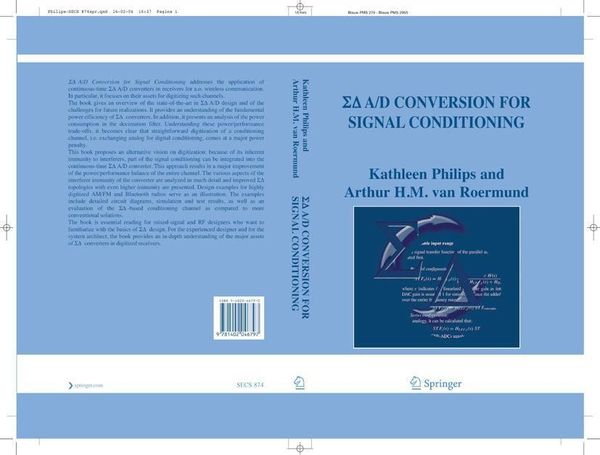
Produktbild: Sigma Delta A/D Conversion for Signal Conditioning
Band 874

Sigma Delta A/D Conversion for Signal Conditioning

149,79 €

inkl. gesetzl. MwSt.

Beschreibung

Produktdetails

Format

PDF

Kopierschutz

Nein

Family Sharing

Nein

Text-to-Speech

Nein

Erscheinungsdatum

05.05.2006

Verlag

Springer Netherlands

Seitenzahl

278 (Printausgabe)

Dateigröße

4201 KB

Sprache

Englisch

EAN

9781402046803

Beschreibung

Produktdetails

Format

PDF

eBooks im PDF-Format haben eine festgelegte Seitengröße und eignen sich daher nur bedingt zum Lesen auf einem tolino eReader oder Smartphone. Für den vollen Lesegenuss empfehlen wir Ihnen bei PDF-eBooks die Verwendung eines Tablets oder Computers.

Kopierschutz

Nein

Dieses eBook können Sie uneingeschränkt auf allen Geräten der tolino Familie, allen sonstigen eReadern und am PC lesen. Das eBook ist nicht kopiergeschützt und kann ein personalisiertes Wasserzeichen enthalten. Weitere Hinweise zum Lesen von eBooks mit einem personalisierten Wasserzeichen finden Sie unter Hilfe/Downloads.

Family Sharing

Nein

Mit Family Sharing können Sie eBooks innerhalb Ihrer Familie (max. sechs Mitglieder im gleichen Haushalt) teilen. Sie entscheiden selbst, welches Buch Sie mit welchem Familienmitglied teilen möchten. Auch das parallele Lesen durch verschiedene Familienmitglieder ist durch Family Sharing möglich. Um eBooks zu teilen oder geteilt zu bekommen, muss jedes Familienmitglied ein Konto bei Thalia oder einem anderen tolino-Buchhändler haben. Weitere Informationen finden Sie unter Hilfe/Family-Sharing.

Text-to-Speech

Nein

Bedeutet Ihnen Stimme mehr als Text? Mit der Funktion Text-to-Speech können Sie sich im tolino webReader und in der aktuellen Thalia – Lesen & Hören App das eBook vorlesen lassen. Weitere Informationen finden Sie unter Hilfe/Text-to-Speech.

Barrierefreiheit

  • keine Information zur Barrierefreiheit bekannt

Erscheinungsdatum

05.05.2006

Verlag

Springer Netherlands

Seitenzahl

278 (Printausgabe)

Dateigröße

4201 KB

Sprache

Englisch

EAN

9781402046803

Kundinnen und Kunden meinen

0 Bewertungen

Informationen zu Bewertungen

Zur Abgabe einer Bewertung ist eine Anmeldung im Konto notwendig. Die Authentizität der Bewertungen wird von uns nicht überprüft. Wir behalten uns vor, Bewertungstexte, die unseren Richtlinien widersprechen, entsprechend zu kürzen oder zu löschen.

Die Bewertungen sind nach Format, Anzahl Sterne und Datum sortiert.

Verfassen Sie die erste Bewertung zu diesem Artikel

Helfen Sie anderen Kund*innen durch Ihre Meinung

Kundinnen und Kunden meinen

0 Bewertungen filtern

Weitere Artikel findest du in

  • Produktbild: Sigma Delta A/D Conversion for Signal Conditioning
  • List of symbols and abbreviations 1 Introduction 1.1 Background 1.1.1 Anelectronicsystem 1.1.2 Digital signalprocessing 1.1.3 Digitizationof signal conditioning 1.1.4 Digitization of inter-die interfaces 1.2 Aim of this thesis 1.3 Scope 1.3.1 BasebandA/Dconditioning channels 1.3.2 Continuous-time single-bit sigma-delta conversion 1.3.3 CMOS technology 1.3.4 Power consumptionas cost parameter 1.3.5 Performance parameters 1.4 Outline 2 The signal conditioning channel 2.1 Generic communication channel 2.2 Performance parameters 2.3 Conventional conditioning channels 2.4 Evolution 2.4.1 Technology advances 2.4.2 Systemdemands 2.4.3 Advances in digital signal processing and analog circuit design 2.4.4 Digitizationof the architecture 2.5 Nomenclature 2.6 Conclusions
    3 Sigma delta A/D conversion 3.1 Historical overview 3.2 State-of-the-art in sigma delta A/D conversion 3.2.1 Architectural considerations 3.2.2 Implementation aspects 3.2.3 Performance metrics for sigma delta ADCs 3.3 sigma delta ADCs infuture conditioning channels 3.3.1 The Shannon theorem and sigma delta based signal conditioning 3.3.2 Comparison of Nyquist and sigma delta based signal conditioning
    3.3.3 Survey of published power/performance values
    3.4 Limitations of sigma delta A/D conversion 3.4.1 Linear limitations 3.4.2 Non-linear limitations 3.5 Conclusions 4 Power consumption in channel building blocks 4.1 Literature on power/performance analysis
    4.2 Figures-of-merit 4.2.1 FOM related to thermal noise 4.2.2 FOMincluding distortion
    4.2.3 FOM related to signal resolution
    4.3 Power consumption in analog conditioning circuits 4.3.1 Power/performance relations 4.3.2 Discussion 4.4 Power consumption in a sigma delta ADC
    4.4.1 Power/performance relations 4.4.2 Discussion 4.5 Power consumption in digital conditioning circuits 4.5.1 Filter functions 4.5.2 Power/performancerelations 4.5.3 Discussion
    4.6 Comparison
    4.7 Conclusions
    5 Full-analog and full-digital conditioning channels 5.1 Full-analog conditioning channel 5.1.1 The conditioning channel 5.2 Full-digital conditioning channel 5.2.1 The conditioning channel 5.2.2 Power/performance analysis 5.3 Conclusions 6 Conditioning sigma delta ADCs 6.1 Generic conditioning sigma delta ADC 6.1.1 Conceptofoperation 6.1.2 Universal model of a sigma delta modulator 6.1.3 Interferer immunity 6.1.4 Power/performance analysis 6.2 Signal conditioning in the decimation filter 6.2.1 Interferer immunity 6.2.2 The conditioning channel 6.2.3 Power/performance analysis 6.3 Signal conditioning with a restricted filtering STF 6.3.1 Interferer immunity 6.3.2 The conditioning channel 6.3.3 Power/performance analysis 6.3.4 Conditioning hybrid sigma delta ADC 6.4 Signal conditioningbyunrestrictedSTFdesign 6.4.1 Interferer immunity 6.4.2 The conditioningchannel 6.4.3 Power/performanceanalysis 6.5 Comparisonof conditioningADCs 6.5.1 Comparison of topologies 6.5.2 Flexibility 6.5.3 Power consumption 6.5.4 Guidelines 6.6 Conclusions 7 Digitization of the inter-die interface 7.1 Considerations 7.2 Power inthe interface 7.2.1 Analoginterface 7.2.2 Digital interface after decimation 7.2.3 Digital interface before decimation 7.2.4 Comparison 7.3 Application to the conditioning channels 7.4 Conclusions 8 Highly analog and highly digital channels for FM/AM radio
    8.1 System
    8.1.1 Conventional radio with analog demodulation
    8.1.2 Radio with digital demodulation
    8.2 VGAdesign 8.2.1 HighlylinearVGAdesign 8.2.2 Evaluation 8.3 ADCdesign 8.3.1 Conventionalsolutions 8.3.2 sigma delta ADC with integrated passive mixer 8.3.3 Evaluation 8.4 Evaluationof the channel 8.4.1 Discussion 8.4.2 Benchmark 8.5 Conclusions 9 Conditioning sigma delta ADCs for Bluetooth
    9.1 System
    9.1.1 Conventional radio with analog demodulation 9.1.2 Radio with digital demodulation and analog signal-conditioning 9.1.3 Radio with digital demodulation, without analog signal conditioning
    9.2 Feed forward sigma delta ADC 9.2.1 Design 9.2.2 Evaluation 9.3 Conditioning feedback sigma deltaADC 9.3.1 Design 9.3.2 Evaluation
    9.4 FFB-ADC 9.4.1 Design 9.4.2 Evaluation 9.5 Evaluationof the channels 9.5.1 Benchmark with published ADCs 9.5.2 Comparison of the presented ADCs 9.5.3 Benchmark with published Bluetooth conditioning channels 9.6 Conclusions 10 General conclusions A Overview of published sigma delta ADCs B Power/performance relation of analog circuits B.1 Simple differential pair B.2 Differentialpair in aglobal feed-back configuration B.3 Degenerated differential pair C Power/performance relation of digital filters C.1 Analysis of the filter topology C.2 Calculation of filter parameters
    C.3 Calculation of powerc onsumption
    C.4 Extensionto other implementations D Third-order distortion in analog circuits and sigma delta ADCs E Power consumption in a data interface.
    E.1 Analogdata interface. E.2 Digital data interface References Original contributions List of publications Summary Samenvatting
    Dankwoord
    Biography