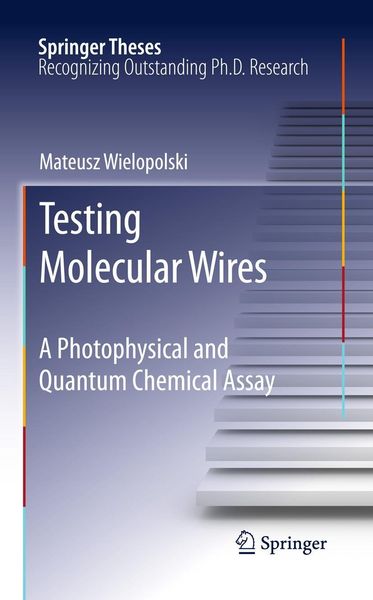
Produktbild: Testing Molecular Wires

Testing Molecular Wires A Photophysical and Quantum Chemical Assay

Aus der Reihe Springer Theses

53,49 €

inkl. gesetzl. MwSt.

Beschreibung

Produktdetails

Format

PDF

Kopierschutz

Nein

Family Sharing

Nein

Text-to-Speech

Nein

Erscheinungsdatum

02.11.2010

Verlag

Springer

Seitenzahl

182 (Printausgabe)

Dateigröße

6544 KB

Sprache

Englisch

EAN

9783642147401

Beschreibung

Produktdetails

Format

PDF

eBooks im PDF-Format haben eine festgelegte Seitengröße und eignen sich daher nur bedingt zum Lesen auf einem tolino eReader oder Smartphone. Für den vollen Lesegenuss empfehlen wir Ihnen bei PDF-eBooks die Verwendung eines Tablets oder Computers.

Kopierschutz

Nein

Dieses eBook können Sie uneingeschränkt auf allen Geräten der tolino Familie, allen sonstigen eReadern und am PC lesen. Das eBook ist nicht kopiergeschützt und kann ein personalisiertes Wasserzeichen enthalten. Weitere Hinweise zum Lesen von eBooks mit einem personalisierten Wasserzeichen finden Sie unter Hilfe/Downloads.

Family Sharing

Nein

Mit Family Sharing können Sie eBooks innerhalb Ihrer Familie (max. sechs Mitglieder im gleichen Haushalt) teilen. Sie entscheiden selbst, welches Buch Sie mit welchem Familienmitglied teilen möchten. Auch das parallele Lesen durch verschiedene Familienmitglieder ist durch Family Sharing möglich. Um eBooks zu teilen oder geteilt zu bekommen, muss jedes Familienmitglied ein Konto bei Thalia oder einem anderen tolino-Buchhändler haben. Weitere Informationen finden Sie unter Hilfe/Family-Sharing.

Text-to-Speech

Nein

Bedeutet Ihnen Stimme mehr als Text? Mit der Funktion Text-to-Speech können Sie sich im tolino webReader und in der aktuellen Thalia – Lesen & Hören App das eBook vorlesen lassen. Weitere Informationen finden Sie unter Hilfe/Text-to-Speech.

Barrierefreiheit

  • keine Information zur Barrierefreiheit bekannt

Erscheinungsdatum

02.11.2010

Verlag

Springer

Seitenzahl

182 (Printausgabe)

Dateigröße

6544 KB

Sprache

Englisch

EAN

9783642147401

Kundinnen und Kunden meinen

0 Bewertungen

Informationen zu Bewertungen

Zur Abgabe einer Bewertung ist eine Anmeldung im Konto notwendig. Die Authentizität der Bewertungen wird von uns nicht überprüft. Wir behalten uns vor, Bewertungstexte, die unseren Richtlinien widersprechen, entsprechend zu kürzen oder zu löschen.

Die Bewertungen sind nach Format, Anzahl Sterne und Datum sortiert.

Verfassen Sie die erste Bewertung zu diesem Artikel

Helfen Sie anderen Kund*innen durch Ihre Meinung

Kundinnen und Kunden meinen

0 Bewertungen filtern

Weitere Artikel findest du in

  • Produktbild: Testing Molecular Wires
  • I. Introduction and Motivation 1
    1. Introduction to Molecular Electronics 2
    1.1. Present Technology . . . . . . . . . . . . . . . . . . . . . . . . . . . . . . . . . . . 6
    1.2. Limitations of Present Technology . . . . . . . . . . . . . . . . . . . . . . . . . . 7
    2. Motivation - Focusing on Molecular Wires 9
    II. Theoretical Concepts 11
    3. Concepts of Photoinduced Electron and Energy Transfer Processes Across
    Molecular Bridges 12
    3.1. Introduction . . . . . . . . . . . . . . . . . . . . . . . . . . . . . . . . . . . . . . . 12
    3.2. Electron TransferMechanisms . . . . . . . . . . . . . . . . . . . . . . . . . . . . 14
    3.2.1. Superexchange . . . . . . . . . . . . . . . . . . . . . . . . . . . . . . . . . 17
    3.2.2. Charge Hopping . . . . . . . . . . . . . . . . . . . . . . . . . . . . . . . . 22
    3.2.3. Interplay ofMechanisms . . . . . . . . . . . . . . . . . . . . . . . . . . . 24
    3.3. Electronic Energy Transfer . . . . . . . . . . . . . . . . . . . . . . . . . . . . . . . 25
    3.3.1. Coulombic Energy Transfer . . . . . . . . . . . . . . . . . . . . . . . . . . 26
    3.3.2. Exchange Energy Transfer . . . . . . . . . . . . . . . . . . . . . . . . . . . 27
    4. Molecule-Assisted Transport of Charges and Energy Across Donor-Wire-
    Acceptor Junctions 30
    4.1. Mechanisms of Charge Transfer throughMolecularWires . . . . . . . . . . . . 32
    4.1.1. Superexchange Charge Transfer inMolecularWires . . . . . . . . . . . . 33
    4.1.2. Sequential Charge Transfer inMolecularWires . . . . . . . . . . . . . . 34
    4.2. Factors that Determine the Charge TransferMechanism . . . . . . . . . . . . . 36
    4.2.1. Electronic Coupling . . . . . . . . . . . . . . . . . . . . . . . . . . . . . . 36
    4.2.2. EnergyMatching . . . . . . . . . . . . . . . . . . . . . . . . . . . . . . . . 37
    4.3. Specific Aspects of Photoinduced Electron Transfer in Organic ?-conjugated
    Systems . . . . . . . . . . . . . . . . . . . . . . . . . . . . . . . . . . . . . . . . . . 39
    4.3.1. Background . . . . . . . . . . . . . . . . . .. . . . . . . . . . . . . . . . . 40
    4.3.2. The ClassicalMarcus Theory . . . . . . . . . . . . . . . . . . . . . . . . . 41
    4.3.3. Photoexcitation and Relaxation Processes in Solution . . . . . . . . . . 45
    4.3.3.1. Photoabsorption . . . . . . . . . . . . . . . . . . . . . . . . . . . 45
    4.3.3.2. The Franck Condon Principle and Radiative Transitions . . . . 49
    4.3.3.3. The Franck Condon Principle and Radiationless Transitions . 52
    4.3.3.4. Relaxation Processes Following Photoexcitation . . . . . . . . 55
    4.3.3.5. Characterization by Stationary Spectroscopy . . . . . . . . . . 57
    4.3.3.6. Characterization by Time-Resolved Spectroscopy . . . . . . . 58
    4.3.3.7. Internal Conversion . . . . . . . . . . . . . . . . . . . . . . . . . 58
    4.3.4. Influence of the Solvation on the Electronic Relaxation Dynamics . . . 59
    4.3.4.1. Static Solvent Influence . . . . . . . . . . . . . . . . . . . . . . . 60
    4.3.4.2. Dynamic Solvent Influence . . . . . . . . . . . . . . . . . . . . . 61
    5. Examples of Molecular Wire Systems 63
    5.1. Oligo(phenylenevinylene)s . . . . . . . . . . . . . . . . . . . . . . . . . . . . . . 64
    5.2. Oligophenylenes . . . . . . . . . . . . . . . . . . . . . . . . . . . . . . . . . . . . 65
    5.3. Oligo(thiophene) . . . . . . . . . . . . . . . . . . . . . . . . . . . . . . . . . . . . 67
    5.4. PhotonicWires . . . . . . . . . . . . . . . . . . . . . . . . . . . . . . . . . . . . . 69
    III.Results and Discussion 70
    6. Objective 71
    7. Instruments and Methods 79
    7.1. Photophysics . . . . . . . . . . . . . . . . . . . . . . . . . . . . . . . . . . . . . . 79
    7.1.1. Absorption spectroscopy . . . . . . . . . . . . . . . . . . . . . . . . . . . 79
    7.1.2. Steady-state emission . . . . . . . . . . . . . . . . . . . . . . . . . . . . . 79
    7.1.3. Time-resolved emission . . . . . . . . . . . . . . . . . . . . . . . . . . . . 79
    7.1.4. Femtosecond transient absorption spectroscopy . . . . . . . . . . . . . 80
    7.1.5. Nanosecond laser Flash Photolysis . . . . . . . . . . . . . .