KI-Beratung Beta

Gutscheinbedingungen

**Gültig vom 23.11. bis 30.11.2026 | Gültig für nicht preisgebundene fremdsprachige Bücher | Einzelne Artikel können ausgeschlossen sein | Online auf www.bücher.de einlösbar | Click & Collect nur mit Online-Zahlung (Paypal/Kreditkarte) vorab | Nicht kombinierbar mit anderen Gutscheinen oder Preisaktionen | Nur einmal pro Einkauf einlösbar | Gutschein wird auf max. 500€ Bestellwert angerechnet | Keine Barauszahlung | Nicht gültig für Versandkosten und Services

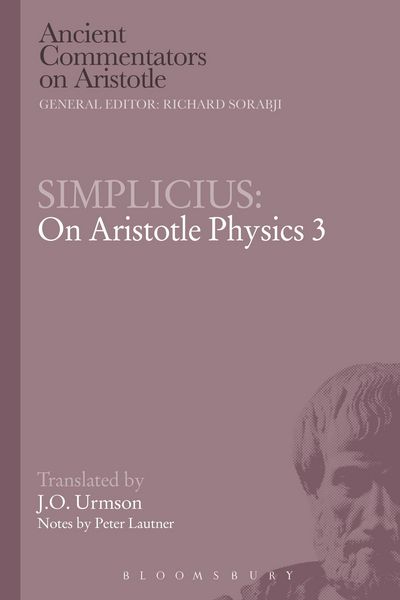
  • Produktbild: Simplicius
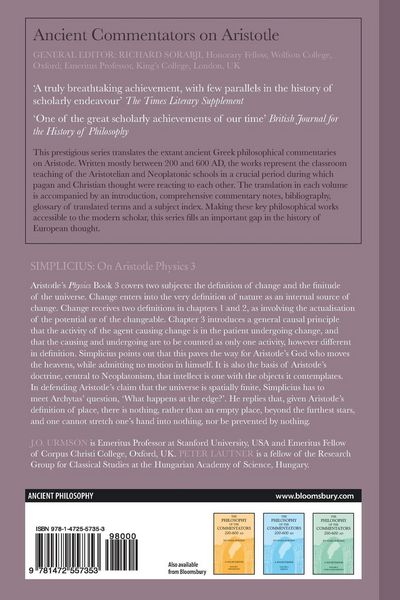
  • Produktbild: Simplicius

Simplicius On Aristotle Physics 3

58,99 €

inkl. gesetzl. MwSt., Versandkostenfrei


Beschreibung

Aristotle's Physics Book 3 covers two subjects: the definition of change and the finitude of the universe. Change enters into the very definition of nature as an internal source of change. Change receives two definitions in chapters 1 and 2, as involving the actualisation of the potential or of the...

Beschreibung

Aristotle's Physics Book 3 covers two subjects: the definition of change and the finitude of the universe. Change enters into the very definition of nature as an internal source of change. Change receives two definitions in chapters 1 and 2, as involving the actualisation of the potential or of the changeable. Alexander of Aphrodisias is reported as thinking that the second version is designed to show that Book 3, like Book 5, means to disqualify change in relations from being genuine change. Aristotle's successor Theophrastus, we are told, and Simplicius himself, prefer to admit relational change. Chapter 3 introduces a general causal principle that the activity of the agent causing change is in the patient undergoing change, and that the causing and undergoing are to be counted as only one activity, however different in definition. Simplicius points out that this paves the way for Aristotle's God who moves the heavens, while admitting no motion in himself. It is also the basis of Aristotle's doctrine, central to Neoplatonism, that intellect is one with the objects it contemplates.In defending Aristotle's claim that the universe is spatially finite, Simplicius has to meet Archytas' question, "What happens at the edge?". He replies that, given Aristotle's definition of place, there is nothing, rather than an empty place, beyond the furthest stars, and one cannot stretch one's hand into nothing, nor be prevented by nothing. But why is Aristotle's beginningless universe not temporally infinite? Simplicius answers that the past years no longer exist, so one never has an infinite collection.

Produktdetails

Einband

Taschenbuch

Erscheinungsdatum

10.04.2014

Verlag Bloomsbury Academic
Seitenzahl

206

Produktdetails

Einband

Taschenbuch

Erscheinungsdatum

10.04.2014

Verlag Bloomsbury Academic
Seitenzahl

206

Maße (L/B/H)

23,4/15,6/1,1 cm

Gewicht

322 g

Übersetzt von

J.O. Urmson

Sprache

Englisch

ISBN

978-1-4725-5735-3

Herstelleradresse

Libri GmbH
Europaallee 1
36244 Bad Hersfeld
DE

Email: gpsr@libri.de

Noch keine Bewertungen vorhanden

Verfassen Sie die erste Bewertung zu diesem Artikel

Helfen Sie anderen Kundinnen und Kunden durch Ihre Meinung.

Kundinnen und Kunden meinen

Bewertungen (0)

  • Produktbild: Simplicius
  • Produktbild: Simplicius
  • Preface
    Introduction
    Textual Emendations
    TRANSLATION
    Notes
    Bibliography English-Greek
    Glossary Greek-English Index
    Index of Passages Cited
    Subject
    Index