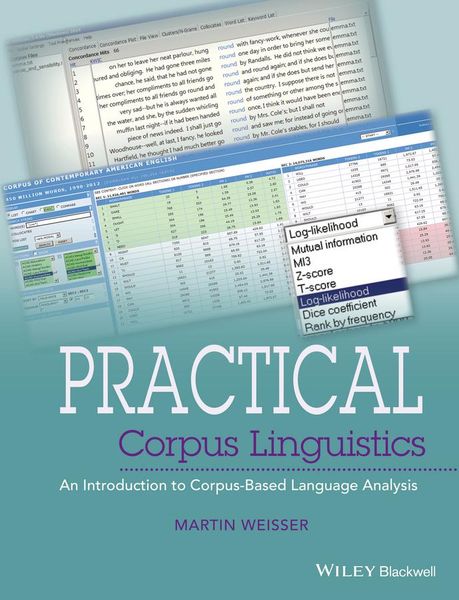
Produktbild: Practical Corpus Linguistics

Practical Corpus Linguistics An Introduction to Corpus-Based Language Analysis

125,99 €

inkl. gesetzl. MwSt., Versandkostenfrei

Lieferung nach Hause

Beschreibung

Produktdetails

Einband

Gebundene Ausgabe

Erscheinungsdatum

16.02.2016

Verlag

John Wiley & Sons Inc

Seitenzahl

312

Maße (L/B/H)

24,9/19,1/2 cm

Gewicht

712 g

Auflage

1. Auflage

Sprache

Englisch

ISBN

978-1-118-83187-8

Beschreibung

Produktdetails

Einband

Gebundene Ausgabe

Erscheinungsdatum

16.02.2016

Verlag

John Wiley & Sons Inc

Seitenzahl

312

Maße (L/B/H)

24,9/19,1/2 cm

Gewicht

712 g

Auflage

1. Auflage

Sprache

Englisch

ISBN

978-1-118-83187-8

Herstelleradresse

Libri GmbH
Europaallee 1
36244 Bad Hersfeld
DE

Email: GPSR Kontakt

Noch keine Bewertungen vorhanden

Verfassen Sie die erste Bewertung zu diesem Artikel

Helfen Sie anderen Kundinnen und Kunden durch Ihre Meinung.

Kundinnen und Kunden meinen

Bewertungen (0)

Die Leseprobe wird geladen.
  • Produktbild: Practical Corpus Linguistics
  • List of Figures xiii

    List of Tables xv

    Acknowledgements xvii

    1 Introduction 1

    1.1 Linguistic Data Analysis 3

    1.1.1 What's data? 3

    1.1.2 Forms of data 3

    1.1.3 Collecting and analysing data 7

    1.2 Outline of the Book 8

    1.3 Conventions Used in this Book 10

    1.4 A Note for Teachers 11

    1.5 Online Resources 11

    2 What's Out There? 13

    2.1 What's a Corpus? 13

    2.2 Corpus Formats 13

    2.3 Synchronic vs. Diachronic Corpora 15

    2.3.1 'Early' synchronic corpora 15

    2.3.2 Mixed corpora 18

    2.3.3 Examples of diachronic corpora 20

    2.4 General vs. Specific Corpora 21

    2.4.1 Examples of specific corpora 22

    2.5 Static Versus Dynamic Corpora 25

    2.6 Other Sources for Corpora 26

    Solutions to/Comments on the Exercises 26

    Note 28

    Sources and Further Reading 28

    3 Understanding Corpus Design 29

    3.1 Food for Thought - General Issues in Corpus Design 29

    3.1.1 Sampling 30

    3.1.2 Size 31

    3.1.3 Balance and representativeness 32

    3.1.4 Legal issues 32

    3.2 What's in a Text? - Understanding Document Structure 33

    3.2.1 Headers, 'footers' and meta-data 34

    3.2.2 The structure of the (text) body 36

    3.2.3 What's (in) an electronic text? - understanding file formats and their properties 37

    3.3 Understanding Encoding: Character Sets, File Size, etc. 38

    3.3.1 ASCII and legacy encodings 38

    3.3.2 Unicode 39

    3.3.3 File sizes 40

    Solutions to/Comments on the Exercises 41

    Sources and Further Reading 42

    4 Finding and Preparing Your Data 43

    4.1 Finding Suitable Materials for Analysis 44

    4.1.1 Retrieving data from text archives 44

    4.1.2 Obtaining materials from Project Gutenberg 44

    4.1.3 Obtaining materials from the Oxford Text Archive 45

    4.2 Collecting Written Materials Yourself ('Web as Corpus') 46

    4.2.1 A brief note on plain-text editors 46

    4.2.2 Browser text export 48

    4.2.3 Browser HTML export 49

    4.2.4 Getting web data using ICEweb 50

    4.2.5 Downloading other types of files 52

    4.3 Collecting Spoken Data 53

    4.4 Preparing Written Data for Analysis 56

    4.4.1 'Cleaning up' your data 56

    4.4.2 Extracting text from proprietary document formats 58

    4.4.3 Removing unnecessary header and 'footer' information 58

    4.4.4 Documenting what you've collected 59

    4.4.5 Preparing your data for distribution or archiving 60

    Solutions to/Comments on the Exercises 62

    Sources and Further Reading 66

    5 Concordancing 67

    5.1 What's Concordancing? 67

    5.2 Concordancing with AntConc 69

    5.2.1 Sorting results 74

    5.2.2 Saving, pruning and reusing your results 75

    Solutions to/Comments on the Exercises 78

    Sources and Further Reading 81

    6 Regular Expressions 82

    6.1 Character Classes 84

    6.2 Negative Character Classes 86

    6.3 Quantification 86

    6.4 Anchoring, Grouping and Alternation 87

    6.4.1 Anchoring 87

    6.4.2 Grouping and alternation 88

    6.4.3 Quoting and using special characters 90

    6.4.4 Constraining the context further 91

    6.5 Further Exercises 92

    Solutions to/Comments on the Exercises 93

    Sources and Further Reading 100

    7 Understanding Part-of-Speech Tagging and Its Uses 101

    7.1 A Brief Introduction to (Morpho-Syntactic) Tagsets 103

    7.2 Tagging Your Own Data 109

    Solutions to/Comments on the Exercises 113

    Sources and Further Reading 120

    8 Using Online Interfaces to Query Mega Corpora 121

    8.1 Searching the BNC with BNCweb 122

    8.1.1 What is BNCweb? 122

    8.1.2 Basic standard queries 123

    8.1.3 Navigating through and exploring search results 124

    8.1.4 More advanced standard query options 126

    8.1.5 Wildcards 126

    8.1.6 Word and phrase alternation 128

    8.1.7 Restricting searches through PoS tags 129

    8.1.8 Headword and lemma queries 131

    8.2 Exploring COCA through the BYU Web-Interface 132

    8.2.1 The basic syntax 133

    8.2.2 Comparing corpora in the BYU interface 135

    Solutions to/Comments on the Exercises 137

    Sources and Further Reading 145

    9 Basic Frequency Analysis - or What Can (Single) Words Tell Us About Texts? 146

    9.1 Understanding Basic Units in Texts 146

    9.1.1 What's a word? 147

    9.1.2 Types and tokens 149

    9.2 Word (Frequency) Lists in AntConc 151

    9.2.1 Stop words - good or bad? 156

    9.2.2 Defining and using stop words in AntConc 158

    9.3 Word Lists in BNCweb 160

    9.3.1 Standard options 160

    9.3.2 Investigating subcorpora 162

    9.3.3 Keyword lists 169

    9.4 Keyword Lists in AntConc and BNCweb 169

    9.4.1 Keyword lists in AntConc 169

    9.4.2 Keyword lists in BNCweb 172

    9.5 Comparing and Reporting Frequency Counts 175

    9.6 Investigating Genre-Specific Distributions in COCA 178

    Solutions to/Comments on the Exercises 179

    Sources and Further Reading 192

    10 Exploring Words in Context 193

    10.1 Understanding Extended Units of Text 194

    10.2 Text Segmentation 195

    10.3 N-Grams, Word Clusters and Lexical Bundles 196

    10.4 Exploring (Relatively) Fixed Sequences in BNCweb 198

    10.5 Simple, Sequential Collocations and Colligations 198

    10.5.1 'Simple' collocations 198

    10.5.2 Colligations 200

    10.5.3 Contextually constrained and proximity searches 201

    10.6 Exploring Colligations in COCA 202

    10.7 N-grams and Clusters in AntConc 205

    10.8 Investigating Collocations Based on Statistical Measures in AntConc, BNCweb and COCA 207

    10.8.1 Calculating collocations 207

    10.8.2 Computing collocations in AntConc 209

    10.8.3 Computing collocations in BNCweb 210

    10.8.4 Computing collocations in COCA 211

    Solutions to/Comments on the Exercises 212

    Sources and Further Reading 226

    11 Understanding Markup and Annotation 227

    11.1 From SGML to XML - A Brief Timeline 229

    11.2 XML for Linguistics 230

    11.2.1 Why bother? 230

    11.2.2 What does markup/annotation look like? 230

    11.2.3 The 'history' and development of (linguistic) markup 232

    11.2.4 XML and style sheets 234

    11.3 'Simple XML' for Linguistic Annotation 236

    11.4 Colour Coding and Visualisation 240

    11.5 More Complex Forms of Annotation 246

    Solutions to/Comments on the Exercises 248

    Sources and Further Reading 253

    12 Conclusion and Further Perspectives 254

    Appendix A: The CLAWS C5 Tagset 259

    Appendix B: The Annotated Dialogue File 261

    Appendix C: The CSS Style Sheet 269

    Glossary 271

    References 277

    Index 283