• Produktbild: Engineering Approaches to Mechanical and Robotic Design for Minimally Invasive Surgery (MIS)
  • Produktbild: Engineering Approaches to Mechanical and Robotic Design for Minimally Invasive Surgery (MIS)
Band 545 - 12%

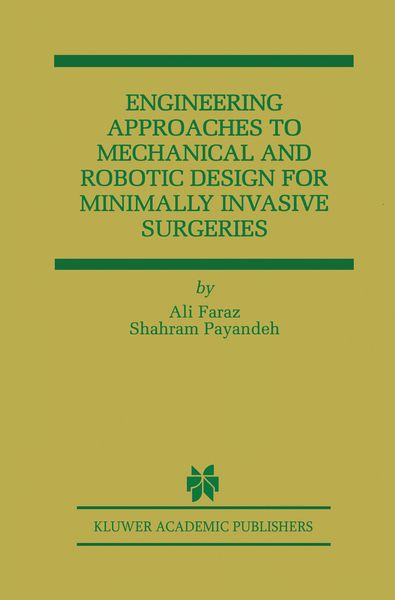
Engineering Approaches to Mechanical and Robotic Design for Minimally Invasive Surgery (MIS)

12% sparen

139,99 € UVP 160,49 €

inkl. gesetzl. MwSt., Versandkostenfrei

Lieferung nach Hause

Beschreibung

Produktdetails

Einband

Taschenbuch

Erscheinungsdatum

17.10.2012

Verlag

Springer Us

Seitenzahl

183

Maße (L/B/H)

23,5/15,5/1,2 cm

Gewicht

324 g

Auflage

Softcover reprint of the original 1st ed. 2000

Sprache

Englisch

ISBN

978-1-4613-6984-4

Beschreibung

Produktdetails

Einband

Taschenbuch

Erscheinungsdatum

17.10.2012

Verlag

Springer Us

Seitenzahl

183

Maße (L/B/H)

23,5/15,5/1,2 cm

Gewicht

324 g

Auflage

Softcover reprint of the original 1st ed. 2000

Sprache

Englisch

ISBN

978-1-4613-6984-4

Herstelleradresse

Springer-Verlag KG
Sachsenplatz 4-6
1201 Wien
AT

Email: GPSR Kontakt

Noch keine Bewertungen vorhanden

Verfassen Sie die erste Bewertung zu diesem Artikel

Helfen Sie anderen Kundinnen und Kunden durch Ihre Meinung.

Kundinnen und Kunden meinen

Bewertungen (0)

  • Produktbild: Engineering Approaches to Mechanical and Robotic Design for Minimally Invasive Surgery (MIS)
  • Produktbild: Engineering Approaches to Mechanical and Robotic Design for Minimally Invasive Surgery (MIS)
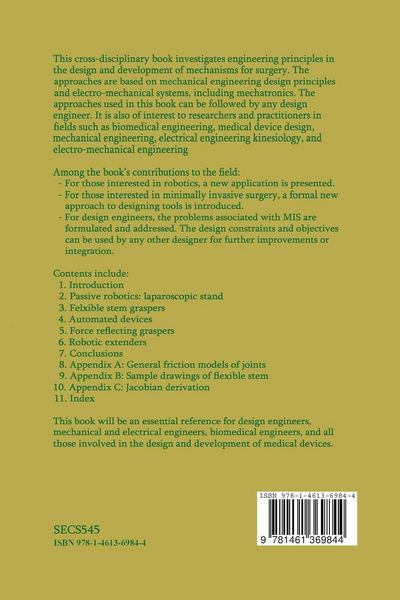
  • 1. Introduction.- 1. Typical set-up for laparoscopic surgery.- 2. Surgical Problems in Endosurgery.- 3. Research Objectives.- 4. Book Overview and Contributions.- 2. Passive Robotics: Laparoscopic Stand.- 1. Kinematic Synthesis.- 2. Synthesis of the Positioning Arm.- 3. Multi-Arms Integration.- 4. Features of Mechanical Design.- 5. Prototype Development and Evaluation.- 6. Discussions.- 3. Flexible Stem Graspers.- 1. Synthesis of Flexible Laparoscopic Extenders.- 2. Laparoscopic Workspace Formulation.- 3. Optimal Design of the Flexible Stem.- 4. Features of the Mechanical Design.- 5. Discussion.- 4. Automated Devices.- 1. New Suturing Device with CCM Design.- 2. Friction Analysis of the Belt Mechanism.- 3. Large Scale Experimental Prototype.- 4. Miniaturization Challenges.- 5. Force Reflecting Graspers.- 1. Design Concepts.- 2. Type Synthesis of Tunable Spring.- 3. Size Synthesis of Tunable Spring.- 4. Design Integration.- 5. Simulation Results.- 6. Bandwidth Analysis.- 7. Experimental Results.- 8. Discussion and Further Developments.- 6. Robotic Extenders.- 1. Configuration of Robotic Extenders.- 2. Kinematics of the Extender.- 3. Jacobian Formulation.- 4. Inverse Velocity Kinematics.- 5. Constrained Motion.- 6. Toward Laparoscopic Tele-Surgery.- 7. Conclusions.- 1. Contributions of the Book.- 2. Suggestions for Future Work.- Appendices.- A— General Friction Models of Joints.- 1. Preliminary Analysis.- 2. Revolute Pin Joints.- 2.1 The Radial Stress Distribution.- 2.2 Equilibrium Analysis.- 3. Spherical Socket-Ball Joints.- 3.1 The Radial Stress Distribution.- 3.2 Equilibrium Analysis.- 4. Discussion I: Contact Angles and Loads.- 5. Discussion II: Joints Clearance for Maximum Stiffness.- 6. Summary.- B- Sample Drawings of Flexible Stem.- C- Jacobian Derivation.- Aboutthe Authors.- References.