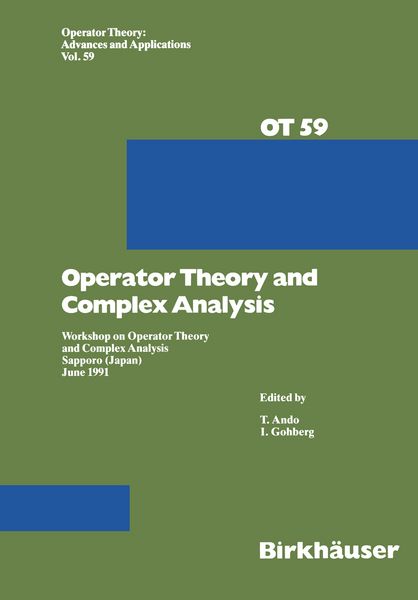
Operator Theory and Complex Analysis Workshop on Operator Theory and Complex Analysis Sapporo (Japan) June 1991
-
- Hardcover
- Taschenbuch ausgewählt
-
Sprache:Englisch
49,99 €
inkl. gesetzl. MwSt.,
Beschreibung
Produktdetails
Einband
Taschenbuch
Erscheinungsdatum
30.10.2012
Abbildungen
X, 406 p.
Verlag
Springer BaselSeitenzahl
406
Maße (L/B/H)
24,4/17/2,3 cm
Gewicht
721 g
Auflage
Softcover reprint of the original 1st ed. 1992
Sprache
Englisch
ISBN
978-3-0348-9699-3
Scattering matrices for microschemes.- 1. General expressions for the scattering matrix.- 2. Continuity condition.- References.- Holomorphic operators between Krein spaces and the number of squares of associated kernels.- 0. Introduction.- 1. Realizations of a class of Schur functions.- 2. Positive squares and injectivity.- 3. Application of the Potapov-Ginzburg transform.- References.- On reproducing kernel spaces, the Schur algorithm, and interpolation in a general class of domains.- 1. Introduction.- 2. Preliminaries.- 3. B(X) spaces.- 4. Recursive extractions and the Schur algorithm.- 5. H?(S) spaces.- 6. Linear fractional transformations.- 7. One sided interpolation.- 8. References.- The central method for positive semi-definite, contractive and strong Parrott type completion problems.- 1. Introduction.- 2. Positive semi-definite completions.- 3. Contractive completions.- 4. Linearly constrained contractive completions.- References.- Interpolation by rational matrix functions and stability of feedback systems: The 4-block case.- 1. Preliminaries.- 2. A homogeneous interpolation problem.- 3. Interpolation problem.- 4. Parametrization of solutions.- 5. Interpolation and internally stable feedback systems.- References.- Matricial coupling and equivalence after extension.- 1. Introduction.- 2. Coupling versus equivalence.- 3. Examples.- 4. Special classes of operators.- References.- Operator means and the relative operator entropy.- 1. Introduction.- 2. Origins of operator means.- 3. Operator means and operator monotone functions.- 4. Operator concave functions and Jensen's inequality.- 5. Relative operator entropy.- References.- An application of Furuta's inequality to Ando's theorem.- 1. Introduction.- 2. Operator functions.- 3. Furuta's type inequalities.-4. An application to Ando's theorem.- References.- Applications of order preserving operator inequalities.- 0. Introduction.- 1. Application to the relative operator entropy.- 2. Application to some extended result of Ando's one.- References.- The band extension of the real line as a limit of discrete band extensions, I. The main limit theorem.- 0. Introduction.- I. Preliminaries and preparations.- II. Band extensions.- III. Continuous versus discrete.- References.- Interpolating sequences in the maximal ideal space of H? II.- 1. Introduction.- 2. Condition (A2).- 3. Condition (A3).- 4. Condition (A1).- References.- Operator matrices with chordal inverse patterns.- 1. Introduction.- 2. Entry formulae.- 3. Inertia formula.- References.- Models and unitary equivalence of cyclic selfadjoint operators in Pontrjagin spaces.- 1. The class F of linear functionals.- 2. The Pontrjagin space associated with ? ? F.- 3. Models for cyclic selfadjoint operators in Pontrjagin spaces.- 4. Unitary equivalence of cyclic selfadjoint operators in Pontrjagin spaces.- References.- The von Neumann inequality and dilation theorems for contractions.- 1. The von Neumann inequality and strong unitary dilation.- 2. Canonical representation of completely contractive maps.- 3. An effect of generation of nuclear algebras.- References.- Interpolation problems, inverse spectral problems and nonlinear equations.- References.- Extended interpolation problem in finitely connected domains.- I. Matrices and transformation formulas.- II. Disc Cases.- III. Domains of finite connectivity.- References.- Accretive extensions and problems on the Stieltjes operator-valued functions relations.- 1. Accretive and sectorial extensions of the positive operators, operators of the class C(?) and theirparametric representation.- 2. Stieltjes operator-valued functions and their realization.- 3. M.S. Livsic triangular model of the M-accretive extensions (with real spectrum) of the positive operators.- 4. Canonical and generalized resolvents of QSC-extensions of Hermitian contractions.- References.- Commuting nonselfadjoint operators and algebraic curves.- 1. Commuting nonselfadjoint operators and the discriminant
Noch keine Bewertungen vorhanden
Verfassen Sie die erste Bewertung zu diesem Artikel
Helfen Sie anderen Kundinnen und Kunden durch Ihre Meinung.
Kurze Frage zu unserer Seite
Vielen Dank für dein Feedback
Wir nutzen dein Feedback, um unsere Produktseiten zu verbessern. Bitte habe Verständnis, dass wir dir keine Rückmeldung geben können. Falls du Kontakt mit uns aufnehmen möchtest, kannst du dich aber gerne an unseren Kund*innenservice wenden.
zum Kundenservice