
Gutscheinbedingungen

**Gültig vom 20.07.2026 bis 22.07.2026 | Gültig für nicht preisgebundene fremdsprachige Bücher | Einzelne Artikel können ausgeschlossen sein | Nicht kombinierbar mit anderen Gutscheinen oder Preisaktionen | Nur einmal pro Einkauf einlösbar | Gutschein wird auf max. 500€ Bestellwert angerechnet | Keine Barauszahlung | Nicht gültig für Versandkosten und Services

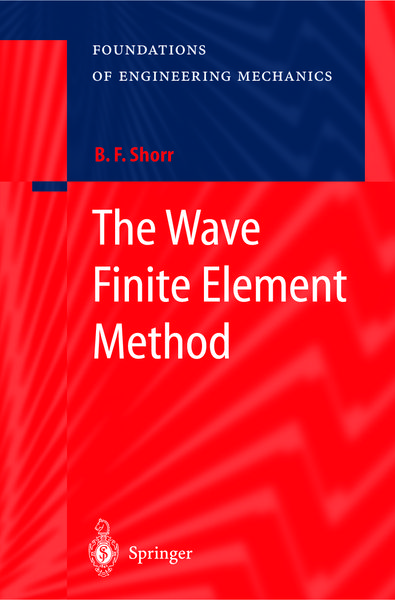
  • Produktbild: The Wave Finite Element Method
  • Produktbild: The Wave Finite Element Method

The Wave Finite Element Method

136,99 €

inkl. gesetzl. MwSt., Versandkostenfrei

Lieferung nach Hause

Beschreibung

Produktdetails

Einband

Taschenbuch

Erscheinungsdatum

20.07.2012

Verlag

Springer Berlin

Seitenzahl

355

Maße (L/B/H)

23,5/15,5/2 cm

Gewicht

557 g

Auflage

Softcover reprint of the original 1st ed. 2004

Sprache

Englisch

ISBN

978-3-642-53605-2

Beschreibung

Rezension

From the reviews:


"This book is devoted to a new approach to the description of complex mechanical systems. … among the actual nonclassical methods, the wave finite element method (WFEM) is of high interest. The author … provides a first exposition of WFEM … . The book is written very clearly, the graphs are excellent, and the reader can grasp the main facts from WFEM. The references are up-to-date … . The book can serve as a reference text book for the students and researchers in mechanics." (Dumitru Stanomir, Zentralblatt MATH, Vol. 1063, 2005)


"I can say that the book contains a valuable collection of 1-D and some 2-D solutions for wave propagation in solids, and it made a valuable contribution towards a new general-purpose transient wave approach for solids. … the book is truly recommended for everybody involved in problems that include explosions, shocks, seismic waves, and structures with suddenly varying properties at a time-scale close to the time a wave takes to propagate over the structure." (Technische Mechanik, Vol. 26 (2), 2006)

Produktdetails

Einband

Taschenbuch

Erscheinungsdatum

20.07.2012

Verlag

Springer Berlin

Seitenzahl

355

Maße (L/B/H)

23,5/15,5/2 cm

Gewicht

557 g

Auflage

Softcover reprint of the original 1st ed. 2004

Sprache

Englisch

ISBN

978-3-642-53605-2

Herstelleradresse

Springer-Verlag KG
Sachsenplatz 4-6
1201 Wien
AT

Email: GPSR Kontakt

Noch keine Bewertungen vorhanden

Verfassen Sie die erste Bewertung zu diesem Artikel

Helfen Sie anderen Kundinnen und Kunden durch Ihre Meinung.

Kundinnen und Kunden meinen

Bewertungen (0)

  • Produktbild: The Wave Finite Element Method
  • Produktbild: The Wave Finite Element Method
  • Theory.- 1 Foundation of the wave finite element method.- 1.1 Direct mathemetical modeling of wave propagation in an elastic rod.- 1.1.1 Background equations.- 1.1.2 Numerical examples.- 1.2 Wave approach to finite element modeling.- 1.2.1 Background equations of the wave finite element method (WFEM).- 1.2.2 Numerical examples.- 2 Simulation of simple one-dimensional wave processes.- 2.1 Longitudinal waves in a rod.- 2.1.1 Collision of rods of different sizes and mechanical parameters.- 2.1.2 Sudden stopping of a rod of a variable cross section.- 2.1.3 Wave propagation in a rod with inner elastic-inertial links.- 2.2 Torsional waves in a rod.- 2.2.1 Sudden stopping of a rotating shaft.- 2.2.2 Setting a disk in motion by sudden connection with a rotating shaft.- 2.3 Transverse waves in strings and cables.- 2.3.1 Waves in a string stretched by a constant force.- 2.3.2 Waves in a cable stretched by its own weight.- 3 Wave propagation in an inelastic rod.- 3.1 Longitudinal waves propagation in an inelastic rod.- 3.1.1 Discrete-continual model of an inelastic rod.- 3.1.2 Governing equations.- 3.2 Waves in a viscoelastic rod.- 3.2.1 Background equations.- 3.2.2 Numerical examples.- 3.3 Waves in an elastic-viscoplastic rod.- 3.3.1 Elastic-plastic models.- 3.3.2 An elastic-viscoplastic model.- 4 Coupled longitudinal-torsional waves in a pre-twisted rod.- 4.1 Basic equations.- 4.1.1 Governing equations for a pre-twisted rod.- 4.1.2 Wave model of a pre-twisted rod.- 4.2 Wave propagation induced by a force and torque.- 4.2.1 Waves induced by a constant load.- 4.2.2 Impulse-induced waves.- 5 Bending waves in a beam.- 5.1 Basic equations.- 5.1.1 Wave model of the Timoshenko beam.- 5.1.2 Finite element simulation of bending waves.- 5.2 Direct mathematical modeling of bending waves propagation.- 5.2.1 Structural bending/shear model of a beam.- 5.2.2 Solution procedure.- 5.3 Numerical examples.- 5.3.1 A stepped force affecting a beam.- 5.3.2 A stepped moment affecting a beam.- 5.3.3 Comparison of the DMM and WFEM approaches for bending waves modeling.- 6 One-dimensional waves in elastic continua and structures.- 6.1 Plane waves.- 6.1.1 Longitudinal waves.- 6.1.2 Transverse and coupled waves.- 6.2 Spherical and cylindrical waves.- 6.2.1 Spherical waves.- 6.2.2 Explosion in a spherical cavity of an elastic medium.- 6.2.3 Cylindrical waves.- 7 Numerical simulation of multi-dimensional wave processes.- 7.1 Foundation of the general WFEM approach.- 7.1.1 Governing equations.- 7.1.2 Waves in a plane region. Code WPRD.- 7 2 Numerical examnles.- 7.2.1 Sudden longitudinal loading of a one-side fixed plate.- 7.2.2 Sudden in-plane bending of a deep plate.- 7.2.3 A plate longitudinally impacted by a heavy body.- 7.2.4 A wide plate subjected to a bending moment.- 7.2.5 Additional remarks.- Applications.- 8 Impact loading of a deformable body.- 8.1 Principle of floating boundary conditions (FBC).- 8.1.1 Application of the FBC principle to WFEM.- 8.1.2 Special cases of body impact interaction.- 8.2 An elastic rod impacted by a rigid body.- 8.2.1 A rod of a constant cross section.- 8.2.2 The DMM accuracy in application to impact problems.- 8.2.3 A rod of variable cross section.- 8.3 An inelastic rod impacted by a rigid body.- 8.3.1 A rod of viscoelastic material.- 8.3.2 A rod of elastic-plastic material.- 8.4 Influence of contact deformation on impact response.- 8.4.1 Basic equations.- 8.4.2 Impact loading of a valve cylindrical spring.- 8.5 A pre-twisted rod impacted by a rigid body.- 8.5.1 Impact interaction of a rigid body with a pre-twisted rod.- 8.5.2 Lengthwise and turning impacts.- 9 Unsteady forced vibration of solids.- 9.1 Wave approach to study of forced vibration.- 9.1.1 Response of an elastic rod to harmonic excitation.- 9.1.2 Response of a rod of inelastic material.- 9.1.3 Transition through resonance domains under quasi-harmonic excitation.- 9.1.4 Response under fluctuating frequency and phase.- 9.2 Unsteady forced vibration of nonlinear systems.- 9.2.1 Torsional vibration of a shaft with a nonlinear clutch.- 9.2.2 Bending vibration of a turbine blade damped by a dry friction device.- 10 Unsteady vibro-impact loading.- 10.1 Multiple collisions at fixed points of a distributed system.- 10.1.1 Interaction of a rod with a viscoelastic foundation.- 10.1.2 Interaction of a rod with a hysteretic foundation.- 10.1.3 Switching on of a free-wheeling mechanism.- 10.2 Multiple collisions at varying points of a distributed system.- 10.2.1 Vibro-impact interaction of a string with limiters.- 10.2.2 A system with multiple inner gaps.- 11 Oscillations of a mechanical system affected by moving loads.- 11.1 General approach to simulation of moving loads.- 11.1.1 Equivalent node forces.- 11.1.2 Equivalent forces for different load/wave speeds ratio.- 11.2 Application of DMM to the study of 1-D waves induced by moving loads.- 11.2.1 A strip on a viscoelastic foundation.- 11.2.2 A beam on a viscoelastic foundation.- 11.3 Application of WFEM to the study of 2-D waves induced by moving loads.- 11.3.1 A long plate loaded by a transverse moving force.- 11.3.2 A long plate loaded by a longitudinal moving force.- 12 Dynamic loading of a free edge of a solid.- 12.1 Constant loads suddenly affecting a thin plate.- 12.1.1 A point force.- 12.1.2 A distributed load.- 12.2 Varying loads affecting a half-space.- 12.2.1 A point impulsive force.- 12.2.2 A distributed impulsive load applied to a limited domain.- 13 Some special problems of solid mechanics.- 13.1 Deformation of a chain of a varying length.- 13.1.1 Sliding down of an elastic chain under own weight.- 13.1.2 Numerical example.- 13.2 Waves in structures interacting with ‘active’ media.- 13.2.1 Strings on an ‘anti-elastic’ or ‘anti-viscous’ foundation.- 13.2.2 Auto-oscillation of a string in nonlinear viscous medium.- 13.2.3 Auto-oscillation in a system with intermittent contacts.- 14 Some special unsteady problems in engineering.- 14.1 Longitudinal dynamics of a train.- 14.1.1 Setting of a problem.- 14.1.2 Transient regimes of a train motion.- 14.2 Wave problems in adjacent areas of engineering.- 14.2.1 A transient process in an electrical circuit.- 14.2.2 Unsteady hydraulics problems.- Conclusion.- References.