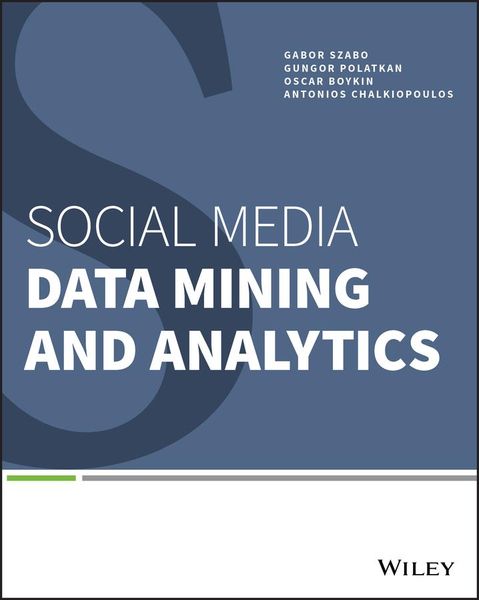
Social Media Data Mining and Analytics
-
- Taschenbuch ausgewählt
- eBook
-
Sprache:Englisch
42,99 €
inkl. gesetzl. MwSt.,
Lieferung nach Hause
Beschreibung
Produktdetails
Einband
Taschenbuch
Erscheinungsdatum
23.10.2018
Verlag
John Wiley & SonsSeitenzahl
352
Maße (L/B/H)
23,3/18,7/2,2 cm
Gewicht
476 g
Auflage
1. Auflage
Sprache
Englisch
ISBN
978-1-118-82485-6
Harness the power of social media to predict customer behavior and improve sales
Social media is the biggest source of Big Data. Because of this, 90% of Fortune 500 companies are investing in Big Data initiatives that will help them predict consumer behavior to produce better sales results. Written by Dr. Gabor Szabo, a Senior Data Scientist at Twitter, and Dr. Oscar Boykin, a Software Engineer at Twitter, Social Media Data Mining and Analytics shows analysts how to use sophisticated techniques to mine social media data, obtaining the information they need to generate amazing results for their businesses.
Social Media Data Mining and Analytics isn't just another book on the business case for social media. Rather, this book provides hands-on examples for applying state-of-the-art tools and technologies to mine social media - examples include Twitter, Facebook, Pinterest, Wikipedia, Reddit, Flickr, Web hyperlinks, and other rich data sources. In it, you will learn:
* The four key characteristics of online services-users, social networks, actions, and content
* The full data discovery lifecycle-data extraction, storage, analysis, and visualization
* How to work with code and extract data to create solutions
* How to use Big Data to make accurate customer predictions
Szabo and Boykin wrote this book to provide businesses with the competitive advantage they need to harness the rich data that is available from social media platforms.
Social media is the biggest source of Big Data. Because of this, 90% of Fortune 500 companies are investing in Big Data initiatives that will help them predict consumer behavior to produce better sales results. Written by Dr. Gabor Szabo, a Senior Data Scientist at Twitter, and Dr. Oscar Boykin, a Software Engineer at Twitter, Social Media Data Mining and Analytics shows analysts how to use sophisticated techniques to mine social media data, obtaining the information they need to generate amazing results for their businesses.
Social Media Data Mining and Analytics isn't just another book on the business case for social media. Rather, this book provides hands-on examples for applying state-of-the-art tools and technologies to mine social media - examples include Twitter, Facebook, Pinterest, Wikipedia, Reddit, Flickr, Web hyperlinks, and other rich data sources. In it, you will learn:
* The four key characteristics of online services-users, social networks, actions, and content
* The full data discovery lifecycle-data extraction, storage, analysis, and visualization
* How to work with code and extract data to create solutions
* How to use Big Data to make accurate customer predictions
Szabo and Boykin wrote this book to provide businesses with the competitive advantage they need to harness the rich data that is available from social media platforms.
Kundinnen und Kunden meinen
Verfassen Sie die erste Bewertung zu diesem Artikel
Helfen Sie anderen Kund*innen durch Ihre Meinung
Kurze Frage zu unserer Seite
Vielen Dank für dein Feedback
Wir nutzen dein Feedback, um unsere Produktseiten zu verbessern. Bitte habe Verständnis, dass wir dir keine Rückmeldung geben können. Falls du Kontakt mit uns aufnehmen möchtest, kannst du dich aber gerne an unseren Kund*innenservice wenden.
zum Kundenservice