KI-Beratung Beta

Produktbild: Power Electronics-Enabled Autonomous Power Systems

Power Electronics-Enabled Autonomous Power Systems Next Generation Smart Grids

Aus der Reihe Wiley - IEEE

164,99 €

inkl. gesetzl. MwSt., Versandkostenfrei


Beschreibung

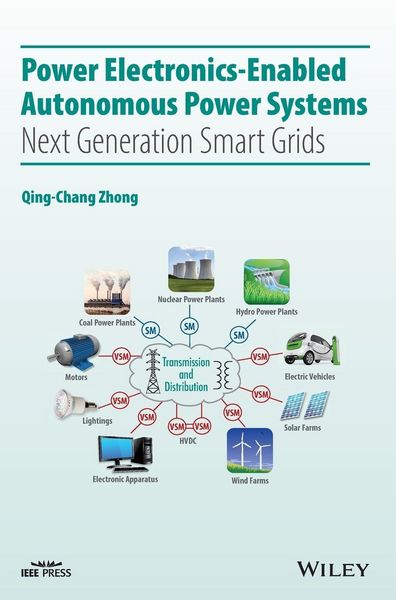
Power systems worldwide are going through a paradigm shift from centralized generation to distributed generation. This book presents the SYNDEM (i.e., synchronized and democratized) grid architecture and its technical routes to harmonize the integration of renewable energy sources, electric vehicles,...

Beschreibung

Power systems worldwide are going through a paradigm shift from centralized generation to distributed generation. This book presents the SYNDEM (i.e., synchronized and democratized) grid architecture and its technical routes to harmonize the integration of renewable energy sources, electric vehicles, storage systems, and flexible loads, with the synchronization mechanism of synchronous machines, to enable autonomous operation of power systems, and to promote energy freedom. This is a game changer for the grid. It is the sort of breakthrough -- like the touch screen in smart phones -- that helps to push an industry from one era to the next, as reported by Keith Schneider, a New York Times correspondent since 1982. This book contains an introductory chapter and additional 24 chapters in five parts: Theoretical Framework, First-Generation VSM (virtual synchronous machines), Second-Generation VSM, Third-Generation VSM, and Case Studies. Most of the chapters include experimental results.
 
As the first book of its kind for power electronics-enabled autonomous power systems, it
 
* introduces a holistic architecture applicable to both large and small power systems, including aircraft power systems, ship power systems, microgrids, and supergrids
* provides latest research to address the unprecedented challenges faced by power systems and to enhance grid stability, reliability, security, resiliency, and sustainability
* demonstrates how future power systems achieve harmonious interaction, prevent local faults from cascading into wide-area blackouts, and operate autonomously with minimized cyber-attacks
* highlights the significance of the SYNDEM concept for power systems and beyond
 
Power Electronics-Enabled Autonomous Power Systems is an excellent book for researchers, engineers, and students involved in energy and power systems, electrical and control engineering, and power electronics. The SYNDEM theoretical framework chapter is also suitable for policy makers, legislators, entrepreneurs, commissioners of utility commissions, energy and environmental agency staff, utility personnel, investors, consultants, and attorneys.

Produktdetails

Einband

Gebundene Ausgabe

Erscheinungsdatum

15.06.2020

Verlag John Wiley & Sons Inc
Seitenzahl

496

Produktdetails

Einband

Gebundene Ausgabe

Erscheinungsdatum

15.06.2020

Verlag John Wiley & Sons Inc
Seitenzahl

496

Maße (L/B/H)

24,6/17,3/3,3 cm

Gewicht

1016 g

Auflage

1. Auflage

Sprache

Englisch

ISBN

978-1-118-80352-3

Herstelleradresse

Libri GmbH
Europaallee 1
36244 Bad Hersfeld
DE

Email: gpsr@libri.de

Noch keine Bewertungen vorhanden

Verfassen Sie die erste Bewertung zu diesem Artikel

Helfen Sie anderen Kundinnen und Kunden durch Ihre Meinung.

Kundinnen und Kunden meinen

Bewertungen (0)

Die Leseprobe wird geladen.
  • Produktbild: Power Electronics-Enabled Autonomous Power Systems
  • List of Figures xix
     
    List of Tables xxxiii
     
    Foreword xxxv
     
    Preface xxxvii
     
    Acknowledgments xxxix
     
    About the Author xli
     
    List of Abbreviations xliii
     
    1 Introduction 1
     
    1.1 Motivation and Purpose 1
     
    1.2 Outline of the Book 3
     
    1.3 Evolution of Power Systems 7
     
    1.3.1 Today's Grids 8
     
    1.3.2 Smart Grids 8
     
    1.3.3 Next-Generation Smart Grids 8
     
    1.4 Summary 10
     
    Part I Theoretical Framework 11
     
    2 Synchronized and Democratized (SYNDEM) Smart Grid 13
     
    2.1 The SYNDEM Concept 13
     
    2.2 SYNDEM Rule of Law - Synchronization Mechanism of Synchronous Machines 15
     
    2.3 SYNDEM Legal Equality - Homogenizing Heterogeneous Players as Virtual Synchronous Machines (VSM) 18
     
    2.4 SYNDEM Grid Architecture 19
     
    2.4.1 Architecture of Electrical Systems 19
     
    2.4.2 Overall Architecture 22
     
    2.4.3 Typical Scenarios 23
     
    2.5 Potential Benefits 24
     
    2.6 Brief Description of Technical Routes 28
     
    2.6.1 The First-Generation (1G) VSM 28
     
    2.6.2 The Second-Generation (2G) VSM 29
     
    2.6.3 The Third-Generation (3G) VSM 29
     
    2.7 Primary Frequency Response (PFR) in a SYNDEM Smart Grid 30
     
    2.7.1 PFR from both Generators and Loads 31
     
    2.7.2 Droop 31
     
    2.7.3 Fast Action Without Delay 31
     
    2.7.4 Reconfigurable Virtual Inertia 31
     
    2.7.5 Continuous PFR 32
     
    2.8 SYNDEM Roots 32
     
    2.8.1 SYNDEM and Taoism 32
     
    2.8.2 SYNDEM and Chinese History 33
     
    2.9 Summary 34
     
    3 Ghost Power Theory 35
     
    3.1 Introduction 35
     
    3.2 Ghost Operator, Ghost Signal, and Ghost System 36
     
    3.2.1 The Ghost Operator 36
     
    3.2.2 The Ghost Signal 37
     
    3.2.3 The Ghost System 39
     
    3.3 Physical Meaning of Reactive Power in Electrical Systems 41
     
    3.4 Extension to Complete the Electrical-Mechanical Analogy 43
     
    3.5 Generalization to Other Energy Systems 46
     
    3.6 Summary and Discussions 47
     
    Part II 1G VSM: Synchronverters 49
     
    4 Synchronverter Based Generation 51
     
    4.1 Mathematical Model of Synchronous Generatorss 51
     
    4.1.1 The Electrical Part 51
     
    4.1.2 The Mechanical Part 53
     
    4.1.3 Presence of a Neutral Line 54
     
    4.2 Implementation of a Synchronverter 55
     
    4.2.1 The Power Part 56
     
    4.2.2 The Electronic Part 56
     
    4.3 Operation of a Synchronverter 57
     
    4.3.1 Regulation of Real Power and Frequency Droop Control 57
     
    4.3.2 Regulation of Reactive Power and Voltage Droop Control 58
     
    4.4 Simulation Results 59
     
    4.4.1 Under Different Grid Frequencies 60
     
    4.4.2 Under Different Load Conditions 62
     
    4.5 Experimental Results 62
     
    4.5.1 Grid-connected Set Mode 63
     
    4.5.2 Grid-connected Droop Mode 63
     
    4.5.3 Grid-connected Parallel Operation 63
     
    4.5.4 Seamless Transfer of the Operation Mode 64
     
    4.6 Summary 67
     
    5 Synchronverter Based Loads 69
     
    5.1 Introduction 69
     
    5.2 Modeling of a Synchronous Motor 70
     
    5.3 Operation of a PWM Rectifier as a VSM 71
     
    5.3.1 Controlling the Power 72
     
    5.3.2 Controlling the DC-bus Voltage 73
     
    5.4 Simulation Results 74
     
    5.4.1 Controlling the Power 74
     
    5.4.2 Controlling the DC-bus Voltage 76
     
    5.5 Experimental Results 77
     
    5.5.1 Controlling the Power 77
     
    5.5.2 Controlling the DC-bus Voltage 77
     
    5.6 Summary 79
     
    6 Control of Permanent Magnet Synchronous Generator (PMS