• Produktbild: Playing with Virtuality
  • Produktbild: Playing with Virtuality
Band 5

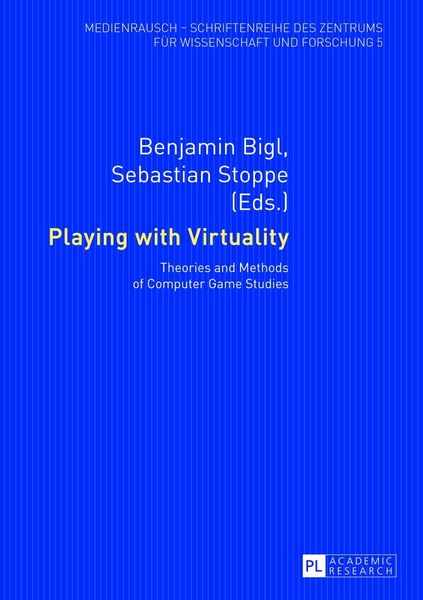
Playing with Virtuality Theories and Methods of Computer Game Studies

Aus der Reihe MedienRausch

91,55 €

inkl. gesetzl. MwSt., Versandkostenfrei


Beschreibung

Produktdetails

Einband

Taschenbuch

Erscheinungsdatum

05.06.2013

Herausgeber

Benjamin Bigl + weitere

Verlag

Peter Lang GmbH, Internationaler Verlag der Wissenschaften

Seitenzahl

423

Maße (L/B/H)

21/14,8/2,3 cm

Gewicht

560 g

Auflage

1

Sprache

Englisch

ISBN

978-3-631-64060-9

Beschreibung

Portrait

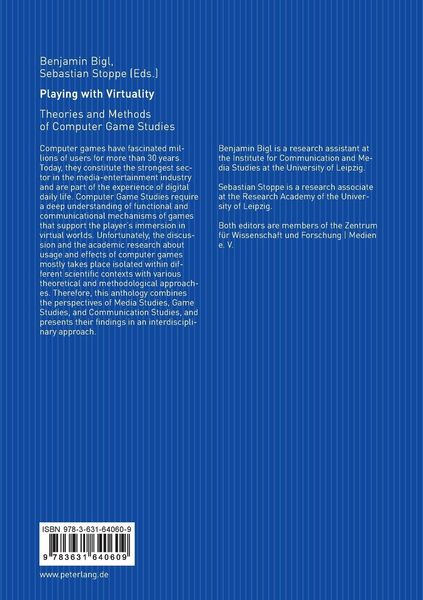
Benjamin Bigl is a research assistant at the Institute for Communication and Media Studies at the University of Leipzig.
Sebastian Stoppe is a research associate at the Research Academy of the University of Leipzig.
Both editors are members of the Zentrum für Wissenschaft und Forschung | Medien e. V.

Produktdetails

Einband

Taschenbuch

Erscheinungsdatum

05.06.2013

Herausgeber

Verlag

Peter Lang GmbH, Internationaler Verlag der Wissenschaften

Seitenzahl

423

Maße (L/B/H)

21/14,8/2,3 cm

Gewicht

560 g

Auflage

1

Sprache

Englisch

ISBN

978-3-631-64060-9

EU-Ansprechpartner

Zeitfracht Medien GmbH
Ferdinand-Jühlke-Straße 7
99095 Erfurt
DE
produktsicherheit@zeitfracht.de

Herstelleradresse

Peter Lang
Avenue du Théâtre 7
1005 Lausanne
CH
orders@peterlang.com

Noch keine Bewertungen vorhanden

Verfassen Sie die erste Bewertung zu diesem Artikel

Helfen Sie anderen Kundinnen und Kunden durch Ihre Meinung.

Kundinnen und Kunden meinen

Bewertungen (0)

  • Produktbild: Playing with Virtuality
  • Produktbild: Playing with Virtuality

  • Contents: Florian Kiefer: Involvierung über Involvierungsbrüche. Eine Strukturanalyse zur Beschreibung des Involvierungspotenzials von
    Call of Duty 4. Modern Warfare 21
    – Matthias Stork: The spectacle of the interface: post-cinematic aesthetics in action computer games and films – Antonio José Planells De La Maza: Sorry, but our princess is in another castle! Towards a theory of video games as ludofictional worlds – Rafael Bienia: Das Computer-Rollenspiel-Genre – Stefan Höltgen: Game Circuits. Platform Studies und Medienarchäologie als Methoden zur Erforschung von Computerspielen – Letícia Perani: Playing for serious reasons: brief notes on the influence of games in early HCI history – Gareth Schott/Jasper Van Vught/Raphaël Marczak: Not knowing: locating player experience between ideal and active play – Benjamin Bigl: If the game goes on. Perceived transfer effects from virtual game worlds into everyday life – Sebastian Koch: Is there a blind spot? An empirical study on the awareness for violence in videogames – Anne Mette Thorhauge: Intended and negotiated gameplay: the interpretive power of the player – Danny Pannicke/Rüdiger Zarnekow: Post-Adoption virtueller Welten – Claus Wohlgemuth: A qualitative study on immersion in videogames: avatar-identification as a factor influencing immersion – Janina Maric: Gaming at the e-sport event: Mediatized confrontations (re)negotiating sport, body and media – Arne Schröder: Playing with the avatar:
    World of Warcraft
    avatars as play things – David Gause/Volker Gehrau: The effect of real world-cues on the use of online football manager games – Pascaline Lorentz: Video-ludological socialization – Gabriela T. Richard: Gender and gameplay: research and future directions – Juan F. Belmonte: Identity through free choice? The frontiers of sexuality and gender in computer games – Matthew Barr: Computer games and learning: the current state of play – Felix Kronenberg: Computer games as agentive and immersive spaces for language learners – Mirian Checa/Ana Belén García Varela/Natalia Monjelat/David Herrero/Héctor Del Castillo: Participatory culture and skills for new media learning – Michael Filsecker/Michael Kerres: Designing and studying educational games: Limitations of current design and research approaches in game-based learning – Jasper A. Friedrich: Computerspiele und Medienethik. Zur Systematik des Forschungsfeldes – Thomas-Gabriel Rüdiger: Gamecrime und Metacrime - Kriminogene Aspekte virtueller Welten.