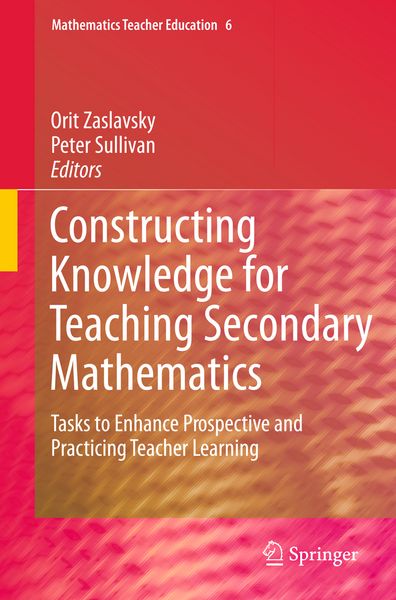
Constructing Knowledge for Teaching Secondary Mathematics Tasks to enhance prospective and practicing teacher learning
-
- Hardcover
- Taschenbuch ausgewählt
-
Sprache:Englisch
92,99 €
UVP
106,99 €
inkl. gesetzl. MwSt.,
Beschreibung
Produktdetails
Einband
Taschenbuch
Erscheinungsdatum
28.05.2013
Abbildungen
X, 330 p.
Herausgeber
Orit Zaslavsky + weitereVerlag
Springer UsSeitenzahl
330
Maße (L/B/H)
23,5/15,5/1,9 cm
Gewicht
517 g
Auflage
2011
Sprache
Englisch
ISBN
978-1-4614-2863-3
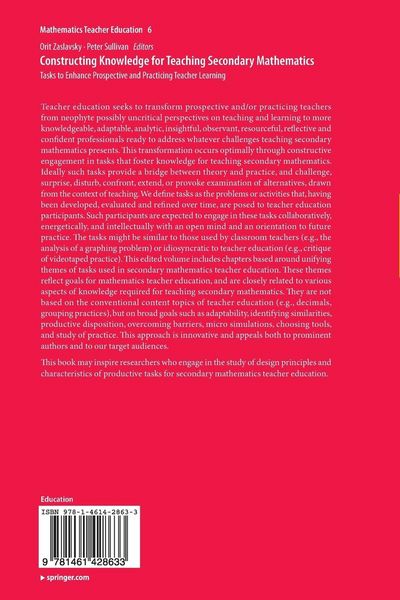
Teacher education seeks to transform prospective and/or practicing teachers from neophyte possibly uncritical perspectives on teaching and learning to more knowledgeable, adaptable, analytic, insightful, observant, resourceful, reflective and confident professionals ready to address whatever challenges teaching secondary mathematics presents.
This transformation occurs optimally through constructive engagement in tasks that foster knowledge for teaching secondary mathematics. Ideally such tasks provide a bridge between theory and practice, and challenge, surprise, disturb, confront, extend, or provoke examination of alternatives, drawn from the context of teaching. We define tasks as the problems or activities that, having been developed, evaluated and refined over time, are posed to teacher education participants. Such participants are expected to engage in these tasks collaboratively, energetically, and intellectually with an open mind and an orientation to future practice. The tasks might be similar to those used by classroom teachers (e.g., the analysis of a graphing problem) or idiosyncratic to teacher education (e.g., critique of videotaped practice).
This edited volume includes chapters based around unifying themes of tasks used in secondary mathematics teacher education. These themes reflect goals for mathematics teacher education, and are closely related to various aspects of knowledge required for teaching secondary mathematics. They are not based on the conventional content topics of teacher education (e.g., decimals, grouping practices), but on broad goals such as adaptability, identifying similarities, productive disposition, overcoming barriers, micro simulations, choosing tools, and study of practice. This approach is innovative and appeals both to prominent authors and to our target audiences.
Noch keine Bewertungen vorhanden
Verfassen Sie die erste Bewertung zu diesem Artikel
Helfen Sie anderen Kundinnen und Kunden durch Ihre Meinung.
Kurze Frage zu unserer Seite
Vielen Dank für dein Feedback
Wir nutzen dein Feedback, um unsere Produktseiten zu verbessern. Bitte habe Verständnis, dass wir dir keine Rückmeldung geben können. Falls du Kontakt mit uns aufnehmen möchtest, kannst du dich aber gerne an unseren Kund*innenservice wenden.
zum Kundenservice