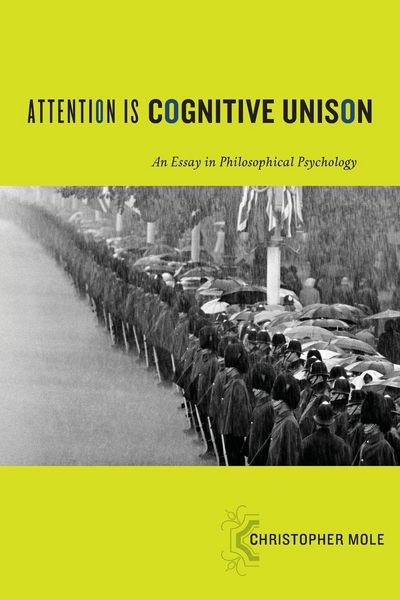
• Produktbild: Attention Is Cognitive Unison
  • Produktbild: Attention Is Cognitive Unison

Attention Is Cognitive Unison An Essay in Philosophical Psychology

59,99 €

inkl. gesetzl. MwSt., Versandkostenfrei

Lieferung nach Hause

Beschreibung

Produktdetails

Einband

Taschenbuch

Erscheinungsdatum

01.09.2013

Verlag

Oxford University Press

Seitenzahl

200

Maße (L/B/H)

23,4/15,6/1,2 cm

Gewicht

313 g

Sprache

Englisch

ISBN

978-0-19-933030-0

Beschreibung

Zitat


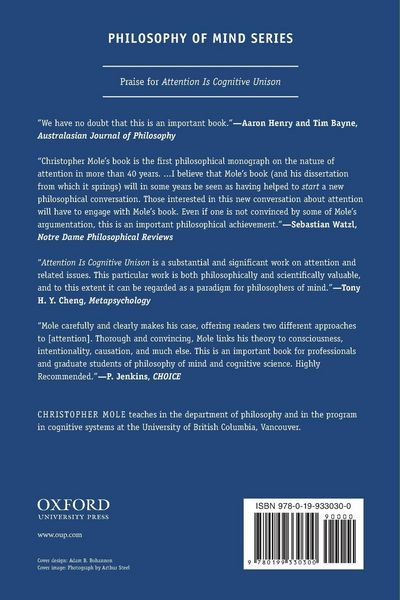
"Mole carefully and clearly makes his case, offering readers two different approaches to [attention]. Thorough and convincing, Mole links his theory to consciousness, intentionality, causation, and much else. This is an important book for professionals and graduate students of philosophy of mind and cognitive science. Highly Recommended." --CHOICE
"Christopher Mole's book is the first philosophical monograph on the nature of attention in more than 40 years. Already for this braveness it should be celebrated. Its appearance marks a renewed interest in the topic of attention by philosophers... I believe that Mole's book (and his dissertation from which it springs) will in some years be seen as having helped to start a new philosophical conversation. Those interested in this new conversation about attention will have to engage with Mole's book. Even if one is not convinced by some of Mole's argumentation, this is an important philosophical achievement." Sebastian Watzl, Notre Dame Philosophical Reviews "Attention as Cognitive Unison is a substantial and significant work on attention and related issues. This particular work is both philosophically and scientifically valuable, and to this extent it can be regarded as a paradigm for philosophers of mind." --Metapsychology

Produktdetails

Einband

Taschenbuch

Erscheinungsdatum

01.09.2013

Verlag

Oxford University Press

Seitenzahl

200

Maße (L/B/H)

23,4/15,6/1,2 cm

Gewicht

313 g

Sprache

Englisch

ISBN

978-0-19-933030-0

Herstelleradresse

Libri GmbH
Europaallee 1
36244 Bad Hersfeld
DE

Email: gpsr@libri.de

Noch keine Bewertungen vorhanden

Verfassen Sie die erste Bewertung zu diesem Artikel

Helfen Sie anderen Kundinnen und Kunden durch Ihre Meinung.

Kundinnen und Kunden meinen

Bewertungen (0)

Die Leseprobe wird geladen.
  • Produktbild: Attention Is Cognitive Unison
  • Produktbild: Attention Is Cognitive Unison
    • 1. Highlights of a Difficult History

    • 1.1 The Preliminary Identification of Our Topic

    • 1.2 Three Approaches

    • 1.3 Bradley's Protest

    • 1.4 James's Disjunctive Theory

    • 1.5 The Source of Bradley's Dissatisfaction

    • 1.6 Behaviourism and After

    • 1.7 Heirs of Bradley in the Twentieth Century

    • 2. The Underlying Metaphysical Issue

    • 2.1 Explanatory Tactics

    • 2.2 The Basic Distinction

    • 2.3 Metaphysical Categories and Taxonomies

    • 2.4 Adverbialism, Multiple Realizability, and Natural Kinds

    • 2.5 Adverbialism and Levels of Explanation

    • 2.6 Taxonomies and Supervenience Relations

    • 3. Rejecting the Process First View

    • 3.1 Supervenience-Failure

    • 3.2 The Modal Commitments of The Process-First View

    • 3.3 The Interference Argument - A Putative Problem for Adverbialist Accounts

    • 3.4 Conclusion

    • 4. Cognitive Unison

    • 4.1 Introduction

    • 4.2 The Problem with Attitude Based Adverbialism

    • 4.3 Gilbert Ryle and Alan White

    • 4.4 White's Argument Against Disposition-Based Adverbialism

    • 4.5 The Cognitive Unison Theory

    • 4.6 Tasks

    • 4.7 Cognitive Processes

    • 4.8 Potential Service of a Task

    • 4.9 Superordinate Tasks

    • 4.10 Some Features of the Theory

    • 4.11 Divided Attention

    • 4.12 Degrees of Attention and Merely Partial Attention

    • 4.13 Summary

    • 5. The Causal Life of Attention

    • 5.1 Mental Causation

    • 5.2 How to Respond to Mental Causation Objections

    • 5.3 The Causal Role of Attention

    • 5.4 Attention as an enabling condition

    • 5.5 Counterfactuals

    • 5.6 The Causal Relevance of Attention per se

    • 5.7 Counterfactuals and Causally Relevant Properties

    • 5.8 Objections to Counterfactual Analysis of Causation and of Causal Relevance

    • 5.9 The Extrinsicness of Unison

    • 5.10 The Privative Character of Unison and The Problem of Absence Causation

    • 5.11 Causal Exclusion

    • 5.12 Summary

    • 6. Consequences for Cognitive Psychology

    • 6.1 Psychology and Metaphysics

    • 6.2 The Metaphysical Commitments of the Process-Identifying Project

    • 6.3 The Diverse Explanatory Construals of Current Psychological Results

    • 6.4 Reasons for Deflation

    • 6.5 Inductively Unreliable Properties

    • 6.6 Questions Without Answers

    • 6.7 The Positive Payoff

    • 7. Philosophical Work for The Theory of Attention

    • 7.1 Putting Attention to Philosophical Work

    • 7.2 Attention and Reference

    • 7.3 Attention and Consciousness

    • 7.4 Prospects for Optimism

    • Notes

    • References