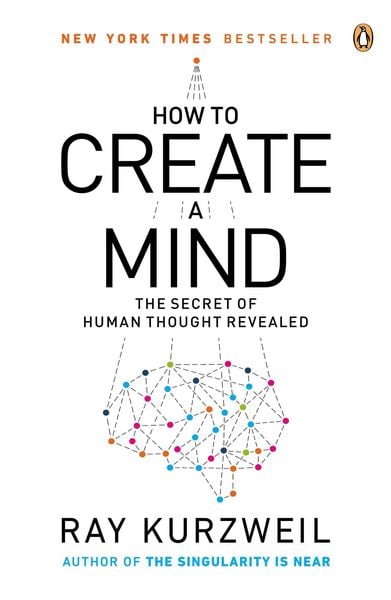
• Produktbild: How to Create a Mind
  • Produktbild: How to Create a Mind
- 18%

How to Create a Mind The Secret of Human Thought Revealed

1
18% sparen

14,99 € UVP 18,50 €

inkl. gesetzl. MwSt., Versandkostenfrei

Lieferung nach Hause

Beschreibung

Produktdetails

Einband

Taschenbuch

Erscheinungsdatum

27.08.2013

Abbildungen

black & white illustrations

Verlag

Penguin LLC US

Seitenzahl

352

Maße (L/B/H)

21,6/14,1/2,2 cm

Gewicht

312 g

Farbe

Weiß / Schwarz

Sprache

Englisch

ISBN

978-0-14-312404-7

Beschreibung

Rezension

Kurzweil's vision of our super-enhanced future is completely sane and calmly reasoned, and his book should nicely smooth the path for the earth's robot overlords, who, it turns out, will be us. The New York Times
 
Kurzweil writes boldly and with a showman s flair, expertly guiding the lay reader into deep thickets of neuroscience. Kate Tuttle, Boston Globe
 
This book is a breath of fresh air . . . . Kurzweil makes an argument for optimism. Laura Spinney, New Scientist
 
A fascinating exercise in futurology. Kirkus Reviews
 
It is rare to find a book that offers unique and inspiring content on every page. How to Create a Mind achieves that and more. Ray has a way of tackling seemingly overwhelming challenges with an army of reason, in the end convincing the reader that it is within our reach to create nonbiological intelligence that will soar past our own. This is a visionary work that is also accessible and entertaining. Rafael Reif, president, MIT
 
Kurzweil s new book on the mind is magnificent, timely, and solidly argued! His best so far! Marvin Minsky, MIT Toshiba Professor of Media Arts and Sciences; cofounder of the MIT Artificial Intelligence Lab; widely regarded as the father of artificial intelligence
 
If you ever wondered about how your mind works, read this book. Kurzweil s insights reveal key secrets underlying human thought and our ability to recreate it. This is an eloquent and thought-provoking work. Dean Kamen, physicist; inventor of the first wearable insulin pump, the HomeChoice dialysis machine, and the IBOT mobility system; founder of FIRST; recipient of the National Medal of Technology
 
One of the eminent AI pioneers, Ray Kurzweil, has created a new book to explain the true nature of intelligence, both biological and nonbiological. The book describes the human brain as a machine that can understand hierarchical concepts ranging from the form of a chair to the nature of humor. His important insights emphasize the key role of learning both in the brain and in AI. He provides a credible road map for achieving the goal of super-human intelligence, which will be necessary to solve the grand challenges of humanity. Raj Reddy, founding director, Robotics Institute, Carnegie Mellon University; recipient of the Turing Award from the Association for Computing Machinery
 
Ray Kurzweil pioneered artificial intelligence systems that could read print in any type style, synthesize speech and music, and understand speech. These were the forerunners of the present revolution in machine learning that is creating intelligent computers that can beat humans in chess, win on Jeopardy!, and drive cars. His new book is a clear and compelling overview of the progress, especially in learning, that is enabling this revolution in the technologies of intelligence. It also offers important insights into a future in which we will begin solving what I believe is the greatest problem in science and technology today: the problem of how the brain works and of how it generates intelligence. Tomaso Poggio, Eugene McDermott Professor, MIT Department of Brain and Cognitive Sciences; director, MIT Center for Biological and Computational Learning; former chair, MIT McGovern Institute for Brain Research; one of the most cited neuroscientists in the world

This book is a Rosetta stone for the mystery of human thought. Even more remarkably, it is a blueprint for creating artificial consciousness that is as persuasive and emotional as our own. Kurzweil deals with the subject of consciousness better than anyone from Blackmore to Dennett. His persuasive thought experiment is of Einstein quality: It forces recognition of the truth. Martine Rothblatt, chairman and CEO, United Therapeutics; creator of Sirius XM Satellite Radio

Kurzweil s book is a shining example of his prodigious ability to synthesize ideas from disparate domains and explain them to readers in simple, elegant language. Just as Chanute s Progress in Flying Machines ushered in the era of aviation over a century ago, this book is the harbinger of the coming revolution in artificial intelligence that will fulfill Kurzweil's own prophecies about it. Dileep George, AI scientist; pioneer of hierarchical models of the neocortex; cofounder of Numenta and Vicarious Systems

Ray Kurzweil s understanding of the brain and artificial intelligence will dramatically impact every aspect of our lives, every industry on Earth, and how we think about our future. If you care about any of these, read this book! Peter H. Diamandis, chairman and CEO, X PRIZE; executive chairman, Singularity University; author of the New York Times bestseller Abundance: The Future Is Better Than You Think

Produktdetails

Einband

Taschenbuch

Erscheinungsdatum

27.08.2013

Abbildungen

black & white illustrations

Verlag

Penguin LLC US

Seitenzahl

352

Maße (L/B/H)

21,6/14,1/2,2 cm

Gewicht

312 g

Farbe

Weiß / Schwarz

Sprache

Englisch

ISBN

978-0-14-312404-7

Herstelleradresse

Libri GmbH
Europaallee 1
36244 Bad Hersfeld
DE

Email: GPSR Kontakt

Kundinnen und Kunden meinen

Informationen zu Bewertungen

Zur Abgabe einer Bewertung ist eine Anmeldung im Konto notwendig. Die Authentizität der Bewertungen wird von uns nicht überprüft. Wir behalten uns vor, Bewertungstexte, die unseren Richtlinien widersprechen, entsprechend zu kürzen oder zu löschen.

Die Bewertungen sind nach Format, Anzahl Sterne und Datum sortiert.

  • Bewertung

    3/5

    26.11.2023

    Buch (Taschenbuch)

    Kein Geheimnis, fundiert geschrieben, aber langatmig

    Der Untertitel ist ein wenig irreführend, weil die vorgestellten Architekturen tatsächlich seit einiger Zeit in Verwendung sind, aber bis vor kurzem (LLMs) keine "Minds" hervorgebracht haben. Das Buch enthält viele Themen mit guten Referenzen, ist aber leider sehr langatmig zu lesen weil es viele Wiederholungen enthält ... vielleicht liegt das aber auch daran, dass das Thema nicht vollständig neu für mich ist.

Kundinnen und Kunden meinen

5

0

4

0

3

1

2

0

1

0

Bewertungen (1)

Weitere Artikel findest du in

Die Leseprobe wird geladen.
  • Produktbild: How to Create a Mind
  • Produktbild: How to Create a Mind