• Produktbild: Extraction of Natural Products Using Near-Critical Solvents
  • Produktbild: Extraction of Natural Products Using Near-Critical Solvents
- 12%

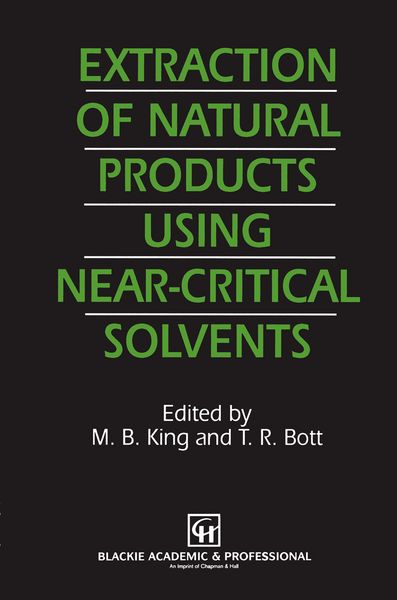
Extraction of Natural Products Using Near-Critical Solvents

12% sparen

187,99 € UVP 213,99 €

inkl. gesetzl. MwSt., Versandkostenfrei

Lieferung nach Hause

Beschreibung

Produktdetails

Einband

Taschenbuch

Erscheinungsdatum

02.11.2012

Herausgeber

M.B. King + weitere

Verlag

Springer Netherland

Seitenzahl

325

Maße (L/B/H)

23,5/15,5/1,9 cm

Gewicht

517 g

Auflage

Softcover reprint of the original 1st ed. 1993

Sprache

Englisch

ISBN

978-94-010-4947-4

Beschreibung

Produktdetails

Einband

Taschenbuch

Erscheinungsdatum

02.11.2012

Herausgeber

Verlag

Springer Netherland

Seitenzahl

325

Maße (L/B/H)

23,5/15,5/1,9 cm

Gewicht

517 g

Auflage

Softcover reprint of the original 1st ed. 1993

Sprache

Englisch

ISBN

978-94-010-4947-4

Herstelleradresse

Springer-Verlag KG
Sachsenplatz 4-6
1201 Wien
AT

Email: [email protected]

Kundinnen und Kunden meinen

0 Bewertungen

Informationen zu Bewertungen

Zur Abgabe einer Bewertung ist eine Anmeldung im Konto notwendig. Die Authentizität der Bewertungen wird von uns nicht überprüft. Wir behalten uns vor, Bewertungstexte, die unseren Richtlinien widersprechen, entsprechend zu kürzen oder zu löschen.

Die Bewertungen sind nach Format, Anzahl Sterne und Datum sortiert.

Verfassen Sie die erste Bewertung zu diesem Artikel

Helfen Sie anderen Kund*innen durch Ihre Meinung

Kundinnen und Kunden meinen

0 Bewertungen filtern

  • Produktbild: Extraction of Natural Products Using Near-Critical Solvents
  • Produktbild: Extraction of Natural Products Using Near-Critical Solvents
  • 1 Introduction.- 1.1 Compressed and liquefied gases as solvents: the commercial applications.- 1.2 The scope of the book.- 1.3 Range of solvent conditions regarded as ‘near-critical’.- 1.4 Range of available solvents.- 1.5 Range of components present in natural products: typical phase behaviour with near-critical carbon dioxide and similar near-critical solvents.- 1.6 Role of solvent density.- 1.7 Possible and actual process layouts.- 1.8 Advantages in use of near-critical solvents: future prospects.- Appendix: Some historical notes.- References.- 2 Food legislation and the scope for increased use of near-critical fluid extraction operations in the food, flavouring and pharmaceutical industries.- 2.1 Introduction.- 2.2 Solvent extraction of foodstuffs and flavourings: legal restrictions on solvents used and residual solvent levels.- 2.3 Widening the choice of extraction solvent: compressed and liquefied gases as solvents: economic and other problems in their use.- 2.4 Use of carbon dioxide for dense gas extractions: ‘rule of thumb’ solubility rules.- 2.5 Actual and proposed applications of extractions using dense CO2: tabular review of the literature.- References.- 3 Other uses for near-critical solvents: chemical reaction and recrystallisation in near-critical solvents.- 3.1 Chemical reaction in near-critical solvents.- 3.2 Recrystallisation in near-critical solvents.- References.- 4 Commercial scale extraction of alpha acids and hop oils with compressed CO2.- 4.1 Introduction, composition and brewing value of hops.- 4.2 Convenience of hop extracts.- 4.3 Advantages of compressed CO2 over conventional organic solvents for the extraction of hops: extraction plant using this solvent.- 4.4 Conclusions.- References.- 5 Commercial scale decaffeination of coffee andtea using supercritical CO2.- 5.1 Introduction: the extent of coffee and tea production worldwide and the need for decaffeination.- 5.2 Present-day demand for decaffeinated products and trends in the market.- 5.3 Brief description of the currently used processes for decaffeination and their history.- 5.4 Decaffeination with compressed CO2.- 5.5 The patent literature for decaffeination processes.- 5.6 Comparison of economic aspects of the CO2-based and ethylacetate-based decaffeination processes.- 5.7 Technical aspects of plant design.- 5.8 Conclusions.- References.- 6 Extraction of flavours and fragrances with compressed CO2.- 6.1 Introduction.- 6.2 The properties of CO2 as an extraction solvent.- 6.3 The raw materials.- 6.4 Equipment.- 6.5 Commercial use of CO2 extracts since 1982.- 6.6 Conclusions.- Appendix: CO2-extracted flavour and fragrance ingredients.- References.- 7 Physico-chemical data required for the design of near-critical fluid extraction process.- 7.1 The need for physico-chemical data.- 7.2 Phase equilibria.- 7.3 Mass transfer rate parameters.- Appendix: The fluid mass balance equations.- References.- 8 Design and operation of the pressure vessels used in near-critical extraction processes.- 8.1 Introduction.- 8.2 Classification of pressure vessels.- 8.3 Vessel design.- 8.4 Operation of the pressure vessels in a near-critical extraction plant.- 8.5 Design and development of equipment for the continuous extraction of solids.- References.- 9 Pumps and compressors for supercritical extraction.- 9.1 Introduction.- 9.2 Process requirements.- 9.3 Pumps for liquids.- 9.4 Compressors for gas recovery.- References.- 10 Estimation of separation cost.- 10.1 Introduction.- 10.2 Energy and economic assessment of near-critical extraction processes.- 10.3 Extractionwith a marginally subcritical solvent.- 10.4 Extraction with supercritical solvent.- 10.5 Energy and other costs in some typical cases.- 10.6 Example of preliminary costing.- References.