
Gutscheinbedingungen

**Gültig vom 07.09.2026 bis 09.09.2026 | Gültig für nicht preisgebundene fremdsprachige Bücher | Einzelne Artikel können ausgeschlossen sein | Online auf www.bücher.de einlösbar | Click & Collect nur mit Online-Zahlung (Paypal/Kreditkarte) vorab | Nicht kombinierbar mit anderen Gutscheinen oder Preisaktionen | Nur einmal pro Einkauf einlösbar | Gutschein wird auf max. 500€ Bestellwert angerechnet | Keine Barauszahlung | Nicht gültig für Versandkosten und Services

  • Produktbild: Managing Salinization
  • Produktbild: Managing Salinization

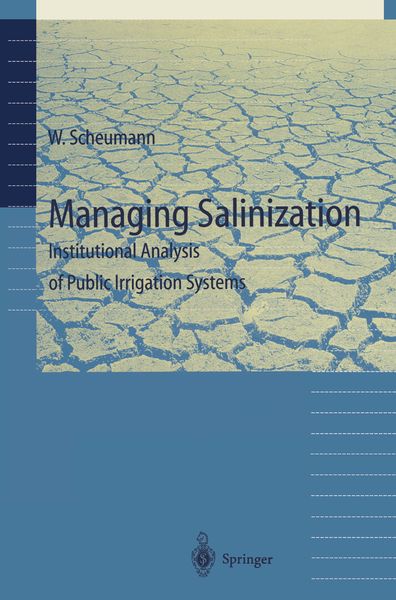
Managing Salinization Institutional Analysis of Public Irrigation Systems

51,99 €

inkl. gesetzl. MwSt., Versandkostenfrei


Beschreibung

Produktdetails

Einband

Taschenbuch

Erscheinungsdatum

14.10.2012

Abbildungen

XVI, 274 p.

Verlag

Springer Berlin

Seitenzahl

274

Maße (L/B/H)

23,5/15,5/1,7 cm

Gewicht

452 g

Auflage

Softcover reprint of the original 1st ed. 1997

Sprache

Englisch

ISBN

978-3-642-63830-5

Beschreibung

Produktdetails

Einband

Taschenbuch

Erscheinungsdatum

14.10.2012

Abbildungen

XVI, 274 p.

Verlag

Springer Berlin

Seitenzahl

274

Maße (L/B/H)

23,5/15,5/1,7 cm

Gewicht

452 g

Auflage

Softcover reprint of the original 1st ed. 1997

Sprache

Englisch

ISBN

978-3-642-63830-5

Herstelleradresse

Springer-Verlag GmbH
Tiergartenstr. 17
69121 Heidelberg
DE

Email: ProductSafety@springernature.com

Noch keine Bewertungen vorhanden

Verfassen Sie die erste Bewertung zu diesem Artikel

Helfen Sie anderen Kundinnen und Kunden durch Ihre Meinung.

Kundinnen und Kunden meinen

Bewertungen (0)

  • Produktbild: Managing Salinization
  • Produktbild: Managing Salinization
  • One: Theories on the Provision and Supply of Goods and Services Through Political and Bureaucratic Systems.- 1. Economic theories of democracy and bureaucracy.- 2. Criticisms to Niskanen’s model of bureaucratic supply from an institutional perspective.- 3. The New Institutional Economics, or the Institutional Rational Choice approach.- 4. The nature of water as a resource, and the peculiarities of irrigation and drainage systems.- 5. A concept for analyzing high groundwater levels and salinization in large-scale public irrigation systems.- Two: Literature Review on Large-Scale Public and on Small-Scale Farmer-Owned and -Managed Irrigation Systems.- 1. Large-scale public irrigation schemes.- 2. Small-scale farmer-owned and -managed irrigation schemes.- 3. Improving the performance of public irrigation systems.- 4. Potentials and constraints for controlling high groundwater levels and salinization.- Three: The Implementation Process of the Lower Seyhan Irrigation Project, With Special Reference to Means of High Groundwater Level and Salinity Control.- 1. Natural conditions in the Lower Seyhan Plain.- 2 The state’s responsibility for the development of water resources.- 3. The project planning and implementation process, and its evaluation with regard to high groundwater levels and salinity.- 4. The effects of the subprojects on the distribution of salt-affected areas and high groundwater levels in the project area.- 5. Conclusions.- Four: Contributions to High Groundwater Levels and Salinization Caused by the Operation and Maintenance of the Lower Seyhan Irrigation Project.- 1. The first public-farmer setting: joint operation and maintenance by the Regional Directorate for State Hydraulic Works and the Water User Groups.- 2. The second public-farmer setting: jointoperation and maintenance by the Regional Directorate for State Hydraulic Works and the Water User Associations.- Five: Effects of High Groundwater Levels, Waterlogging and Salinity on Farm Economy.- 1. Agriculture in the Lower Seyhan Plain prior to the project.- 2. Positive impacts of the irrigation project on yields and net incomes.- 3. Effects of high groundwater levels and salinity on yields.- 4. The farmers’ option towards groundwater and salinity control in irrigated cotton farming.- 5. Conclusions.- Six: Discussion and Outlook.- 1. The concept for analysis and the empirical results.- 2. Coordination and cooperation in multiorganizational arrangements.- 3. The conditions for changing institutional arrangements, and for successful farmer participation.- 4. Towards coordinated management of salinization in public irrigation systems.- Annexes.- Annex 1. Data on the service area and the irrigation and drainage networks.- Annex 2. Irrigated area as percentage of irrigable land (1964–1989).- Annex 3. Crop patterns from 1966 to 1990.- Annex 4. Data on groundwater tables and dissolved salt concentrations.- Annex 5. The DSI’s responsibilities for groundwater and salinity control, observation guidelines and annual reports.- Annex 6. Annual Decree on Water Tariffs for O&M and investment.- Annex 7. Contractual agreements between the DSI and the WUGs.- Annex 8. Data on the Water User Associations in the project area.- Annex 9. Formation statute of the North Yüregir Water User Association.- Annex 10. Contract between the DSI and the North Yüregir Water User Association.- Annex 11. The General Directorate for Rural Services’ experiences with groundwater cooperatives.- Annex 12. Water rights in the Majelle, the Ottoman codification of Moslem Law (Shari’a).-References.