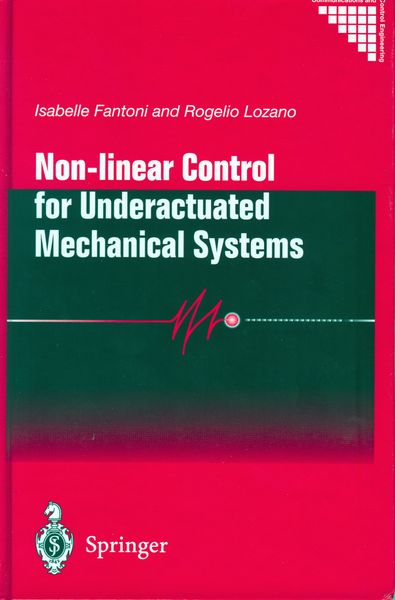
Non-linear Control for Underactuated Mechanical Systems
-
- Hardcover
- Taschenbuch ausgewählt
- eBook
-
Sprache:Englisch
49,99 €
inkl. gesetzl. MwSt.,
Beschreibung
Produktdetails
Einband
Taschenbuch
Erscheinungsdatum
17.10.2012
Abbildungen
XI, 295 p.
Verlag
Springer LondonSeitenzahl
295
Maße (L/B/H)
23,5/15,5/1,7 cm
Gewicht
470 g
Auflage
Softcover reprint of the original 1st edition 2002
Sprache
Englisch
ISBN
978-1-4471-1086-6
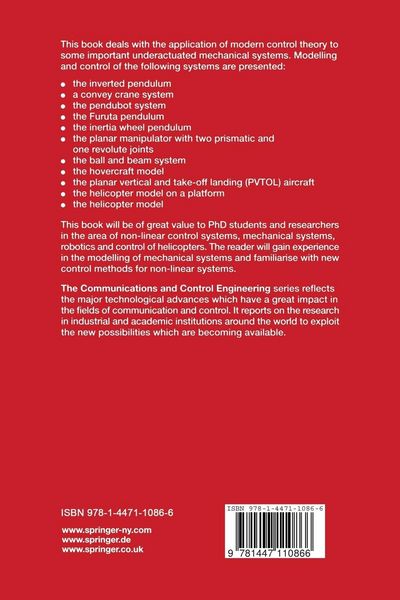
1 Introduction.- 1.1 Motivation.- 1.2 Outline of the book.- 2 Theoretical preliminaries.- 2.1 Lyapunov stability.- 2.3 Passivity and dissipativity.- 2.4 Stabilization.- 2.5 Non-holonomic systems.- 2.6 Underactuated systems.- 2.7 Homoclinic orbit.- 3 The cart-pole system.- 3.1 Introduction.- 3.2 Model derivation.- 3.3 Passivity of the inverted pendulum.- 3.4 Controllability of the linearized model.- 3.5 Stabilizing control law.- 3.3 Stability analysis.- 3.4 Simulation results.- 3.5 Experimental results.- 3.6 Conclusions.- 4 A convey-crane system.- 4.1 Introduction.- 4.2 Model.- 4.3 Passivity of the system.- 4.4 Damping oscillations control law.- 4.6 Simulation results.- 4.7 Concluding remarks.- 5 The pendubot system.- 5.1 Introduction.- 5.2 System dynamics.- 5.3 Passivity of the pendubot.- 5.4 Linearization of the system.- 5.5 Control law for the top position.- 5.6 Stability analysis.- 5.7 Simulation results.- 5.8 Experimental results.- 5.9 Conclusions.- 6 The Furuta pendulum.- 6.1 Introduction.- 6.2 Modeling of the system.- 6.3 Controllability of the linearized model.- 6.4 Stabilization algorithm.- 6.5 Stability analysis.- 6.6 Simulation results.- 6.7 Conclusions.- 7 The reaction wheel pendulum.- 7.1 Introduction.- 7.2 The reaction wheel pendulum.- 7.3 First energy-based control design.- 7.4 Second energy-based controller.- 7.5 Simulation results.- 7.6 Conclusions.- 7.7 Generalization for Euler-Lagrange systems.- 8 The planar flexible-joint robot.- 8.1 Introduction.- 8.2 The two-link planar robot.- 8.3 Control law for the two-link manipulator.- 8.4 Stability analysis.- 8.5 Simulation results.- 8.6 The three-link planar robot.- 8.7 Control law for the three-link robot.- 8.8 Stability analysis.- 8.9 Simulation results.- 8.10 Conclusions.- 9 The PPR planar manipulator.- 9.1 Introduction.- 9.2 System dynamics.- 9.3 Energy-based stabilizing control law.- 9.4 Convergence and stability analysis.- 9.5 Simulation results.- 9.6 Conclusions.- 10 The ball and beam acting on the ball.- 10.1 Introduction.- 10.2 Dynamical model.- 10.3 The control law.- 10.4 Simulation results.- 10.5 Conclusions.- 11 The hovercraft model.- 11.1 Introduction.- 11.2 The hovercraft model.- 11.3 Stabilizing control law for the velocity.- 11.4 Stabilization of the position>.- 11.5 Simulation results.- 11.6 Conclusions.- 12 The PVTOL aircraft.- 12.1 Introduction.- 12.2 The PVTOL aircraft model.- 12.3 Input-output linearization of the system.- 12.4 Second stabilization approach.- 12.5 Third stabilization algorithm.- 12.6 Forwarding control law.- 12.7 Simulation results.- 12.8 Conclusions.- 13 Helicopter on a platform.- 13.1 Introduction.- 13.2 General considerations.- 13.3 The helicopter-platform model.- 13.4 Dissipativity properties of the 3-DOF model.- 13.5 Control design.- 13.6 Simulation results.- 13.7 Conclusions.- 14 Lagrangian helicopter model.- 14.1 Introduction.- 14.2 Helicopter model.- 14.3 Energy-based control design.- 14.4 Analysis and simulations.- 14.5 Conclusions.- 15 Newtonian helicopter model.- 15.1 Introduction.- 15.2 Modeling a helicopter using Newton's laws.- 15.3 New dynamic model for control design.- 15.4 Lyapunov-based tracking control design.- 15.5 Analysis.- 15.6 Simulations.- 15.7 Conclusions.
Noch keine Bewertungen vorhanden
Verfassen Sie die erste Bewertung zu diesem Artikel
Helfen Sie anderen Kundinnen und Kunden durch Ihre Meinung.
Kurze Frage zu unserer Seite
Vielen Dank für dein Feedback
Wir nutzen dein Feedback, um unsere Produktseiten zu verbessern. Bitte habe Verständnis, dass wir dir keine Rückmeldung geben können. Falls du Kontakt mit uns aufnehmen möchtest, kannst du dich aber gerne an unseren Kund*innenservice wenden.
zum Kundenservice