KI-Beratung Beta

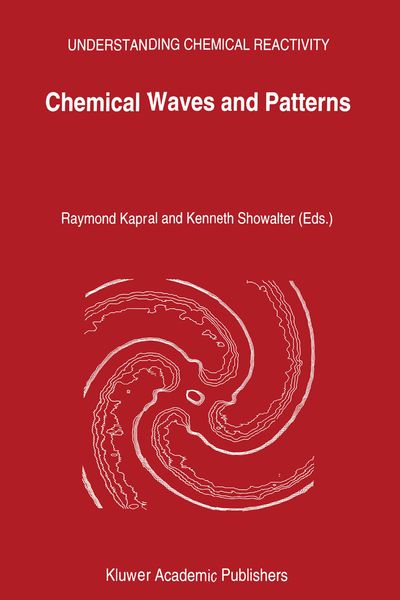
Produktbild: Chemical Waves and Patterns
Band 10 - 12%

Chemical Waves and Patterns

12% sparen

187,99 € UVP 213,99 €

inkl. gesetzl. MwSt., Versandkostenfrei


Beschreibung

The concept of macroscopic waves and patterns developing from chemical reaction coupling with diffusion was presented, apparently for the first time, at the Main Meeting of the Deutsche Bunsengesellschaft fur Angewandte Physikalische Chemie, held in Dresden, Germany from May 21 to 24, 1906. Robert Luther,...

Beschreibung

The concept of macroscopic waves and patterns developing from chemical reaction coupling with diffusion was presented, apparently for the first time, at the Main Meeting of the Deutsche Bunsengesellschaft fur Angewandte Physikalische Chemie, held in Dresden, Germany from May 21 to 24, 1906. Robert Luther, Director of the Physical Chemistry Laboratory in Leipzig, read his paper on the discovery and analysis of propagating reaction-diffusion fronts in autocatalytic chemical reactions [1, 2]. He presented an equation for the velocity of these new waves, V = a(KDC)1/2, and asserted that they might have features in common with propagating action potentials in nerve cell axons. During the discussion period, a skeptic in the audience voiced his objections to this notion. It was none other than the great physical chemist Walther Nernst, who believed that nerve impulse propagation was far too rapid to be akin to the propagating fronts. He was also not willing to accept Luther's wave velocity equation without a derivation. Luther stood his ground, saying his equation was "a simple consequence of the corresponding differential equation. " He described several different autocatalytic reactions that exhibit propagating fronts (recommending gelling the solution to prevent convection) and even presented a demonstration: the autocatalytic permanganate oxidation of oxalate was carried out in a test tube with the image of the front projected onto a screen for the audience.

Produktdetails

Einband

Taschenbuch

Erscheinungsdatum

13.10.2012

Abbildungen

X, 641 p.

Herausgeber Raymond Kapral + weitere

Produktdetails

Einband

Taschenbuch

Erscheinungsdatum

13.10.2012

Abbildungen

X, 641 p.

Herausgeber
Verlag Springer Netherland
Seitenzahl

641

Maße (L/B/H)

24/16/3,6 cm

Gewicht

1031 g

Auflage

1995

Sprache

Englisch

ISBN

978-94-010-4504-9

Herstelleradresse

Springer-Verlag KG
Sachsenplatz 4-6
1201 Wien
AT

Email: ProductSafety@springernature.com

Noch keine Bewertungen vorhanden

Verfassen Sie die erste Bewertung zu diesem Artikel

Helfen Sie anderen Kundinnen und Kunden durch Ihre Meinung.

Kundinnen und Kunden meinen

Bewertungen (0)

  • Produktbild: Chemical Waves and Patterns
  • One. Spiral Waves.- 1. Lingering Mysteries about Organizing Centers in the Belousov—Zhabotinksy Medium and Its Oregonator Model.- 2. Spiral Wave Dynamics.- 3. A Theory of Rotating Scroll Waves in Excitable Media.- 4. Spiral Waves in Weakly Excitable Media.- 5. Spiral Meandering.- 6. Spiral and Target Waves in Finite and Discontinuous Media.- Two. Turing and Turing-like Paiterns.- 7. Turing Patterns: From Myth to Reality.- 8. Onset and Beyond Turing Pattern Formation.- 9. The Chemistry behind the First Experimental Chemical Examples of Turing Patterns.- 10. Turing Bifurcations and Pattern Selection.- 11. The Differential Flow Instabilities.- Three. Chemical Wave Dynamics.- 12. Wave Propagation and Wave Pattern Formation in Nonuniform Reaction-Diffusion Systems.- 13. Chemical Front Propagation: Initiation and Relative Stability.- 14. Pattern Formation on Catalytic Surfaces.- 15. Simple and Complex Reaction-Diffusion Fronts.- 16. Modeling Front Pattern Formation and Intermittent Bursting Phenomena in the Couette Flow Reactor.- Four. Fluctuations and Chemical Waves.- 17. Probabilistic Approach to Chemical Instabilities and Chaos.- 18. Internal Noise, Oscillations, Chaos and Chemical Waves.