• Produktbild: Lexical Semantics and Knowledge Representation in Multilingual Text Generation
  • Produktbild: Lexical Semantics and Knowledge Representation in Multilingual Text Generation
Band 492 - 12%

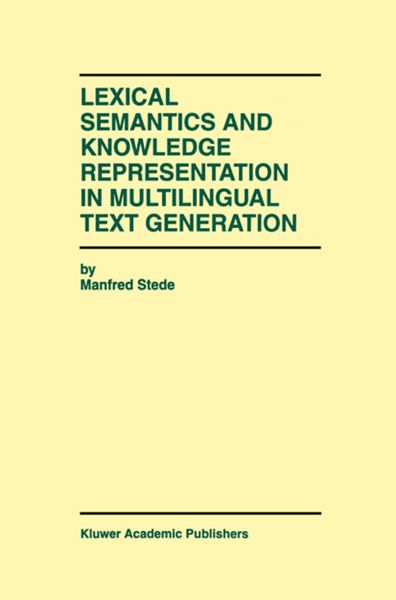
Lexical Semantics and Knowledge Representation in Multilingual Text Generation

12% sparen

139,99 € UVP 160,49 €

inkl. gesetzl. MwSt., Versandkostenfrei

Lieferung nach Hause

Beschreibung

Produktdetails

Einband

Taschenbuch

Erscheinungsdatum

23.10.2012

Verlag

Springer Us

Seitenzahl

219

Maße (L/B/H)

23,5/15,5/1,4 cm

Gewicht

371 g

Auflage

Softcover reprint of the original 1st ed. 1999

Sprache

Englisch

ISBN

978-1-4613-7359-9

Beschreibung

Rezension

`
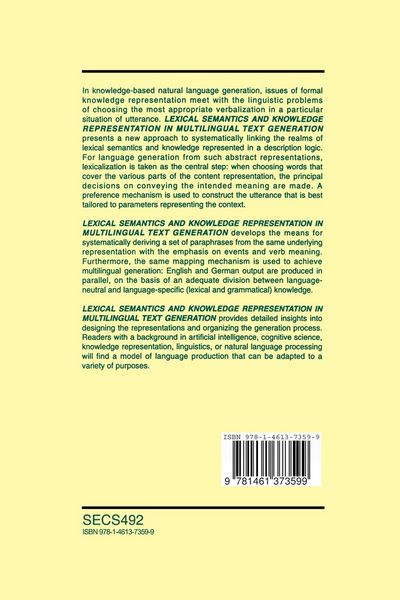
I recommend the book not only to researchers interested in text generation and in machine translation, but to everybody interested in the relationship between language-independent knowledge representation and language-specific ontologies... Stede's specific proposal is well defined and effective.
'

Computational Linguistics, 26:2

Produktdetails

Einband

Taschenbuch

Erscheinungsdatum

23.10.2012

Verlag

Springer Us

Seitenzahl

219

Maße (L/B/H)

23,5/15,5/1,4 cm

Gewicht

371 g

Auflage

Softcover reprint of the original 1st ed. 1999

Sprache

Englisch

ISBN

978-1-4613-7359-9

Herstelleradresse

Springer-Verlag GmbH
Tiergartenstr. 17
69121 Heidelberg
DE

Email: ProductSafety@springernature.com

Kundinnen und Kunden meinen

0 Bewertungen

Informationen zu Bewertungen

Zur Abgabe einer Bewertung ist eine Anmeldung im Konto notwendig. Die Authentizität der Bewertungen wird von uns nicht überprüft. Wir behalten uns vor, Bewertungstexte, die unseren Richtlinien widersprechen, entsprechend zu kürzen oder zu löschen.

Die Bewertungen sind nach Format, Anzahl Sterne und Datum sortiert.

Verfassen Sie die erste Bewertung zu diesem Artikel

Helfen Sie anderen Kund*innen durch Ihre Meinung

Kundinnen und Kunden meinen

0 Bewertungen filtern

  • Produktbild: Lexical Semantics and Knowledge Representation in Multilingual Text Generation
  • Produktbild: Lexical Semantics and Knowledge Representation in Multilingual Text Generation
  • 1. Introduction.- 1.1 Natural language generation.- 1.2 Goals of this research.- 1.3 Overview of the book.- 2. Lexicalization in NLG.- 2.1 Introduction.- 2.2 The nature of lexical items in NLP.- 2.3 Linking concepts to lexical items.- 2.4 Criteria for lexical choice.- 2.5 Placing lexicalization in the generation process.- 2.6 Conclusions: making progress on lexicalization.- 3. Classifying Lexical Variation.- 3.1 Intra-lingual paraphrases.- 3.2 Inter-lingual divergences.- 3.3 Divergences as paraphrases.- 4. Modelling the Domain.- 4.1 Building domain models for NLG.- 4.2 Knowledge representation in LOOM.- 4.3 Ontological categories.- 4.4 The domain model.- 5. Levels of Representation: Sitspec and Semspec.- 5.1 Finding appropriate representation levels in NLG.- 5.2 Linguistic ontology: adapting the ‘Upper Model’.- 5.3 SitSpecs.- 5.4 SemSpecs.- 6. Representing the Meaning of Words.- 6.1 Introduction: Lexical semantics.- 6.2 Denotation and covering.- 6.3 Partial SemSpecs.- 6.4 Connotation.- 6.5 Salience.- 7. Verb Alternations and Extensions.- 7.1 Background: verb alternations.- 7.2 Alternations as meaning extensions.- 7.3 Lexical rules for alternations and extensions.- 7.4 Extension rules for circumstances.- 7.5 Examples: lexical entries for verbs.- 7.6 Summary.- 8. A System Architecture for Multilingual Generation.- 8.1 Lexicalization with constraints and preferences.- 8.2 The computational problem.- 8.3 Architecture and algorithm.- 8.4 Implementation: MOOSE.- 8.5 Summary: lexicalization qua subsumption.- 9. Generating Paraphrases.- 9.1 Verbalizing states.- 9.2 Verbalizing activities.- 9.3 Verbalizing events.- 9.4 Solutions to legalization problems.- 10. From Sentences to Text.- 10.1 Text representation.- 10.2 Embedding MOOSE in a text generator.- 10.3 Example:technical documentation.- 11. Summary and Conclusions.- 11.1 Summary of the work.- 11.2 Comparison to related work.- 11.3 Directions for future research.- References.