
KI-Beratung Beta

Gutscheinbedingungen

**Gültig vom 23.11. bis 30.11.2026 | Gültig für nicht preisgebundene fremdsprachige Bücher | Einzelne Artikel können ausgeschlossen sein | Online auf www.bücher.de einlösbar | Click & Collect nur mit Online-Zahlung (Paypal/Kreditkarte) vorab | Nicht kombinierbar mit anderen Gutscheinen oder Preisaktionen | Nur einmal pro Einkauf einlösbar | Gutschein wird auf max. 500€ Bestellwert angerechnet | Keine Barauszahlung | Nicht gültig für Versandkosten und Services

  • Produktbild: Near-Field Nano-Optics
  • Produktbild: Near-Field Nano-Optics

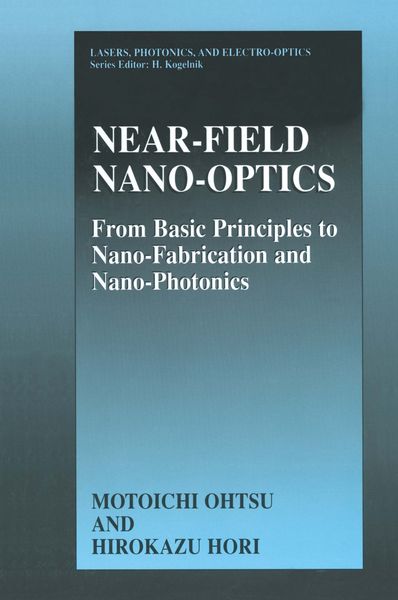
Near-Field Nano-Optics From Basic Principles to Nano-Fabrication and Nano-Photonics

48,99 €

inkl. gesetzl. MwSt., Versandkostenfrei


Beschreibung

Conventional optical science and technology have been restricted by the diffraction limit from reducing the sizes of optical and photoruc devices to nanometric dimensions. Thus, the size of optical integrated circuits has been incompatible with that of their counterpart, integrated electronic circuits,...

Beschreibung

Conventional optical science and technology have been restricted by the diffraction limit from reducing the sizes of optical and photoruc devices to nanometric dimensions. Thus, the size of optical integrated circuits has been incompatible with that of their counterpart, integrated electronic circuits, which have much smaller dimensions. This book provides potential ideas and methods to overcome this difficulty. Near-field optics has developed very rapidly from around the middle 1980s after preliminary trials in the microwave frequency region, as proposed as early as 1928. At the early stages of this development, most technical efforts were devoted to realizing super-high-resolution optical microscopy beyond the diffraction limit. However, the possibility of exploiting the optical near-field, phenomenon of quasistatic electromagnetic interaction at subwavelength distances between nanometric particles has opened new ways to nanometric optical science and technology, and many applications to nanometric fabrication and manipulation have been proposed and implemented. Building on this historical background, this book describes recent progress in near-field optical science and technology, mainly using research of the author's groups. The title of this book, Near-Field Nano-Optics-From Basic Principles to Nano-Fabrication and Nano-Photonics, implies capabilities of the optical near field not only for imaging/microscopy, but also for fabrication/manipulation/proc essing on a nanometric scale.

Produktdetails

Einband

Taschenbuch

Erscheinungsdatum

15.10.2012

Abbildungen

XII, 386 p.

Verlag Springer Us

Produktdetails

Einband

Taschenbuch

Erscheinungsdatum

15.10.2012

Abbildungen

XII, 386 p.

Verlag Springer Us
Seitenzahl

386

Maße (L/B/H)

22,9/15,2/2,2 cm

Gewicht

583 g

Auflage

Softcover reprint of the original 1st ed. 1999

Sprache

Englisch

ISBN

978-1-4613-7192-2

Herstelleradresse

Springer-Verlag KG
Sachsenplatz 4-6
1201 Wien
AT

Email: ProductSafety@springernature.com

Noch keine Bewertungen vorhanden

Verfassen Sie die erste Bewertung zu diesem Artikel

Helfen Sie anderen Kundinnen und Kunden durch Ihre Meinung.

Kundinnen und Kunden meinen

Bewertungen (0)

  • Produktbild: Near-Field Nano-Optics
  • Produktbild: Near-Field Nano-Optics
  • 1. Introduction.- 1.1. Near-Field Optics and Photonics.- 1.2. Ultra-High-Resolution Near-Field Optical Microscopy (NOM).- 1.3. General Features of Optical Near-Field Problems.- 1.4. Theoretical Treatment of Optical Near-Field Problems.- 1.5. Remarks on Near-Field Optics and Outline of This Book.- 1.6. References.- 2. Principles of Near-Field Optical Microscopy.- 2.1. An Example of Near-Field Optical Microscopy.- 2.2. Construction of the NOM System.- 2.3. Theoretical Description of Near-Field Optical Microscopy.- 2.4. Near-Field Problems and the Tunneling Process.- 2.5. References.- 3. Instrumentation.- 3.1. Basic Systems of a Near-Field Optical Microscope.- 3.2. Light Sources.- 3.3. Light Detection and Signal Amplification.- 3.4. References.- 4. Fabrication of Probes.- 4.1. Sharpening of Fibers by Chemical Etching.- 4.2. Metal Coating and Fabrication of a Protruded Probe.- 4.3. Other Novel Probes.- 4.4. References.- 5. Imaging Experiments.- 5.1. Basic Features of the Localized Evanescent Field.- 5.2. Imaging Biological Samples.- 5.3. Spatial Power Spectral Analysis of the NOM Image.- 5.4. References.- 6. Diagnostics and Spectroscopy of Photonic Devices and Materials.- 6.1. Diagnosing a Dielectric Optical Waveguide.- 6.2. Spatially Resolved Spectroscopy of Lateral p—n Junctions in Silicon-Doped Gallium Arsenide.- 6.3. Photoluminescence Spectroscopy of a Semiconductor Quantum Dot.- 6.4. Imaging of Other Materials.- 6.5. References.- 7. Fabrication and Manipulation.- 7.1. Fabrication of Photonic Devices.- 7.2. Manipulating Atoms.- 7.3. References.- 8. Optical Near-Field Theory.- 8.1. Introduction.- 8.2. Electromagnetic Theory as the Basis of Treating Near-Field Problems.- 8.3. Optical Near-Field Theory as an Electromagnetic Scattering Problem.- 8.4. Diffraction Theory inNear-Field Optics.- 8.5. Intuitive Model of Optical Near-Field Processes.- 8.6. References.- 9. Theoretical Description of Near-Field Optical Microscope.- 9.1. Electromagnetic Processes Involved in the Near-Field Optical Microscope.- 9.2. Representation of the Electromagnetic Field and the Interaction Propagator.- 9.3. States of Vector Fields and Their Representations.- 9.4. Angular Spectrum Representation of Electromagnetic Interactions.- 9.5. Near-Field Interaction of Dielectric Spheres Near a Planar Dielectric Surface.- 9.6. References.