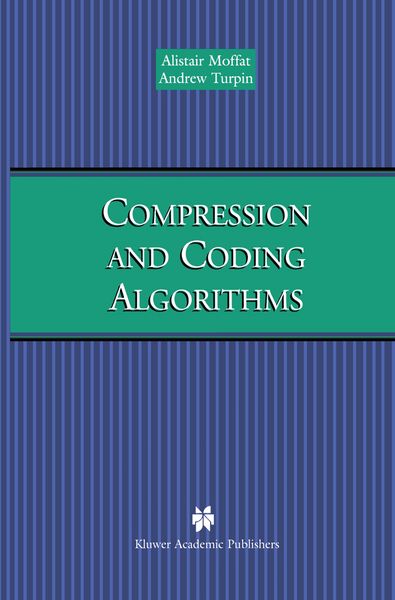
Compression and Coding Algorithms
-
- Hardcover
- Taschenbuch ausgewählt
-
Sprache:Englisch
48,99 €
inkl. gesetzl. MwSt.,
Beschreibung
Produktdetails
Einband
Taschenbuch
Erscheinungsdatum
30.10.2012
Abbildungen
XII, 275 p.
Verlag
Springer UsSeitenzahl
275
Maße (L/B/H)
23,5/15,5/1,6 cm
Gewicht
446 g
Auflage
Softcover reprint of the original 1st ed. 2002
Sprache
Englisch
ISBN
978-1-4613-5312-6
Compression and Coding Algorithms
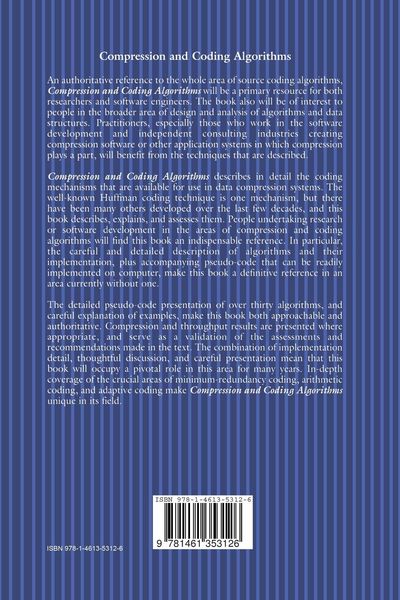
describes in detail the coding mechanisms that are available for use in data compression systems. The well known Huffman coding technique is one mechanism, but there have been many others developed over the past few decades, and this book describes, explains and assesses them. People undertaking research of software development in the areas of compression and coding algorithms will find this book an indispensable reference. In particular, the careful and detailed description of algorithms and their implementation, plus accompanying pseudo-code that can be readily implemented on computer, make this book a definitive reference in an area currently without one.
Noch keine Bewertungen vorhanden
Verfassen Sie die erste Bewertung zu diesem Artikel
Helfen Sie anderen Kundinnen und Kunden durch Ihre Meinung.
Kurze Frage zu unserer Seite
Vielen Dank für dein Feedback
Wir nutzen dein Feedback, um unsere Produktseiten zu verbessern. Bitte habe Verständnis, dass wir dir keine Rückmeldung geben können. Falls du Kontakt mit uns aufnehmen möchtest, kannst du dich aber gerne an unseren Kund*innenservice wenden.
zum Kundenservice