• Produktbild: The Fourier Transform in Biomedical Engineering
  • Produktbild: The Fourier Transform in Biomedical Engineering
- 12%

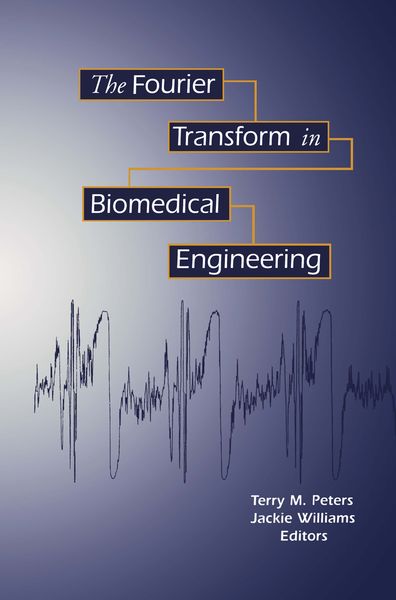
The Fourier Transform in Biomedical Engineering

12% sparen

93,99 € UVP 106,99 €

inkl. gesetzl. MwSt., Versandkostenfrei

Lieferung nach Hause

Beschreibung

Produktdetails

Einband

Taschenbuch

Erscheinungsdatum

12.10.2012

Verlag

Birkhäuser Boston

Seitenzahl

199

Maße (L/B/H)

23,5/15,5/1,3 cm

Gewicht

347 g

Auflage

Softcover reprint of the original 1st ed. 1998

Sprache

Englisch

ISBN

978-1-4612-6849-9

Beschreibung

Produktdetails

Einband

Taschenbuch

Erscheinungsdatum

12.10.2012

Verlag

Birkhäuser Boston

Seitenzahl

199

Maße (L/B/H)

23,5/15,5/1,3 cm

Gewicht

347 g

Auflage

Softcover reprint of the original 1st ed. 1998

Sprache

Englisch

ISBN

978-1-4612-6849-9

Herstelleradresse

Springer-Verlag GmbH
Tiergartenstr. 17
69121 Heidelberg
DE

Email: ProductSafety@springernature.com

Kundinnen und Kunden meinen

0 Bewertungen

Informationen zu Bewertungen

Zur Abgabe einer Bewertung ist eine Anmeldung im Konto notwendig. Die Authentizität der Bewertungen wird von uns nicht überprüft. Wir behalten uns vor, Bewertungstexte, die unseren Richtlinien widersprechen, entsprechend zu kürzen oder zu löschen.

Die Bewertungen sind nach Format, Anzahl Sterne und Datum sortiert.

Verfassen Sie die erste Bewertung zu diesem Artikel

Helfen Sie anderen Kund*innen durch Ihre Meinung

Kundinnen und Kunden meinen

0 Bewertungen filtern

  • Produktbild: The Fourier Transform in Biomedical Engineering
  • Produktbild: The Fourier Transform in Biomedical Engineering
  • 1 Introduction to the Fourier Transform.- 1.1 Introduction.- 1.2 Basic Functions.- 1.3 Sines, Cosines and Composite waves.- 1.4 Orthogonality.- 1.5 Waves in time and space.- 1.6 Complex numbers. A Mathematical Tool.- 1.7 The Fourier transform.- 1.8 Fourier transforms in the physical world: The Lens as an FT computer.- 1.9 Blurring and convolution.- 1.9.1 Blurring.- 1.9.2 Convolution.- 1.10 The “Point” or “Impulse” response function..- 1.11 Band-limited functions.- 1.12 Summary.- 1.13 Bibliography.- 2 The 1-D Fourier Transform.- 2.1 Introduction.- 2.2 Re-visiting the Fourier transform.- 2.3 The Sampling Theorem.- 2.4 Aliasing.- 2.5 Convolution.- 2.6 Digital Filtering.- 2.7 The Power Spectrum.- 2.8 Deconvolution.- 2.9 System Identification.- 2.10 Summary.- 2.11 Bibliography.- 3 The 2-D Fourier Transform.- 3.1 Introduction.- 3.2 Linear space-invariant systems in two dimensions.- 3.3 Ideal systems.- 3.4 A simple X-ray imaging system.- 3.5 Modulation Transfer Function (MTF).- 3.6 Image processing.- 3.7 Tomography.- 3.8 Computed Tomography.- 3.9 Summary.- 3.10 Bibliography.- 4 The Fourier Transform in Magnetic Resonance Imaging.- 4.1 Introduction.- 4.2 The 2-D Fourier transform.- 4.3 Magnetic Resonance Imaging.- 4.3.1 Nuclear Magnetic Resonance.- 4.3.2 Excitation, Evolution, and Detection.- 4.3.3 The Received Signal: FIDs and Echos.- 4.4 MRI.- 4.4.1 Localization: Magnetic Field Gradients.- 4.4.2 The MRI Signal Equation.- 4.4.3 2-D Spin-Warp Imaging.- 4.4.4 Fourier Sampling: Resolution, Field-of-View, and Aliasing.- 4.4.5 2-D Multi-slice and 3-D Spin Warp Imaging.- 4.4.6 Alternate k -space Sampling Strategies.- 4.5 Magnetic Resonance Spectroscopic Imaging.- 4.5.1 Nuclear Magnetic Resonance Spectroscopy: 1-D.- 4.5.2 Magnetic Resonance Spectroscopic Imaging: 2-D, 3-D, and 4-D.- 4.6 Motion in MRI.- 4.6.1 Phase Contrast Velocity Imaging.- 4.6.2 Phase Contrast Angiography.- 4.7 Conclusion.- 4.8 Bibliography.- 5 The Wavelet Transform.- 5.1 Introduction.- 5.1.1 Frequency analysis: Fourier transform.- 5.2 Time-Frequency analysis.- 5.2.1 Generalities.- 5.2.2. How does time-frequency analysis work?.- 5.2.3 Windowed Fourier transform.- 5.2.4 Wavelet transform.- 5.3 Multiresolution Analysis.- 5.3.1 Scaling Functions.- 5.3.2 Definition.- 5.3.3 Scaling Relation.- 5.3.4 Relationship of multiresolution analysis to wavelets.- 5.3.5 Multiresolution signal decomposition.- 5.3.6 Digital filter interpretation.- 5.3.7 Fast Wavelet Transform Algorithm.- 5.3.8 Multidimensional Wavelet Transforms.- 5.3.9 Fourier vs. Wavelet Digital Signal Processing.- 5.4 Applications.- 5.4.1 Image Compression.- 5.4.2 Irregular heart beat detection from EKG signals.- 5.5 Summary.- 5.6 Bibliography.- 6 The Discrete Fourier Transform and Fast Fourier Transform.- 6.1 Introduction.- 6.2 From Continuous to Discrete.- 6.2.1 The comb function.- 6.2.2 Sampling.- 6.2.3 Interpreting DFT data in a cyclic buffer.- 6.3 The Discrete Fourier Transform.- 6.4 The Fast Fourier Transform.- 6.4.1 The DFT as a matrix equation.- 6.4.2 Simplifying the transition matrix.- 6.4.3 Signal-flow-graph notation.- 6.4.4 The DFT expressed as a signal flow graph.- 6.4.5 Speed advantages of the FFT.- 6.5 Caveats to using the DFT/FFT.- 6.6 Conclusion.- 6.7 Bibliography.