KI-Beratung Beta

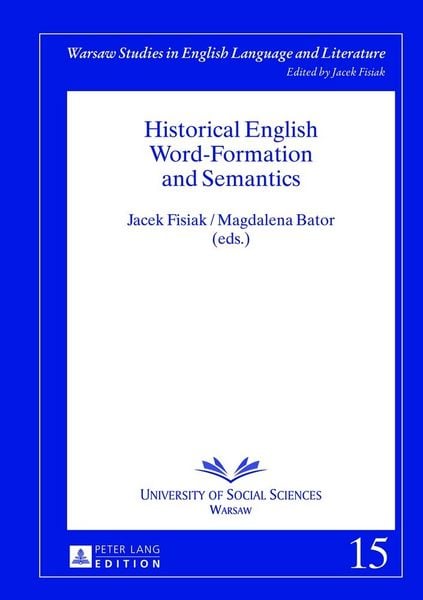
Produktbild: Historical English Word-Formation and Semantics
Band 15

Historical English Word-Formation and Semantics

112,65 €

inkl. gesetzl. MwSt., Versandkostenfrei


Beschreibung

Produktdetails

Einband

Gebundene Ausgabe

Erscheinungsdatum

17.01.2013

Herausgeber

Jacek Fisiak + weitere

Verlag

Peter Lang GmbH, Internationaler Verlag der Wissenschaften

Seitenzahl

503

Maße (L/B/H)

21,6/15,3/3,1 cm

Gewicht

750 g

Auflage

1

Sprache

Englisch

ISBN

978-3-631-63415-8

Beschreibung

Portrait

Jacek Fisiak is a retired professor and head of the School of English at Adam Mickiewicz University, Poznań (Poland), and currently head of the School of English at the Warsaw Division of the University of Social Sciences (Społeczna Akademia Nauk) in Łódź. He has published widely in the area of English linguistics including the history of English, Old and Middle English and historical dialectology on both sides of the Atlantic. Magdalena Bator received her PhD from Adam Mickiewicz University, Poznań in 2008. Currently she is a lecturer at the School of English at the University of Social Sciences in Warsaw. Her research interests focus on various aspects of English historical linguistics, in particular historical semantics.

Produktdetails

Einband

Gebundene Ausgabe

Erscheinungsdatum

17.01.2013

Herausgeber

Verlag

Peter Lang GmbH, Internationaler Verlag der Wissenschaften

Seitenzahl

503

Maße (L/B/H)

21,6/15,3/3,1 cm

Gewicht

750 g

Auflage

1

Sprache

Englisch

ISBN

978-3-631-63415-8

EU-Ansprechpartner

Kolibri 360 GmbH
Ettore-Bugatti-Straße 6-14
51149 Köln
DE
produktsicherheit@kolibri360.de

Herstelleradresse

Peter Lang
Avenue du Théâtre 7
1005 Lausanne
CH
orders@peterlang.com

Noch keine Bewertungen vorhanden

Verfassen Sie die erste Bewertung zu diesem Artikel

Helfen Sie anderen Kundinnen und Kunden durch Ihre Meinung.

Kundinnen und Kunden meinen

Bewertungen (0)

  • Produktbild: Historical English Word-Formation and Semantics

  • Contents: Dieter Kastovsky: English prefixation: A historical sketch – D. Gary Miller: On the history and analysis of V-P nouns – Grzegorz A. Kleparski: Historical semantics: A sketch on new categories and types of semantic change – Hans Sauer: Reginald Pecock and his vocabulary: A preliminary sketch – Magdalena Bator: Verbs of cooking in Middle English:
    fry
    ,
    roast
    and
    bake
    – Michael Bilynsky: Unanalysable verb-related coinages as reflected in the OED textual prototypes – Olga Chupryna: Old English
    sǣl
    ‘time’: Metaphor and metonymy in word and text – Gaye Çinkiliç/Helmut Weiß: Historical word formation in German. On the interpretation of N-N compounds – Ewa Ciszek: Middle English decline of the Old English word
    lēode
    : A case study of the two manuscripts of
    Laʒamon’s Brut
    – Xavier Dekeyser: Loss of the prototypical meaning related to lexical borrowing. The battle of (near) synonyms: A case study – Bożena Duda: From
    portcwene
    to
    fille de joie
    : On etymology and the word-formation processes behind the historical lexical representations in the category FALLEN WOMAN in English – Radosław Dylewski: The first years of
    dude
    . What else can early American newspapers and the
    COHA
    tell us about its early meanings and usages? – Camiel Hamans: Historical word-formation caught in the present – changes in modern usage – Robert Kiełtyka:
    Sniff danger
    and
    wietrzyć podstęp
    : On the categorization of verbal zoosemy – Małgorzata Kłos: Old English poetic diction and the language of death: Circumlocutory terms denoting the sense ‘die’ in Anglo-Saxon poetry – Beata Kopecka: Whatever the weather - on semantic change and word-formation processes – Anya Kursova: Folk-etymologies: On the way to improving naturalness – Olivier Simonin: The semantics of noun postmodifying
    to
    -infinitives in Old English – Marta Sylwanowicz: Names of medicines in Early Modern English medical texts (1500-1700) – Agnieska Wawrzyniak: Metaphors of darkness in
    The Canterbury Tales
    – Jerzy Wełna: The regional aspects of the distribution of nouns in -
    ling
    in Middle English.