
Human Rights and Human Well-Being
-
- Hardcover
- Taschenbuch ausgewählt
- eBook
-
Sprache:Englisch
62,99 €
inkl. gesetzl. MwSt.,
Beschreibung
Produktdetails
Einband
Taschenbuch
Erscheinungsdatum
01.05.2013
Verlag
Oxford University PressSeitenzahl
426
Maße (L/B/H)
23,4/15,6/2,5 cm
Gewicht
721 g
Sprache
Englisch
ISBN
978-0-19-931136-1
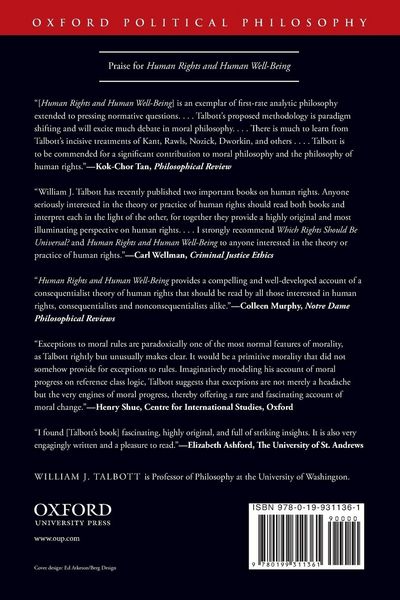
In the last half of the twentieth century, legalized segregation ended in the southern United States, apartheid ended in South Africa, women in many parts of the world came to be recognized as having equal rights with men, persons with disabilities came to be recognized as having rights to develop and exercise their human capabilities, colonial peoples' rights of self-determination were recognized, and rights of gays and lesbians have begun to be recognized. It is hard not to see these developments as examples of real moral progress. But what is moral progress?
In this book, William Talbott offers a surprising answer to that question. He proposes a consequentialist meta-theoretical principle of moral and legal progress, the "main principle", to explain why these changes are examples of moral and legal progress. On Talbott's account, improvements to our moral or legal practices are changes that, when evaluated as a practice, contribute to equitably promoting well-being. Talbott uses the main principle to explain why almost all the substantive moral norms and principles used in moral or legal reasoning have exceptions and why it is almost inevitable that, no matter how much we improve them, there will always be more exceptions. This explanation enables Talbott to propose a new, non-skeptical understanding of what has been called the "naturalistic fallacy".
Talbott uses the main principle to complete the project begun in his 2005 book of identifying the human rights that should be universal-that is, legally guaranteed in all human societies. Talbott identifies a list of fourteen robust, inalienable human rights.
Talbott contrasts his consequentialist (though not utilitarian) account with many of the most influential nonconsequentialist accounts of morality and justice in the philosophical literature, including those of Ronald Dworkin, Jurgen Habermas, Martha Nussbaum, Phillip Pettit, John Rawls, T.M. Scanlon, Amartya Sen, Judith Thomson.
Noch keine Bewertungen vorhanden
Verfassen Sie die erste Bewertung zu diesem Artikel
Helfen Sie anderen Kundinnen und Kunden durch Ihre Meinung.
Kurze Frage zu unserer Seite
Vielen Dank für dein Feedback
Wir nutzen dein Feedback, um unsere Produktseiten zu verbessern. Bitte habe Verständnis, dass wir dir keine Rückmeldung geben können. Falls du Kontakt mit uns aufnehmen möchtest, kannst du dich aber gerne an unseren Kund*innenservice wenden.
zum Kundenservice