• Produktbild: Computer Graphics through Key Mathematics
  • Produktbild: Computer Graphics through Key Mathematics
- 12%

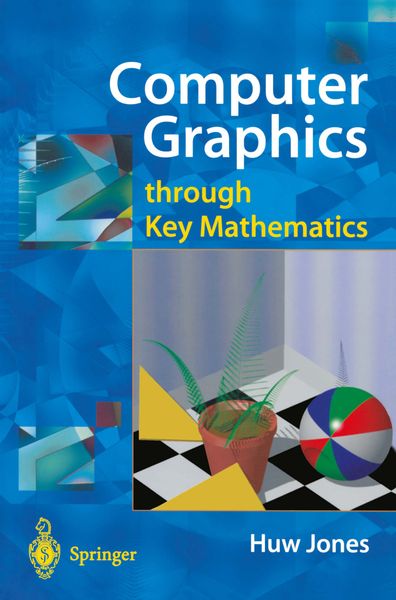
Computer Graphics through Key Mathematics

12% sparen

79,99 € UVP 90,94 €

inkl. gesetzl. MwSt., Versandkostenfrei

Lieferung nach Hause

Beschreibung

Produktdetails

Einband

Taschenbuch

Erscheinungsdatum

27.04.2001

Abbildungen

XIV, 10 illus., schwarz-weiss Illustrationen

Verlag

Springer London

Seitenzahl

343

Maße (L/B/H)

23,5/15,5/2 cm

Gewicht

557 g

Auflage

Softcover reprint of the original 1st ed. 2001

Sprache

Englisch

ISBN

978-1-85233-422-2

Beschreibung

Produktdetails

Einband

Taschenbuch

Erscheinungsdatum

27.04.2001

Abbildungen

XIV, 10 illus., schwarz-weiss Illustrationen

Verlag

Springer London

Seitenzahl

343

Maße (L/B/H)

23,5/15,5/2 cm

Gewicht

557 g

Auflage

Softcover reprint of the original 1st ed. 2001

Sprache

Englisch

ISBN

978-1-85233-422-2

Herstelleradresse

Springer-Verlag KG
Sachsenplatz 4-6
1201 Wien
AT

Email: ProductSafety@springernature.com

Kundinnen und Kunden meinen

0 Bewertungen

Informationen zu Bewertungen

Zur Abgabe einer Bewertung ist eine Anmeldung im Konto notwendig. Die Authentizität der Bewertungen wird von uns nicht überprüft. Wir behalten uns vor, Bewertungstexte, die unseren Richtlinien widersprechen, entsprechend zu kürzen oder zu löschen.

Die Bewertungen sind nach Format, Anzahl Sterne und Datum sortiert.

Verfassen Sie die erste Bewertung zu diesem Artikel

Helfen Sie anderen Kund*innen durch Ihre Meinung

Kundinnen und Kunden meinen

0 Bewertungen filtern

  • Produktbild: Computer Graphics through Key Mathematics
  • Produktbild: Computer Graphics through Key Mathematics
  • 1 The Processes of Computer Graphics.- Object Model Building.- Depiction of Models.- Conclusion.- 2 Numbers, Counting and Measuring.- Natural Numbers.- Integers.- Rational Numbers.- Real Numbers.- Complex Numbers.- Representations of Number.- The Computer Representation of Number.- Boolean Algebra.- Summary.- 3 Coordinates and Dimension: Representations of Space and Colour.- Cartesian Coordinates.- Defining Space by Equations and Inequalities.- Angles.- Trigonometry and Polar Coordinates.- Dimension.- Coordinate Systems in Three Dimensions.- Colour and its Representation.- Summary.- 4 Functions and Transformations: Ways of Manipulating Space.- Functions as Mappings.- Graphs of Functions.- Transformations in 2D.- Transformations in 3D.- Combining Affine Transformations.- Inversion of Affine Transformations.- Inversion of Functions.- Shape Transformation by Function Change.- Conclusions.- 5 Form from Function: Analysis of Shapes.- The Straight Line.- Drawing General Function Graphs.- Graphs of Polynomials.- Calculus: Differentiation.- Calculus: Integration.- Series Expansions.- Calculus and Animation.- The Exponential Function.- The Conic Sections.- Some Standard 3D Forms and their Equations.- Summary.- 6 Matrices: Tools for Manipulating Space.- Matrices in Computer Graphics.- Definition and Notation.- Forms of Matrices.- Operations on Matrices: Addition.- Operations on Matrices: Multiplication.- The Identity Matrix.- Matrices and Equations.- The Inverse of a Square Matrix.- Matrices, Transformations and Homogeneous Coordinates: Two Dimensions.- Matrices, Transformations and Homogeneous Coordinates: Three Dimensions.- Inverse of a Transformation Matrix.- Perspective Projection.- Computer Implementation of Matrix Methods.- Summary.- 7 Vectors: Descriptions of Spatial Relationships.- Definition of a Vector.- Notation.- Addition of Vectors: The Parallelogram and Triangle Laws.- Multiplication of a Vector by a Scalar.- Examples of Vector Quantities.- Vectors in 2D Cartesian Spaces.- Vectors in 3D Cartesian Spaces.- Multiplication of Vectors: The Scalar or Dot Product.- Multiplication of Vectors: The Vector or Cross Product.- Representation of Lines Using Vectors.- Classification of Points against Planes Using Vectors.- Representation of Planes in Standard Form.- Intersection of a Line with a Plane.- Inclusion of a Point in a Triangle.- Reflected and Refracted Rays.- Distance between Two Skew Lines.- Intersection of Two Planes.- Summary.- 8 Geometric Modelling and Fractals: Building Descriptions of Objects.- Data Structures.- Geometric Modelling Systems.- Voxel Modelling Methods.- Constructive Solid Geometry (CSG).- Boundary Representation (B-Rep).- Isosurface Modelling.- Fractals.- Fractal Dimension.- Fractals Based in the Complex Plane: Julia and Mandelbrot Sets.- Fractals in Simulation of Natural Phenomena.- Summary.- 9 Splines: Generation of Curves and Surfaces.- Reasons for Splines.- Interpolation.- Bézier Splines for Curve Drawing.- Animation Control Using Cubic Bézier Curves.- Drawing Bézier Curves.- Interpolating Splines for Curve Generation.- Animation Control Using Interpolating Splines.- B-Splines.- Non-Uniform Rational B-Splines: NURBS.- Circles and Other Conic Sections.- Surface Construction Using Bézier Patches.- Surface Generation Based on Other Forms of Curve.- Depiction of Surface Patches.- Summary.- 10 Drawing and Rendering: How to Create Pictures.- What is a 3D Drawing?.- Methods for Rendering.- Hidden Surface Removal.- Flat or Lambert Shading.- Scan Line Methods.- Gouraud Shading.- Phong Shading.- Exact Object Rendering.- Shadows.- Specular Highlights.- Textures.- Ray Tracing.- Radiosity.- Anti-Aliasing.- Summary.- Suggestions for Further Reading.- Mathematical and Scientific Minds.- Understanding of Mathematics.- Computer Graphics in General.- Geometric Modelling.- Fractals and Related Issues.- Journals.- Names.