
KI-Beratung Beta

Gutscheinbedingungen

**Gültig vom 23.11. bis 30.11.2026 | Gültig für nicht preisgebundene fremdsprachige Bücher | Einzelne Artikel können ausgeschlossen sein | Online auf www.bücher.de einlösbar | Click & Collect nur mit Online-Zahlung (Paypal/Kreditkarte) vorab | Nicht kombinierbar mit anderen Gutscheinen oder Preisaktionen | Nur einmal pro Einkauf einlösbar | Gutschein wird auf max. 500€ Bestellwert angerechnet | Keine Barauszahlung | Nicht gültig für Versandkosten und Services

  • Produktbild: Mathematics in Industrial Problems
  • Produktbild: Mathematics in Industrial Problems
Band 83 - 12%

Mathematics in Industrial Problems Part 8

12% sparen

93,99 € UVP 106,99 €

inkl. gesetzl. MwSt., Versandkostenfrei


Beschreibung

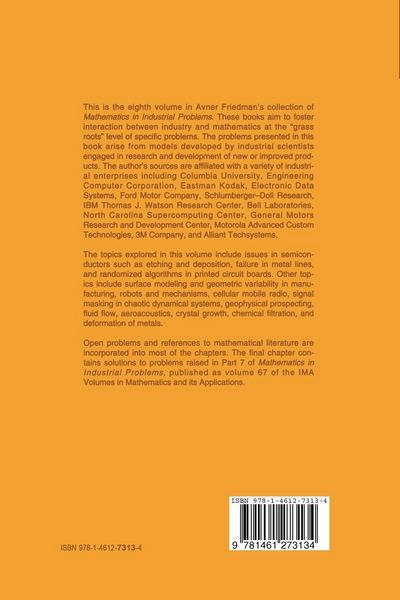
This is the eighth volume in the series "Mathematics in Industrial Prob lems." The motivation for these volumes is to foster interaction between Industry and Mathematics at the "grass roots level"; that is, at the level of specific problems. These problems come from Industry: they arise from models developed...

Beschreibung

This is the eighth volume in the series "Mathematics in Industrial Prob lems." The motivation for these volumes is to foster interaction between Industry and Mathematics at the "grass roots level"; that is, at the level of specific problems. These problems come from Industry: they arise from models developed by the industrial scientists in ventures directed at the manufacture of new or improved products. At the same time, these prob lems have the potential for mathematical challenge and novelty. To identify such problems, I have visited industries and had discussions with their scientists. Some of the scientists have subsequently presented their problems in the IMA Seminar on Industrial Problems. The book is based on the seminar presentations and on questions raised in subsequent discussions. Each chapter is devoted to one of the talks and is self-contained. The chapters usually provide references to the mathematical literature and a list of open problems that are of interest to industrial scientists. For some problems, a partial solution is indicated briefly. The last chapter of the book contains a short description of solutions to some of the problems raised in the previous volume, as well as references to papers in which such solutions have been published.

Produktdetails

Einband

Taschenbuch

Erscheinungsdatum

06.10.2012

Abbildungen

X, 192 p.

Verlag Springer Us

Produktdetails

Einband

Taschenbuch

Erscheinungsdatum

06.10.2012

Abbildungen

X, 192 p.

Verlag Springer Us
Seitenzahl

192

Maße (L/B/H)

23,5/15,5/1,2 cm

Gewicht

318 g

Auflage

Softcover reprint of the original 1st ed. 1997

Sprache

Englisch

ISBN

978-1-4612-7313-4

Herstelleradresse

Springer-Verlag KG
Sachsenplatz 4-6
1201 Wien
AT

Email: ProductSafety@springernature.com

Noch keine Bewertungen vorhanden

Verfassen Sie die erste Bewertung zu diesem Artikel

Helfen Sie anderen Kundinnen und Kunden durch Ihre Meinung.

Kundinnen und Kunden meinen

Bewertungen (0)

  • Produktbild: Mathematics in Industrial Problems
  • Produktbild: Mathematics in Industrial Problems
  • 1 Dealing with geometric variations in manufacturing.- 1.1 Tolerancing.- 1.2 Metrology.- 1.3 Mathematical issues.- 1.4 References.- 2 Interdisciplinary computational fluid dynamics.- 2.1 Industrial interdisciplinary CFD.- 2.2 Thermal flow and combustion model.- 2.3 References.- 3 A mathematical model of a crystallizer.- 3.1 The physical model.- 3.2 Mathematical model for CSTR mixer.- 3.3 Mathematical model for PFR mixer.- 3.4 Scaling.- 3.5 Numerical results.- 3.6 References.- 4 Randomized algorithms in industrial problems.- 4.1 Programmable logical array (PLA).- 4.2 Gate arrays.- 4.3 Printed circuit board (PCB).- 4.4 References.- 5 Global geodesic coordinates on aG0 continuous surface.- 5.1 Basic problems.- 5.2 Geodesics on a smooth surface.- 5.3 Geodesics on non-smooth surfaces.- 5.4 References.- 6 Micromechanics effects in creep metal-matrix composites.- 6.1 Metal-matrix composites.- 6.2 The unreinforced model.- 6.3 The composite problem.- 6.4 References.- 7 Seismic inversion for geophysical prospecting.- 7.1 Data acquisition.- 7.2 Some traditional data processing steps.- 7.3 Multiparameter inversion.- 7.4 Open problems.- 7.5 References.- 8 Simulations for etch/deposition profile evolution.- 8.1 The problem.- 8.2 Mathematical formulation.- 8.3 Numerical results.- 8.4 Open problems.- 8.5 References.- 9 Analysis of cellular mobile radio.- 9.1 A cellular mobile radio system.- 9.2 Traditional queueing networks.- 9.3 An interacting queue model.- 9.4 Open problems.- 9.5 References.- 10 A pseudo non-time-splitting scheme in air quality modeling.- 10.1 The model.- 10.2 The pseudo non-time-splitting method.- 10.3 Numerical results.- 10.4 References.- 11 Fluid flow in a porous medium.- 11.1 The problem.- 11.2 The quasi-stationary 2-d model.- 11.3 Numerical results.- 11.4 Need for another model.- 11.5 Open problems.- 11.6 References.- 12 Robots, mechanisms and polynomial continuation.- 12.1 Examples.- 12.2 Polynomial continuation.- 12.3 The Stewart platform.- 12.4 Open questions.- 12.5 References.- 13 Failure times in metal lines.- 13.1 Electromigration.- 13.2 A mathematical model.- 13.3 Another model.- 13.4 Analysis of the solution.- 13.5 References.- 14 Surface modeling: impacts of design and manufacturing.- 14.1 Patched surfaces.- 14.2 Feature-based approach.- 14.3 Free-form deformation.- 14.4 References.- 15 Chemical filtration modeling.- 15.1 The chemistry of absorption.- 15.2 The occurrence of absorption.- 15.3 A recirculation model.- 15.4 Open problems.- 15.5 References.- 16 The element-free Galerkin method in large deformations.- 16.1 Large deformations.- 16.2 Moving least square interpolants.- 16.3 Kinematics of large deformations of continua.- 16.4 The EFG method.- 16.5 Proposed further research.- 16.6 References.- 17 Aeroacoustic research in the automotive industry.- 17.1 Basic acoustics.- 17.2 Mathematical modeling of sound.- 17.3 Acoustic source models.- 17.4 The antenna model.- 17.5 Open problems.- 17.6 References.- 18 Synchronization for chaotic dynamical systems.- 18.1 Synchronization.- 18.2 General definition of synchronization.- 18.3 Conditional Lyapunov exponents.- 18.4 Chaotic signal masking.- 18.5 Controlling chaos.- 18.6 References.- 19 Solutions to problems from part 7.- 19.1 Chapter 2.- 19.2 Chapter 3.- 19.3 Chapter 4.- 19.4 Chapter 14.- 19.5 Chapter 20.- 19.6 References.