
Design for Creep
-
- Hardcover
- Taschenbuch ausgewählt
- eBook
-
Sprache:Englisch
322,99 €
inkl. gesetzl. MwSt.,
Lieferung nach Hause
Beschreibung
Produktdetails
Einband
Taschenbuch
Erscheinungsdatum
05.10.2012
Verlag
Springer NetherlandSeitenzahl
430
Maße (L/B/H)
23,5/15,5/2,4 cm
Auflage
Second Edition 1995
Sprache
Englisch
ISBN
978-94-010-4248-2
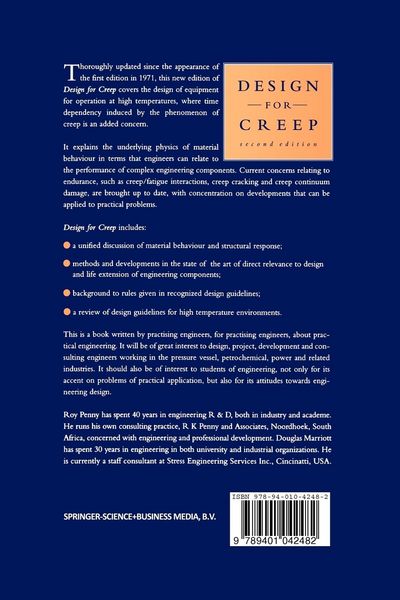
Our rationale for the second edition remains the same as for the first edition, which appeared over twenty years ago. This is to offer simplified, useful and easily understood methods for dealing with the creep of components operating under conditions met in practice. When the first edition was written, we could not claim that the methods which were introduced were well-tried. They were somewhat conjectural, although firmly based, but not sufficiently well devel oped. Since that time, the Reference Stress Methods (RSM) introduced in the book have received much scrutiny and development. The best recognition we could have of the original methods is the fact that they are now firmly embedded in codes of practice. Hopefully, we have now gone a long way towards achieving our original objectives. There are major additions to this second edition which should help to justify our claims. These include further clarification regarding Reference Stress Methods in Chapter 4. There are also new topics which depend on RSM in varying degrees: • Creep fracture is covered in Chapter 7, where methods for assessing creep crack initiation and crack growth are fully described. This chapter starts with a review of the basic concepts of fracture mechanics and follows with useful, approximate methods, compatible with the needs of design for creep and the availability of standard data. • Creep/fatigue interactions and environmental effects appear in Chapter 8.
Kundinnen und Kunden meinen
Verfassen Sie die erste Bewertung zu diesem Artikel
Helfen Sie anderen Kund*innen durch Ihre Meinung
Kurze Frage zu unserer Seite
Vielen Dank für dein Feedback
Wir nutzen dein Feedback, um unsere Produktseiten zu verbessern. Bitte habe Verständnis, dass wir dir keine Rückmeldung geben können. Falls du Kontakt mit uns aufnehmen möchtest, kannst du dich aber gerne an unseren Kund*innenservice wenden.
zum Kundenservice