• Produktbild: Soil as World Heritage
  • Produktbild: Soil as World Heritage
- 13%

Soil as World Heritage

13% sparen

138,99 € UVP 160,49 €

inkl. gesetzl. MwSt., Versandkostenfrei

Lieferung nach Hause

Beschreibung

Produktdetails

Einband

Gebundene Ausgabe

Erscheinungsdatum

09.10.2013

Abbildungen

XVIII, 105 illus., 42 illus. in color., farbige Illustrationen, schwarz-weiss Illustrationen

Herausgeber

David Dent

Verlag

Springer Netherland

Seitenzahl

502

Maße (L/B/H)

24,1/16/3,3 cm

Gewicht

939 g

Auflage

2014

Sprache

Englisch

ISBN

978-94-007-6186-5

Beschreibung

Portrait

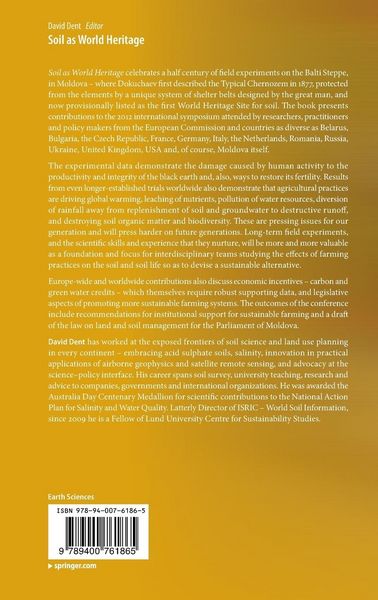
David Dent has worked at the exposed frontiers of soil science and land use planning in every continent - embracing acid sulphate soils, salinity, innovation in practical applications of airborne geophysics and satellite remote sensing, and advocacy at the science–policy interface. His career spans soil survey, university teaching, research and advice to companies, governments and international organizations. He was awarded the Australia Day Centenary Medallion for scientific contributions to the National Action Plan for Salinity and Water Quality. Latterly Director of ISRIC – World Soil Information, since 2009 he is a Fellow of Lund University Centre for Sustainability Studies.

Produktdetails

Einband

Gebundene Ausgabe

Erscheinungsdatum

09.10.2013

Abbildungen

XVIII, 105 illus., 42 illus. in color., farbige Illustrationen, schwarz-weiss Illustrationen

Herausgeber

David Dent

Verlag

Springer Netherland

Seitenzahl

502

Maße (L/B/H)

24,1/16/3,3 cm

Gewicht

939 g

Auflage

2014

Sprache

Englisch

ISBN

978-94-007-6186-5

Herstelleradresse

Springer-Verlag GmbH
Tiergartenstr. 17
69121 Heidelberg
DE

Email: [email protected]

Kundinnen und Kunden meinen

0 Bewertungen

Informationen zu Bewertungen

Zur Abgabe einer Bewertung ist eine Anmeldung im Konto notwendig. Die Authentizität der Bewertungen wird von uns nicht überprüft. Wir behalten uns vor, Bewertungstexte, die unseren Richtlinien widersprechen, entsprechend zu kürzen oder zu löschen.

Die Bewertungen sind nach Format, Anzahl Sterne und Datum sortiert.

Verfassen Sie die erste Bewertung zu diesem Artikel

Helfen Sie anderen Kund*innen durch Ihre Meinung

Kundinnen und Kunden meinen

0 Bewertungen filtern

  • Produktbild: Soil as World Heritage
  • Produktbild: Soil as World Heritage
  • The soil and environment.- Chernozem: soil of the steppe - The quality of Moldovan soils: issues and solutions.- The state of soil erosion in the Republic of Moldova and the need  for monitoring .- Chernozem under different land uses in long-term field experiments.- Essential mass and structure of soil microorganisms in the black earth.- Effects of long-term fertility management on the soil nematode community and cyst nematode Heteroera schachtii population in experimental sugar beet fields.- Biochemical parameters of arable chernozem in long-term field experiments.- Energy status of soil agro-ecosystems.- Heavy metals in the anthropogenic cycle of elements.- Effects of long-term application of fertilizers on the trace element content of soils.- Po tassium in Brown forest soils.- Pure and applied agro-physics.- Evolution of chernozem in the complex section  at Storozheve, Ukraine.- Climate-change and its impact on soil productivity in Moldova.- Differences between two multi-scalar indices of drought in intensively farmed regions of the Czech Republic.- Soil fertility: lessons from long-term field experiments.- The continuing value of long-term field experiments: insights  for achieving food security and environment.- Long-term field experiments with fertilizers in Romania: their relevance to sustainable agriculture.- The beginnings of long-term field experiments on crop rotations at Balti.- 50 years of field experiments with crop rotations and continuous cultures at the Selectia Research Institute for Field Crops.- Long-term field experiments as a foundation for conserving and enhancing soil fertility.- Productivity and fertility of the Balti chernozem under crop rotation with different systems of fertilization.- Long-term field experiment with irrigation on the Balti chernozem.- Quality of soil organic matter under crop rotations and continuous cultures.- Soil organic matter and soil microbial biomass in the Baltilong-term experiments.- Total and labile organic matter in Typical chernozem under crop rotation, continuous cropping, perennial crops and fertilization.-  Primary soil tillage in rotations of the main field crops in Moldova.- Humus dynamics and efficiency of crop rotations on Calcareous and Common chernozem.- Soil conservation capability of crops and crop rotations: data from long-term studies in Belarus.- Crop yield and quality depending on fertilization in crop rotation on Sod-Podzolic soil.- Potassium effects on wheat yield and quality in long-term experiments on Luvisol in Romania.- Effect of systematic mineral fertilization on available potassium in Pellic Vertisol.- Different ways of doing things.- Towards sustainable, self-supporting agriculture: biological nitrogen factories as a key for future cropping systems.- Legumes as an alternative source of nitrogen for modern agriculture.- Resource-conserving agriculture: under-sowing and mixed crops as stepping stones towards a solution.- Rationale for humus conservation in arable soils in Moldova.- Phyto-amelioration of degraded chernozem.- Phyto-technology for remediation of chernozem in the south of Moldova.- Organic manuring to restore the fertility of eroded soils.- Structural indices of Typical chernozem under various methods of tillage.- Direct and residual effects of phosphate-enhanced organic fertilizers on soil fertility and crop production.- Worm compost to improve soil fertility.-  Efficiency of grass strips and sodded waterways.- Sown and natural grassland for soil protection and productivity in the forest-steppe of Ukraine.- Perennial grasses creating soil structure and raising  fertility.- Ecological agriculture to mitigate soil fatigue.- Mitigation of western corn rootworm (Diabrotica virgifera virgifera Le Conte) by maize varietal selection.- Soil policy and communications to decision makers.- Abating climate change and feeding the World through soil carbon sequestration.-Business case for Green Water Credits.- European Commission’s policy initiatives towards European and global  soil protection.- Scientific evidence on the contribution of crop rotation to more sustainable agriculture.- Recommendations of the symposium.