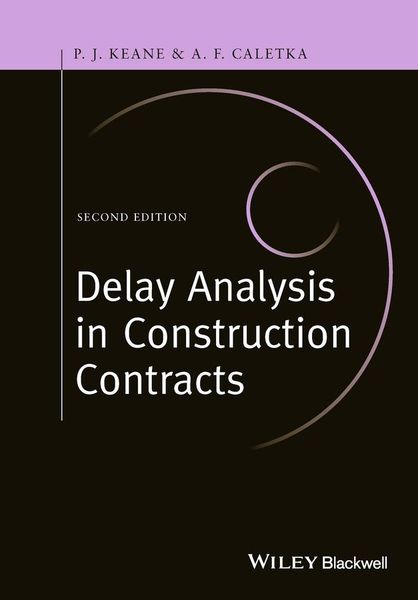
Delay Analysis in Construction Contracts
137,99 €
inkl. gesetzl. MwSt.,
Lieferung nach Hause
Beschreibung
Produktdetails
Einband
Gebundene Ausgabe
Erscheinungsdatum
12.06.2015
Verlag
WileySeitenzahl
288
Maße (L/B/H)
16,7/24,2/1,6 cm
Gewicht
482 g
Auflage
2. Auflage
Sprache
Englisch
ISBN
978-1-118-63117-1
The most significant unanticipated costs on many construction projects are the financial impacts associated with delay and disruption to the works. Assessing these, and establishing a causal link from each delay event to its effect, contractual liability and the damages experienced as a direct result of each event, can be difficult and complex.
This book is a practical guide to the process of delay analysis and includes an in-depth review of the primary methods of delay analysis, together with the assumptions that underlie the precise calculations required in any quantitative delay analysis. The techniques discussed can be used on projects of any size, under all forms of construction contract, both domestic and international.
The authors discuss not only delay analysis techniques, but also their appropriateness under given circumstances, demonstrating how combined approaches may be applied where necessary. They also consider problematic issues including 'who owns the float', concurrent delay, early completion programmes, and disruption. The book has been brought fully up to date, including references to the latest publications from the CIOB, AACEI and SCL, as well as current case law. Broad in scope, the book discusses the different delay analysis approaches likely to be encountered on national and international projects, and features practical worked examples and case studies demonstrating the techniques commonly used by experienced practitioners.
This is an invaluable resource to programmers and schedulers, delay analysts, contractors, architects, engineers and surveyors. It will also be of interest to clients' professional advisors managing extension of time or delay claims, as well as construction lawyers who require a better understanding of the underlying assumptions on which many quantitative delay analyses are based.
Reviews of First Edition
"John Keane and Anthony Caletka are pukka analysts in that tricky area of delays, programming and extension of time. I highly recommend their book Delay Analysis in Construction Contracts. Buy the book." (Building Magazine, February 2009)
"The book′s stated purpose is to provide a practical guide for those interested in schedule delay analysis. It provides a good in-depth review of the most common delay analysis techniques.... An excellent book, full of practical tips for the reader and very timely in its publication. It is well worth the cost and a good read for anyone involved in schedule delay analysis." (Cost Engineering, February 2009)
It achieves in spades its stated aim of being a practical guide for contractors, contract administrators, programmers and delay analysts, as well as construction lawyers who require a better understanding of the underlying assumptions on which many quantitative delay analyses are based. (Construction Law Journal, 2009)
Noch keine Bewertungen vorhanden
Verfassen Sie die erste Bewertung zu diesem Artikel
Helfen Sie anderen Kundinnen und Kunden durch Ihre Meinung.
Kurze Frage zu unserer Seite
Vielen Dank für dein Feedback
Wir nutzen dein Feedback, um unsere Produktseiten zu verbessern. Bitte habe Verständnis, dass wir dir keine Rückmeldung geben können. Falls du Kontakt mit uns aufnehmen möchtest, kannst du dich aber gerne an unseren Kund*innenservice wenden.
zum Kundenservice