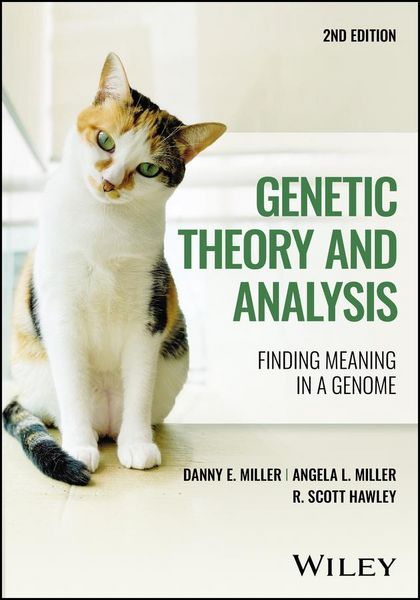
Produktbild: Genetic Theory and Analysis
- 27%

Genetic Theory and Analysis Finding Meaning in a Genome

27% sparen

69,99 € UVP 95,90 €

inkl. gesetzl. MwSt., Versandkostenfrei

Lieferung nach Hause

Beschreibung

Produktdetails

Einband

Taschenbuch

Erscheinungsdatum

29.08.2023

Verlag

John Wiley & Sons Inc

Seitenzahl

304

Maße (L/B/H)

25,3/17,6/1,7 cm

Gewicht

644 g

Auflage

2nd edition

Sprache

Englisch

ISBN

978-1-118-08692-6

Beschreibung

Produktdetails

Einband

Taschenbuch

Erscheinungsdatum

29.08.2023

Verlag

John Wiley & Sons Inc

Seitenzahl

304

Maße (L/B/H)

25,3/17,6/1,7 cm

Gewicht

644 g

Auflage

2nd edition

Sprache

Englisch

ISBN

978-1-118-08692-6

Herstelleradresse

Libri GmbH
Europaallee 1
36244 Bad Hersfeld
DE

Email: GPSR Kontakt

Noch keine Bewertungen vorhanden

Verfassen Sie die erste Bewertung zu diesem Artikel

Helfen Sie anderen Kundinnen und Kunden durch Ihre Meinung.

Kundinnen und Kunden meinen

Bewertungen (0)

Die Leseprobe wird geladen.
  • Produktbild: Genetic Theory and Analysis
  • Preface xi

    Introduction xiii

    1 Mutation 1

    1.1 Types of Mutations 1

    Muller's Classification of Mutants 2

    Nullomorphs 2

    Hypomorphs 4

    Hypermorphs 5

    Antimorphs 6

    Neomorphs 8

    Modern Mutant Terminology 10

    Loss-of-Function Mutants 10

    Dominant Mutants 10

    Gain-of-Function Mutants 11

    Separation-of-Function Mutants 11

    DNA-Level Terminology 11

    Base-Pair-Substitution Mutants 11

    Base-Pair Insertions or Deletions 12

    Chromosomal Aberrations 12

    1.2 Dominance and Recessivity 13

    The Cellular Meaning of Dominance 13

    The Cellular Meaning of Recessivity 15

    Difficulties in Applying the Terms Dominant and Recessive to Sex-Linked Mutants 16

    The Genetic Utility of Dominant and Recessive Mutants 17

    1.3 Summary 17

     References 17

    2 Mutant Hunts 20

    2.1 Why Look for New Mutants? 20

    Reason 1: To Identify Genes Required for a Specific Biological Process 21

    Reason 2: To Isolate more Mutations in a Specific Gene of Interest 31

    Reason 3: To Obtain Mutants for a Structure-Function Analysis 32

    Reason 4: To Isolate Mutations in a Gene So Far Identified only by Computational Approaches 32

    2.2 Mutagenesis and Mutational Mechanisms 32

    Method 1: Ionizing Radiation 33

    Method 2: Chemical Mutagens 33

    Alkylating Agents 34

    Crosslinking Agents 35

    Method 3: Transposons 35

    Identifying Where Your Transposon Landed 37

    Why not Always Screen With TEs? 40

    Method 4: Targeted Gene Disruption 40

    RNA Interference 40

    CRISPR/Cas9 41

    TALENs 42

    So Which Mutagen Should You Use? 43

    2.3 What Phenotype Should You Screen (or Select) for? 44

    2.4 Actually Getting Started 45

    Your Starting Material 45

    Pilot Screen 45

    What to Keep? 45

    How many Mutants is Enough? 46

    Estimating the Number of Genes not Represented by Mutants in Your New Collection 46

    2.5 Summary 48

     References 48

    3 Complementation 51

    3.1 The Essence of the Complementation Test 51

    3.2 Rules for Using the Complementation Test 55

    The Complementation Test Can be Done Only When Both Mutants are Fully Recessive 55

    The Complementation Test Does Not Require that the Two Mutants Have Exactly the Same Phenotype 56

    The Phenotype of a Compound Heterozygote Can be More Extreme than that of Either Homozygote 56

    3.3 How the Complementation Test Might Lie to You 57

    Two Mutations in the Same Gene Complement Each Other 57

    A Mutation in One Gene Silences Expression of a Nearby Gene 57

    Mutations in Regulatory Elements 59

    3.4 Second-Site Noncomplementation (Nonallelic Noncomplementation) 59

    Type 1 SSNC (PoisonousInteractions): The Interaction is Allele Specific at Both Loci 60

    An Example of Type 1 SSNC Involving the Alpha- and Beta-Tubulin Genes in Yeast 60

    An Example of Type 1 SSNC Involving the Actin Genes in Yeast 62

    Type 2 SSNC (Sequestration): The Interaction is Allele Specific at One Locus 66

    An Example of Type 2 SSNC Involving the Tubulin Genes in Drosophila 66

    An Example of Type 2 SSNC in Drosophila that Does Not Involve the Tubulin Genes 69

    An Example of Type 2 SSNC in the Nematode Caenorhabditis elegans 71

    Type 3 SSNC (Combined Haploinsufficiency): The Interaction is Allele-Independent at Both Loci 72

    An Example of Type 3 SSNC Involving Two Motor Protein Genes in Flies 72

    Summary of SSNC in Model Organisms 72

    SSNC in Humans (Digenic Inheritance) 73

    Pushing the Limits: Third-Site Noncomplementation 74

    3.5 An Extension of SSNC: Dominant Enhancers 74

    A Successful Screen for Dominant Enhancers 75

    3.6 Summary 76

     References 77

    4 Meiotic Recombination 81

    4.1 An Introduction to Meiosis 81

    A Cytological Description of Meiosis 88

    A More Detailed Description of Meiotic Prophase 89

    4.2 Crossing Over and Chiasmata 92

    4.3 The Classical Analysis of Recombination 93

    4.4 Measuring the Frequency of Recombination 96

    The Curious Relationship Between the Frequency of Recombination and Chiasma Frequency 97

    Map Lengths and Recombination Frequency 97

    The Mapping Function 99

    Tetrad Analysis 100

    Statistical Estimation of Recombination Frequencies 101

    Two-Point Linkage Analysis 101

    What Constitutes Statistically Significant Evidence for Linkage? 104

    An Example of LOD Score Analysis 105

    Multipoint Linkage Analysis 105

    Local Mapping via Haplotype Analysis 106

    The Endgame 108

    The Actual Distribution of Exchange Events 109

    The Centromere Effect 110

    The Effects of Heterozygosity for Aberration Breakpoints on Recombination 110

    Practicalities of Mapping 110

    4.5 The Mechanism of Recombination 111

    Gene Conversion 111

    Early Models of Recombination 112

    The Holliday Model 112

    The Meselson-Radding Model 114

    The Currently Accepted Mechanism of Recombination: The Double-Strand Break Repair Model 114

    Class I Versus Class II Recombination Events 116

    4.6 Summary 117

    References 118

    5 Identifying Homologous Genes 126

    5.1 Homology 126

    Orthologs 127

    Paralogs 127

    Xenologs 128

    5.2 Identifying Sequence Homology 128

    Nucleotide-Nucleotide BLAST (blastn) 129

    An Example Using blastn 129

    Translated Nucleotide-Protein BLAST (blastx) 131

    An Example Using blastx 131

    Protein-Protein BLAST (blastp) 132

    An Example Using blastp 132

    Translated BLASTx (tblastx) and Translated BLASTn (tblastn) 133

    5.3 How Similar is Similar? 133

    5.4 Summary 134

     References 134

    6 Suppression 136

    6.1 Intragenic Suppression 137

    Intragenic Suppression of Loss-of-Function Mutations 137

    Intragenic Suppression of a Frameshift Mutation by the Addition of a Second, Compensatory Frameshift Mutation 138

    Intragenic Suppression of Missense Mutations by the Addition of a Second and Compensatory Missense Mutation 140

    Intragenic Suppression of Antimorphic Mutations that Produce a Poisonous Protein 141

    6.2 Extragenic Suppression 141

    6.3 Transcriptional Suppression 141

    Suppression at the Level of Gene Expression 142

    A CRISPR Screen for Suppression of Inhibitor Resistance in Melanoma 142

    Suppression of Transposon-Insertion Mutants by Altering the Control of mRNA Processing 143

    Suppression of Nonsense Mutants by Messenger Stabilization 143

    6.4 Translational Suppression 144

    tRNA-Mediated Nonsense Suppression 144

    The Numerical and Functional Redundancy of tRNA Genes Allows Suppressor Mutations to be Viable 146

    tRNA-Mediated Frameshift Suppression 146

    6.5 Suppression by Post-Translational Modification 147

    6.6 Conformational Suppression: Suppression as a Result of Protein-Protein Interaction 147

    Searching for Suppressors that Act by Protein-Protein Interaction in Eukaryotes 148

    Actin and Fimbrin in Yeast 148

    Mediator Proteins and RNA Polymerase II in Yeast 150

    "Lock-and-key" Conformational Suppression 152

    Suppression of a Flagellar Motor Mutant in E. coli 152

    Suppression of a Mutant Transporter Gene in C. elegans¿152

    Suppression of a Telomerase Mutant in Humans 153

    6.7 Bypass Suppression: Suppression Without Physical Interaction 154

    "Push me, Pull You" Bypass Suppression 155

    Multicopy Bypass Suppression 156

    6.8 Suppression of Dominant Mutations 157

    6.9 Designing Your Own Screen for Suppressor Mutations 157

    6.10 Summary 158

     References 158

    7 Epistasis Analysis 163

    7.1 Ordering Gene Function in Pathways 163

    Biosynthetic Pathways 164

    Nonbiosynthetic Pathways 165

    7.2 Dissection of Regulatory Hierarchies 167

    Epistasis Analysis Using Mutants with Opposite Effects on the Phenotype 167

    Hierarchies for Sex Determination in Drosophilä169

    Epistasis Analysis Using Mutants with the Same or Similar Effects on the Final Phenotype 170

    Using Opposite-Acting Conditional Mutants to Order Gene Function by Reciprocal Shift Experiments 170

    Using a Drug or Agent that Stops the Pathway at a Given Point 170

    Exploiting Subtle Phenotypic Differences Exhibited by Mutants that Affect the Same Signal State 172

    7.3 How Might an Epistasis Experiment Mislead You? 172

    7.4 Summary 173

     References 173

    8 Mosaic Analysis 175

    8.1 Tissue Transplantation 176

    Early Tissue Transplantation in Drosophilä176

    Tissue Transplantation in Zebrafish 177

    8.2 Mitotic Chromosome Loss 178

    Loss of the Unstable Ring-X Chromosome 179

    Other Mechanisms of Mitotic Chromosome Loss 179

    Mosaics Derived from Sex Chromosome Loss in Humans and Mice (Turner Syndrome) 180

    8.3 Mitotic Recombination 181

    Gene Knockout Using the FLP/FRT or Cre-Lox Systems 182

    8.4 Tissue-Specific Gene Expression 184

    Gene Knockdown Using RNAi 184

    Tissue-Specific Gene Editing Using CRISPR/Cas9 185

    8.5 Summary 187

    References 188

    9 Meiotic Chromosome Segregation 191

    9.1 Types and Consequences of Failed Segregation 192

    9.2 The Origin of Spontaneous Nondisjunction 193

    MI Exceptions 194

    MII Exceptions 194

    9.3 The Centromere 195

    The Isolation and Analysis of the Saccharomyces cerevisiae Centromere 195

    The Isolation and Analysis of the Drosophila Centromere 198

    The Concept of the Epigenetic Centromere in Drosophila and Humans 200

    Holocentric Chromosomes 201

    9.4 Chromosome Segregation Mechanisms 202

    Chiasmate Chromosome Segregation 202

    Segregation Without Chiasmata (Achiasmate Chromosome Segregation) 203

    Achiasmate Segregation in Drosophila Males 203

    Achiasmate Segregation in D. melanogaster Females 204

    Achiasmate Segregation in S. cerevisiae¿205

    Achiasmate Segregation in S. pombe¿207

    Achiasmate Segregation in Silkworm Females 207

    9.5 Meiotic Drive 207

    Meiotic Drive Via Spore Killing 207

    An Example in Schizosaccharomyces pombe¿207

    An Example in D. melanogaster¿208

    Meiotic Drive Via Directed Segregation 208

    9.6 Summary 210

    References 210

    Appendix A: Model Organisms 215

    Appendix B: Genetic Fine-Structure Analysis 228

    Appendix C: Tetrad Analysis 250

    Glossary 262

    Index 275