Beschreibung
Produktdetails
Einband
Gebundene Ausgabe
Erscheinungsdatum
19.08.2013
Verlag
John Wiley & SonsSeitenzahl
128
Maße (L/B/H)
23,4/15,7/1,8 cm
Gewicht
376 g
Auflage
1. Auflage
Sprache
Englisch
ISBN
978-1-84821-532-0
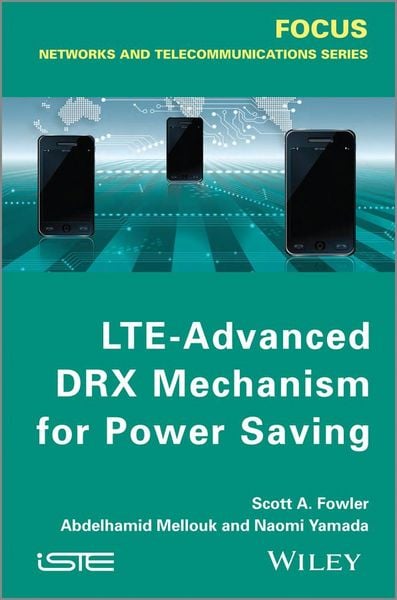
Resource allocation and power optimization is a new challenge in multimedia services in cellular communication systems. To provide a better end-user experience, the fourth generation (4G) standard Long Term Evolution/Long Term Evolution-Advanced (LTE/LTE-Advanced) has been developed for high-bandwidth mobile access to accommodate today's data-heavy applications. LTE/LTE-Advanced has adopted discontinuous reception (DRX) to extend the user equipment's battery lifetime, thereby further supporting various services and large amounts of data transmissions. By introducing the basics of mathematical analysis and performance evaluation of power-saving mechanisms in 3rd generation partnership project (3GPP) LTE and LTE-Advanced networks, the authors of this book aim to describe novel algorithms which could have better performance capabilities than previous methods. Chapter 1 gives the basic theory description of the 3GPP LTE network and 3GPP DRX power saving mechanism, empirical measurements of LTE network traffic and an overview of the basic LTE DRX model in the field of power saving techniques. Chapter 2 provides steps for deriving a 2-state analytical model up to a 4-state DRX model. The third and final chapter summarizes alternative methods for the implementation of LTE DRX. Contents 1. Basic Theory. 2. Analytical Semi-Markov Power-Saving Models. 3. Other Approaches for LTE Power Saving. About the Authors Scott A. Fowler is Associate Professor at Linköping University, Sweden, working with the Mobile Telecommunication (MT) group. He has served on several IEEE conferences/workshops as TPC to Chair, including Special Interest Groups coordinator for IEEE Communications Software (CommSoft) Technical Committee since 2012. His research interests include Quality of Service (QoS) support over heterogeneous networks, computer networks (wired, wireless), energy management, mobile computing, pervasive/ubiquitous, performance evaluation of networks and security. Abdelhamid Mellouk is Full Professor at the University of Paris-Est Créteil VdM (UPEC, ex. Paris 12), Networks & Telecommunications (N&T) Department (IUT C/V) and LiSSi Laboratory in France. He is a founder of the Network Control Research activity with extensive international academic and industrial collaborations. His general area of research is in adaptive real-time control for high-speed new generation dynamic wired/wireless networking in order to maintain acceptable Quality of Service/Experience for added-value services. Naomi Yamada is a research associate at Linköping University, Sweden.
Noch keine Bewertungen vorhanden
Verfassen Sie die erste Bewertung zu diesem Artikel
Helfen Sie anderen Kundinnen und Kunden durch Ihre Meinung.
Kurze Frage zu unserer Seite
Vielen Dank für dein Feedback
Wir nutzen dein Feedback, um unsere Produktseiten zu verbessern. Bitte habe Verständnis, dass wir dir keine Rückmeldung geben können. Falls du Kontakt mit uns aufnehmen möchtest, kannst du dich aber gerne an unseren Kund*innenservice wenden.
zum Kundenservice