Gutscheinbedingungen

**Gültig bis 10.06.2026 / Gültig für gebrauchte Bücher / Mindestbestellwert 20,00 € / Einzelne Artikel können ausgeschlossen sein / Online auf www.bücher.de.de / Nicht kombinierbar mit anderen Gutscheinen oder Preisaktionen / Nur einmal pro Einkauf einlösbar / Gutschein wird auf max. 500€ Bestellwert angerechnet / Keine Barauszahlung / Nicht gültig für Versandkosten und Services

Produktbild: Life During Wartime

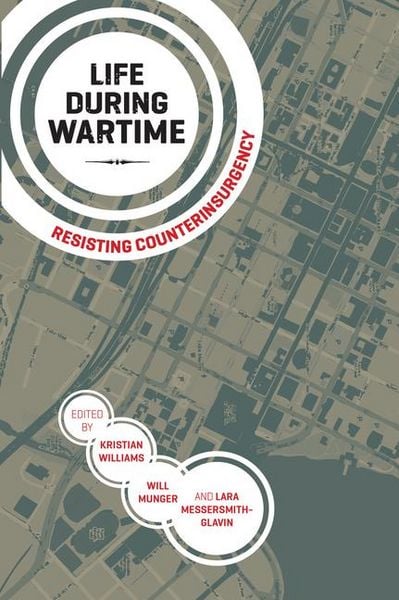
Life During Wartime Resisting Counterinsurgency

18,99 €

inkl. gesetzl. MwSt., Versandkostenfrei

Lieferung nach Hause

Beschreibung

Produktdetails

Einband

Taschenbuch

Erscheinungsdatum

27.08.2013

Herausgeber

Kristian Williams + weitere

Verlag

Turnaround

Maße (L/B/H)

22,8/15,4/3,5 cm

Gewicht

687 g

Sprache

Englisch

ISBN

978-1-84935-130-0

Beschreibung

Portrait

Kristian Williams is the author of Our Enemies in Blue: Police and Power in America, American Methods: Torture and the Logic of Domination, Confrontations: Selected Journalism, and Hurt: Notes on Torture in a Modern Democracy. He has written about counterinsurgency and political repression for Counterpunch, Clamor, In These Times, Z Magazine, International Socialist Review, Labor Notes, Social Anarchism, the Earth First! Journal, Eat the State, PDXS, Dollars and Sense, and (perhaps oddly) The Comics Journal -- as well as in the introduction to the 2007 edition of The New State Repression.

Lara Messersmith-Glavin is the founder and managing editor of the non-fiction journal Alltopia. Her own writing has appeared in Alltopia, Perspectives on Anarchist Theory, the Spoon Cafe Journal, and MaLa, the premier English-language literary and nonfiction journal of China. Her accounts of culture shock, education, the military response to a Tibetan uprising, and the Sichuan earthquake earned her the 2008 Chinalyst.com award for Best Travel Writing. Lara is on the board of directors for the Institute for Anarchist Studies, which seeks to further anarchist thought, solidarity, and practice by funding radical writers through grants, and providing opportunities for publication through Perspectives (now both online and in print form) and the Anarchist Interventions book series (produced in collaboration with AK Press).

Will Munger is a member of the Life During Wartime editorial collective and also organized the 2011 Counter Counterinsurgency Convergence.

Produktdetails

Einband

Taschenbuch

Erscheinungsdatum

27.08.2013

Herausgeber

Verlag

Turnaround

Maße (L/B/H)

22,8/15,4/3,5 cm

Gewicht

687 g

Sprache

Englisch

ISBN

978-1-84935-130-0

Herstelleradresse

Libri GmbH
Europaallee 1
36244 Bad Hersfeld
DE

Email: gpsr@libri.de

Kundinnen und Kunden meinen

0 Bewertungen

Informationen zu Bewertungen

Zur Abgabe einer Bewertung ist eine Anmeldung im Konto notwendig. Die Authentizität der Bewertungen wird von uns nicht überprüft. Wir behalten uns vor, Bewertungstexte, die unseren Richtlinien widersprechen, entsprechend zu kürzen oder zu löschen.

Die Bewertungen sind nach Format, Anzahl Sterne und Datum sortiert.

Verfassen Sie die erste Bewertung zu diesem Artikel

Helfen Sie anderen Kund*innen durch Ihre Meinung

Kundinnen und Kunden meinen

0 Bewertungen filtern

Die Leseprobe wird geladen.
  • Produktbild: Life During Wartime
  • Part One: The Politics of Repression

    COINTELPRO to COIN
    Claude Marks, interviewed by Kristian Williams and Walidah Imarisha
    Marks discusses the continuities and the developments in repression from the Cointelpro era to today.

    Repression, Civil Liberties, Right-Wingers, and Liberals
    by Chip Berlet
    Berlet contrasts the state's approach to addressing challenges from the right with its response to opposition from the left. He then considers the political implications for left movements when the state attacks the right.

    Canada's Counterinsurgency Strategy Against Indigenous Peoples
    by Zig Zag
    Zig Zag shows how its history of colonialism has shaped the Canadian government's strategy of repression.

    Part Two: Counterinsurgency and Domestic Policing

    The Other Side of the COIN: Counterinsurgency and Community Policing
    by Kristian Williams
    Williams describes the historical transfer of counterinsurgency theory, strategy, and technique, from the U.S. military to the domestic police and back again. He ends by pointing to the implications for social movements as they encounter and resist repression.

    Social War in the Salad Bowl: Counterinsurgency in Salinas
    by Will Munger
    Will Munger presents a contemporary case study of police counterinsurgency, drawn from his thesis research on the collaboration between the Naval Postgraduate School and the Salinas Police Department.

    Gang Injunctions and the Control of Neighborhood Life
    by Rachel Herzig
    This chapter considers the history of gang injunctions and the effects of their implementation in communities of color. It then details the campaign against the introduction of injunctions in Oakland, California.

    Part Three: Security Culture: Recognizing and Subverting Repression

    Recognizing Informants and Avoiding Entrapment
    by Jenny Esquivel
    Esquivel recounts documented cases of infiltration and entrapment, drawing lessons for social movements.

    Who needs the NSA when we have social media?
    by Evan Tucker
    Tucker explains how the state and private businesses use of social media to monitor, track, and disrupt their opponents.

    Data Security
    by Josef Schneider
    This short paper explains the basic principles of computer security and suggests some simple ways to diminish its effectiveness. 

    Part Four: Political Offenses and Legal Defenses: Case Studies

    The Curious Case of Conor Cash
    by Conor Cash and Kevin Van Meter
    Conor Cash is one of the only "Green Scare" defendants who is not in jail and there are a number of important reasons for this beyond his innocence. Cash and Van Meter provide a chronology of the case, describe the surrounding environment, and detail the support strategy. They identify lessons for current political organizing in general and political prisoner support work in particular. 

    Repression to Resistance: How Fighting State Repression Can Make Us Stronger Layne Mullett, Sarah Small, and Luce Guillen-Givins
    This paper is an exploration of how fighting government repression and supporting political prisoners can and does open doors for us to advance and connect our movements while we support our comrades. The authors discuss how their own experience organizing around the RNC-8 case led to alliances with other people fighting repression, in particular the Puerto Rican independence movement's struggle to free their political prisoners.

    Part Five: Political Prisoners, Politicizing Prisons

    White Supremacy and the Prison Crisis: Connecting the Dots
    by Beriah Empie
    This paper offers a framework for tackling white supremacy within radical currents. It briefly covers the history of white supremacy and explains the ways the prison industrial complex is central to the maintenance of a racist culture.

    Political Prisoners and Prisoner Support
    by Jenny Esquivel
    This chapter outlines both the political necessity and the practical challenges of organizing in support of political prisoners, tracing the steps of a campaign from arrest to trial to long-term incarceration and eventual release.

    On Memory and Resistance
    by Elaine Brown
    This excerpt from Brown's keynote speech connects the history of the black freedom movement with her work in supporting the 2010 Georgia prison strike, the largest prison strike in US history.

    Part Six: Social Science and Social War

    Geography, Counter-insurgency and the "G-Bomb": the Case of México Indígena
    by Geoffrey Boyce and Conor Cash
    In 2005, geographers from the University of Kansas began a "collaborative mapping" project with indigenous peoples in Oaxaca, Mexico. Dubbed "Mexica Indigena", this project was presented as a means of defending traditional land claims. Instead, Mexica Indigena was the pilot for a Foreign Military Studies Office program meant to augment counterinsurgency efforts in the Dominican Republic, Haiti, Colombia, and elsewhere. This paper explores the implications for military/academic collaboration, professional ethics, and the colonial legacy of geography and anthropology.

    Targeting Translation: Counterinsurgency and the Weaponization of Language
    by Vicente L. Rafael
    Rafael focuses on two prevalent tropes in the discourse of counterinsurgency: the "weaponization" and "targeting" of foreign languages. How is the counterinsurgent notion of languages as "weapons" and "targets" linked to the strategic imperative of deploying translation as a means for colonization? What are the limits and contradictions to the targeting of speech?

    Part Seven: Counter-COIN

    Countering Counterinsurgency: Strategies, Situations and Tactics
    by John Kelly
    Kelly argues that counterinsurgency doctrines preemptively define local situations in transvalued, global terms. He examines the antidemocratic roots of the "insurgency" concept, and then tracks the fall, rise, and current status of "insurgency" and "counterinsurgency" metaphors in military theory and practice. Citing examples from his own research in Thailand, Burma, and Northeast India, he outlines the stark consequences of such transvaluation.

    Counter-Recruitment as Counter-Counterinsurgency
    by Mario Hardy
    Hardy places opposition to military recruitment within a framework of broader resistance.

    Just Us: Transforming Justice by Building Communities
    by Alexis Pauline Gumbs
    Gumbs examines crime as a problem for resistance movements, both in terms of its corrosive effects on solidarity and as a source of legitimacy for the state. She then describes some of the ways social movements have addressed this problem, and the politics implicit in interventions outside of the existing justice system.

    Capture/Rupture: Insurrectionary Counter to Counterinsurgency
    by David Cunningham
    Cunningham argues that empire responds to all social conflict with methods of counterinsurgency; and he advocates countering the state with the insurrectionary potentialities that exist in our day-to-day struggles.