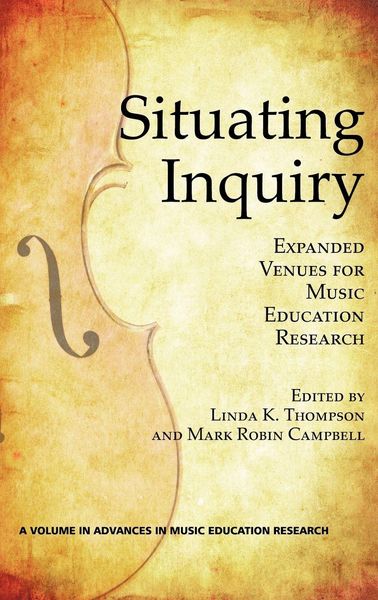
Situating Inquiry Expanded Venues for Music Education Research (Hc)
-
- Hardcover ausgewählt
- Taschenbuch
- eBook
-
Sprache:Englisch
137,99 €
inkl. gesetzl. MwSt.,
Beschreibung
Produktdetails
Einband
Gebundene Ausgabe
Erscheinungsdatum
07.09.2012
Herausgeber
Linda K. Thompson + weitereVerlag
Information Age PublishingSeitenzahl
258
Maße (L/B/H)
24/16,1/1,9 cm
Gewicht
555 g
Sprache
Englisch
ISBN
978-1-61735-896-8
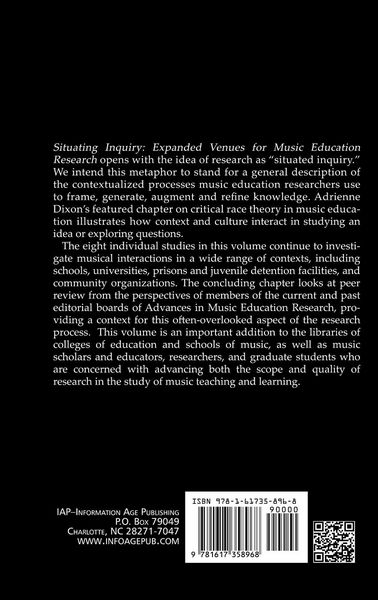
This volume of Advances in Music Education Research with the idea of research as "situated inquiry." We intend this metaphor to stand for a general description of the contextualized processes music education researchers use to frame, generate, augment and refine knowledge. The works in this volume illustrate the many ways in which knowledge has been constructed out of multiple approaches to studying an idea or exploring questions. All seek to expand our knowledge of music education in some form. How we go about engaging in knowledge construction, and what we learn from the different processes involved, is a function of the activities, contexts, and cultures in which our work is "situated." Both knowledge and action is "located," that is, research is placed, positioned or embedded (Lave & Wenger, 1990). Each study illustrates these ideas: All are informed by different theoretical frameworks, use different pathways to explore problems of interest and concern, and have something important to say to different constituencies or stakeholders. All, however, are the result of perceived phenomena or human interpretations of a context. Situated inquiry is neither a quantitative nor qualitative approach to research, nor is it a "mixed-methods" approach. Rather, situated inquiry is a function of the beliefs and behaviors of the individuals involved in it. It is also a function (and outcome) of the individuals who seek to join a community of practitioners who practice and engage in research. Although the authors in this volume identify with or have self-selected to employ specific kinds of approaches, they exemplify their communities of practices by the very discourses and structures of their reports. Active perception, however, remains central to their inquiry and to the way they frame, generate, augment and refine knowledge.
Noch keine Bewertungen vorhanden
Verfassen Sie die erste Bewertung zu diesem Artikel
Helfen Sie anderen Kundinnen und Kunden durch Ihre Meinung.
Kurze Frage zu unserer Seite
Vielen Dank für dein Feedback
Wir nutzen dein Feedback, um unsere Produktseiten zu verbessern. Bitte habe Verständnis, dass wir dir keine Rückmeldung geben können. Falls du Kontakt mit uns aufnehmen möchtest, kannst du dich aber gerne an unseren Kund*innenservice wenden.
zum Kundenservice