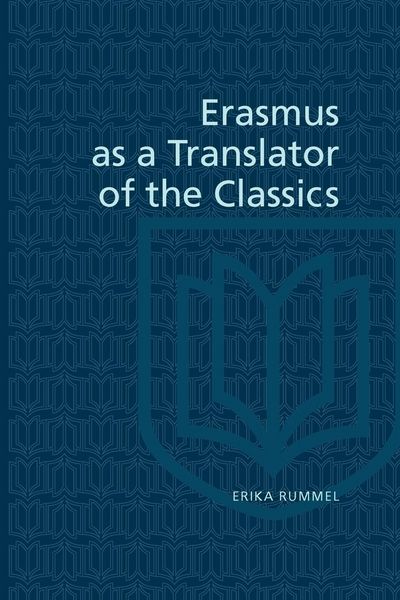

Erasmus as a Translator of the Classics
-
- Englisch ausgewählt
39,99 €
inkl. gesetzl. MwSt.,
Lieferung nach Hause
Beschreibung
Produktdetails
Einband
Taschenbuch
Erscheinungsdatum
15.12.1985
Verlag
University of Toronto PressSeitenzahl
194
Maße (L/B/H)
22,8/15,1/1,7 cm
Gewicht
279 g
Sprache
Englisch
ISBN
978-1-4426-1514-4
This first full-length study of Erasmus’ translations of classical literature examines his approach to translation and, more generally, his role as a transmitter of the classics. It traces in chronological order the progress of his Greek studies and the publication history of his translations from Greek into Latin; these included selections from the works of Libanius, Euripides, Plutarch, Lucian, Galen, Isocrates and Xenophon. It also illustrates Erasmus’ methods with appropriate examples from his own texts and from those of his predecessors and contemporaries. In so doing it provides an overview of the state of Greek literature in the Renaissance.
Erasmus shifted from literal translation to a more liberal approach – a change in attitude that was accompanied by a redefinition of his role as translator. In his early work he had pursued private goals, regarding his versions from secular authors as private pieces for his magnum opus, the New Testament. In later years his approach became more reader-oriented. He saw his work in terms of a service to scholarship – making Greek literature accessible to Latin readers and acting as their guide to classical thought. He was concerned not only with the mechanics of conveying the factual contents and literary qualities of the original, but also with the applicability of its moral content to Christian philosophy.
This book includes a chapter on Erasmus’ New Testament version; by allowing a fuller evaluation of Erasmus’ contribution to philology, this subject adds an important dimension to the book. Erasmus’ translations of Greek texts reflect two concerns that dominated his life. As an educator he wanted to see classical philology firmly established in the curriculum of schools; as a Christian humanist he wanted to convince biblical scholars that it was an indispensable tool of their profession.
Noch keine Bewertungen vorhanden
Verfassen Sie die erste Bewertung zu diesem Artikel
Helfen Sie anderen Kundinnen und Kunden durch Ihre Meinung.
Kurze Frage zu unserer Seite
Vielen Dank für dein Feedback
Wir nutzen dein Feedback, um unsere Produktseiten zu verbessern. Bitte habe Verständnis, dass wir dir keine Rückmeldung geben können. Falls du Kontakt mit uns aufnehmen möchtest, kannst du dich aber gerne an unseren Kund*innenservice wenden.
zum Kundenservice