Gutscheinbedingungen

**Gültig vom 20.07.2026 bis 22.07.2026 | Gültig für nicht preisgebundene fremdsprachige Bücher | Einzelne Artikel können ausgeschlossen sein | Nicht kombinierbar mit anderen Gutscheinen oder Preisaktionen | Nur einmal pro Einkauf einlösbar | Gutschein wird auf max. 500€ Bestellwert angerechnet | Keine Barauszahlung | Nicht gültig für Versandkosten und Services

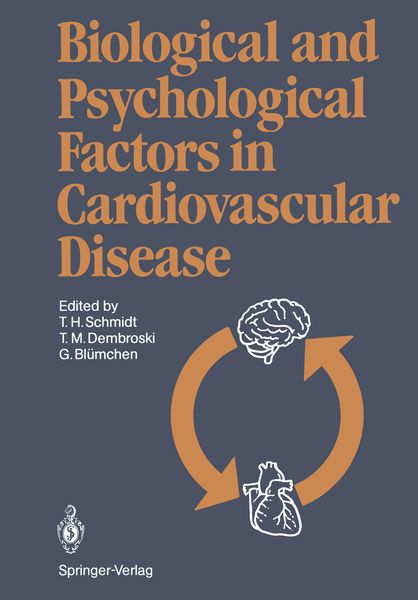
  • Produktbild: Biological and Psychological Factors in Cardiovascular Disease
  • Produktbild: Biological and Psychological Factors in Cardiovascular Disease

Biological and Psychological Factors in Cardiovascular Disease

97,99 €

inkl. gesetzl. MwSt., Versandkostenfrei

Lieferung nach Hause

Beschreibung

Produktdetails

Einband

Taschenbuch

Erscheinungsdatum

17.11.2011

Herausgeber

Thomas H. Schmidt + weitere

Verlag

Springer Berlin

Seitenzahl

628

Maße (L/B/H)

24,4/17/3,5 cm

Gewicht

1099 g

Auflage

Softcover reprint of the original 1st ed. 1986

Sprache

Englisch

ISBN

978-3-642-71236-4

Beschreibung

Produktdetails

Einband

Taschenbuch

Erscheinungsdatum

17.11.2011

Herausgeber

Verlag

Springer Berlin

Seitenzahl

628

Maße (L/B/H)

24,4/17/3,5 cm

Gewicht

1099 g

Auflage

Softcover reprint of the original 1st ed. 1986

Sprache

Englisch

ISBN

978-3-642-71236-4

Herstelleradresse

Springer-Verlag GmbH
Tiergartenstr. 17
69121 Heidelberg
DE

Email: GPSR Kontakt

Noch keine Bewertungen vorhanden

Verfassen Sie die erste Bewertung zu diesem Artikel

Helfen Sie anderen Kundinnen und Kunden durch Ihre Meinung.

Kundinnen und Kunden meinen

Bewertungen (0)

  • Produktbild: Biological and Psychological Factors in Cardiovascular Disease
  • Produktbild: Biological and Psychological Factors in Cardiovascular Disease
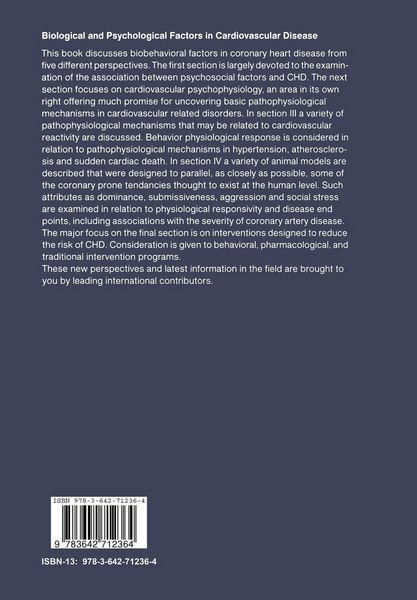
  • From Clinical Experience to Tested Hypothesis: The Role of Psychosocial Factors in Coronary Heart Disease.- I. Psychosocial Factors and CHD.- Current and Past History of Type A Behavior Pattern.- Type A Behavior and Risk of Coronary Heart Disease in the Multiple Risk Factor Intervention Trial.- The Predictive Power of the A/B Typology in Holland: Results of a 9.5-Year Follow-Up Study.- Type A and Other Psychosocial Factors in Relation to Coronary Heart Disease.- Is Neuroticism a Risk Factor for CAD? Is Type A a Measure of Neuroticism?.- Type A: Behavior or Trait?.- Type A as a Coping Career — Toward a Conceptual and Methodological Redefinition.- The Importance of the Type A Subcomponent Hostility for Myocardial Infarction at Young Age.- Hostility and Conflict as Antecedents of Arousal and Disease.- Psychological Stress and Sudden Cardiac Death.- II. Cardiovascular Psychophysiology.- Behavioral Correlates of Cardiovascular Reactivity in School Children.- Familial Aspects of the Type A Behavior Pattern and Physiologic Reactivity to Stress.- Stress and Cigarette Smoking: Implications for Cardiovascular Risk.- Anger, Aerobics and Autonomic Reactivity.- Psychophysiological Responses to Mental Stress in Type A and Type B Subjects With and Without a Family History of Hypertension.- Vigilance Performance and Psychophysiologic Reactions of Type A and Vitally Exhausted Persons.- Psychophysiologic Testing of Cardiovascular Responses to Physiologic and Psychological Challenge: Analysis of Intraindividual Stability.- Psychobiological Markers of Stress in Surgeons and Anaesthetists.- New Dimensions in Studying Sympathetic Nervous System Responses to Stressors.- The Measurement of Continuous Finger Arterial Pressure Noninvasively in Stationary Subjects.- III. Pathophysiology.- Neural Mechanism in Human Cardiovascular Regulation.- Behavioral Influences on Neuroendocrines and Insulin Sensitivity as Precursors of Coronary Heart Disease.- Some Working Hypotheses on the Significance of Behaviorally Evoked Cardiovascular Reactivity to Pathophysiology.- Behavioral Aspects of Cardiovascular Reactivity in Essential Hypertension.- The Prognostic Significance of Exercise Induced Hypertension in Heart Infarction Patients.- IV. Animal Models.- Atherosclerosis, Social Dominance and Cardiovascular Reactivity.- Psychosocial Stress and Its Pathophysiological Effects in Tree Shrews (Tupaia belangeri).- Heart Rate of Tree Shrews and Its Persistent Modification by Social Contact.- Blood Pressure Regulation by Sodium Intake and Behavioral Stress.- Individual Differences in Blood Pressure Reactivity and Behavior of Male Rats.- A Peculiar Breathing Pattern and Consequent Blood Pressure Oscillation During Social Stress.- V. Prevention and Control.- Prevention Paradox in Coronary Heart Disease.- How Does Relaxation Training Reduce Blood Pressure in Primary Hypertension?.- Hypertension: Biobehavioral Influences and Their Implications for Treatment.- Biobehavioral Effects of Antihypertensive Monotherapy: Oxprenolol and Nitrendipine.- Type A, Social Context, and Adaptation to Serious Illness: A Longitudinal Investigation of the Role of the Family in Recovery from Myocardial Infarction.- Endurance Training and Its Importance in the Prevention of Degenerative Cardiovascular Diseases.