KI-Beratung Beta

Gutscheinbedingungen

**Gültig vom 23.11. bis 30.11.2026 | Gültig für nicht preisgebundene fremdsprachige Bücher | Einzelne Artikel können ausgeschlossen sein | Online auf www.bücher.de einlösbar | Click & Collect nur mit Online-Zahlung (Paypal/Kreditkarte) vorab | Nicht kombinierbar mit anderen Gutscheinen oder Preisaktionen | Nur einmal pro Einkauf einlösbar | Gutschein wird auf max. 500€ Bestellwert angerechnet | Keine Barauszahlung | Nicht gültig für Versandkosten und Services

  • Produktbild: Sieve Elements
  • Produktbild: Sieve Elements
- 10%

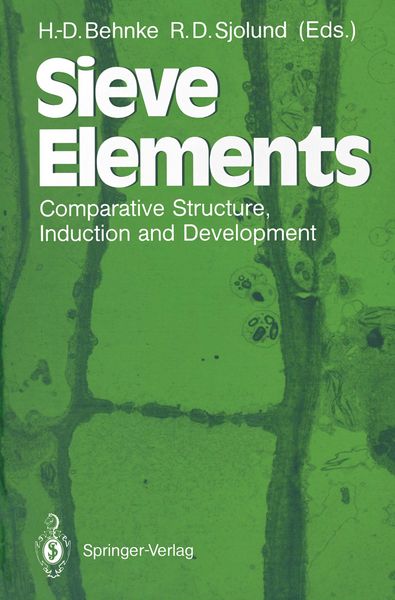
Sieve Elements Comparative Structure, Induction and Development

10% sparen

95,99 € UVP 106,99 €

inkl. gesetzl. MwSt., Versandkostenfrei


Beschreibung

As part of his Comparative Investigations of the Organization of the Trunk of the Native Forest Trees (Theodor Hartig 1837, Vergleichende Untersuchungen tiber die Organisation des Stammes der einheimischen Waldbaume. lahresberichte tiber die Fortschritte der Forstwissenschaften und forstlichen Naturkunde...

Beschreibung

As part of his Comparative Investigations of the Organization of the Trunk of the Native Forest Trees (Theodor Hartig 1837, Vergleichende Untersuchungen tiber die Organisation des Stammes der einheimischen Waldbaume. lahresberichte tiber die Fortschritte der Forstwissenschaften und forstlichen Naturkunde 1: 125-168) Hartig gives an anatomical description of the "composition and nature" of the then "completely uninvestigated elementary organs" of what he called the "sap skin" (Safthaut) of trees, a tissue for which Nageli later (1858) coined the term phloem. Within the "Safthaut" Hartig describes three cell types in detail, (1) "Siebfasern", (2) "Siebrohren", and (3) "keulenfOrmige Saftrohren" (club-shaped sap-tubes). While the description of the latter refers to laticifers in Euphorbia and resin ducts in Acer and Robinia. "Siebfasern" and "Siebrohren" comprise the sieve elements. A literal translation of the more significant parts of the description of these cell types demonstrates that his "Siebrohren" entirely correspond to what has later been defined as "sieve tubes" but that his "Siebfasern" are less well defined and in addition to what we call "sieve cells" also include small sieve tubes as well as spindle-shaped cells of cambium, phloem parenchyma and sclerenchyma. Both in his "Siebfasern" and "Siebrohren" Hartig describes sieve areas (his expression is "lense-shaped cavities") and sieve pores (Siebporen).

Produktdetails

Einband

Taschenbuch

Erscheinungsdatum

23.11.2011

Abbildungen

XIII, 305 p.

Herausgeber H.-D. Behnke + weitere

Produktdetails

Einband

Taschenbuch

Erscheinungsdatum

23.11.2011

Abbildungen

XIII, 305 p.

Herausgeber
Verlag Springer Berlin
Seitenzahl

305

Maße (L/B/H)

23,5/15,5/1,8 cm

Gewicht

487 g

Auflage

Softcover reprint of the original 1st ed. 1990

Sprache

Englisch

ISBN

978-3-642-74447-1

Herstelleradresse

Springer-Verlag GmbH
Tiergartenstr. 17
69121 Heidelberg
DE

Email: ProductSafety@springernature.com

Noch keine Bewertungen vorhanden

Verfassen Sie die erste Bewertung zu diesem Artikel

Helfen Sie anderen Kundinnen und Kunden durch Ihre Meinung.

Kundinnen und Kunden meinen

Bewertungen (0)

  • Produktbild: Sieve Elements
  • Produktbild: Sieve Elements
  • 1 Algae.- 1.1 Requirement for Medium-Distance and Long-Distance Transport in Algae.- 1.2 Medium-Distance Transport.- 1.3 Long-Distance Transport.- 1.4 Conducting Cells of Red Algae.- 1.5 Conducting Cells in Brown Algae.- 2 Mosses.- 2.1 Introduction.- 2.2 General Organization of Conducting Tissues in Mosses.- 2.3 Structure of Sieve Elements.- 2.4 Associated Parenchyma.- 3 Seedless Vascular Plants.- 3.1 Introduction.- 3.2 The Sieve-Element Protoplast.- 3.3 The Wall.- 3.4 The Sieve Areas.- 3.5 Parenchymatous Cells Associated with the Sieve Elements.- 3.6 Longevity of the Sieve Elements.- 3.7 Comments on Terminology.- 4 Conifers.- 4.1 Introduction.- 4.2 General Description.- 4.3 Development of the Sieve Cell.- 4.4 Strasburger Cells.- 5 Cycads and Gnetophytes.- 5.1 Introduction.- 5.2 Cycads.- 5.3 Gnetophytes.- 6 Dicotyledons.- 6.1 Introduction.- 6.2 The Sieve-Tube Member Protoplast.- 6.3 The Wall.- 6.4 The Sieve Plate.- 6.5 The Lateral Sieve Areas.- 6.6 Parenchymatous Cells Associated with Sieve-Tube Members.- 6.7 Longevity of Sieve-Tube Members.- 7 Monocotyledons.- 7.1 Introduction.- 7.2 Ontogeny.- 7.3 The Protoplast.- 7.4 Cell Wall.- 7.5 Thick-Walled Sieve Elements.- 7.6 Sieve Plates.- 8 Sieve Elements in Internodal and Nodal Anastomoses of the Monocotyledon Liana Dioscorea.- 8.1 Introduction.- 8.2 The Vascular Construction in the Aerial Stem of Dioscorea.- 8.3 The Specific Composition of Phloem Anastomoses.- 8.4 Ultrastructure of the Sieve Elements of Anastomoses.- 8.5 Parenchymatous Cells Associated with the Sieve Elements of Anastomoses.- 8.6 Some Physiological Implications of Nodal Anastomoses.- 9 Sieve Elements in Plant Tissue Cultures: Development, Freeze-Fracture, and Isolation.- 9.1 Introduction.- 9.2 Phloem Function in Vitro.- 9.3 Phloem Development in Callus Tissues.- 9.4 P-Protein, Callus Phloem and Wounding.- 9.5 Freeze-Fracture Studies Using Callus Sieve Elements.- 9.6 Sieve-Area Pores.- 9.7 The Sieve-Element Reticulum (SER).- 9.8 Isolation and Partial Purification of Callus Sieve Elements.- 9.9 Antibody Formation Against Callus Sieve Elements.- 10 Wound-Sieve Elements.- 10.1 Introduction.- 10.2 Tissue Changes During Wound-Phloem Development.- 10.3 Cytoplasm of Wound-Sieve Elements.- 10.4 Symplastic Connections of Wound-Sieve Elements.- 10.5 Companion Cells.- 10.6 Comparison Between Wound-and Bundle-Sieve Elements.- 11 Sieve Elements of Graft Unions.- 11.1 Introduction.- 11.2 Grafting Procedure.- 11.3 Histology and Cytology of the Graft Union.- 11.4 Function of Phloem Connections in Graft Unions.- 11.5 Questions Concerning the Mechanism of Sieve-Element Formation in Graft Unions.- 12 Sieve Elements in Haustoria of Parasitic Angiosperms.- 12.1 Introduction.- 12.2 Phloem in the Haustorium of Cuscuta.- 12.3 Development of Haustorial Sieve Elements.- 12.4 The Contact Hypha of Cuscuta.- 12.5 Phloem in the Haustoria of Different Parasitic Plants.- 12.6 Comparative Aspects.- 13 Phloem Proteins.- 13.1 Introduction.- 13.2 P-Protein.- 13.3 Other Phloem-Specific Proteins.- 13.4 Biochemistry of Phloem Proteins.- 14 Phloem Evolution: An Appraisal Based on the Fossil Record.- 14.1 Introduction.- 14.2 Phloem of Vascular Cryptogams.- 14.3 Gymnosperm Phloem.- 14.4 Conclusions — Phloem Phylogeny.