Beschreibung
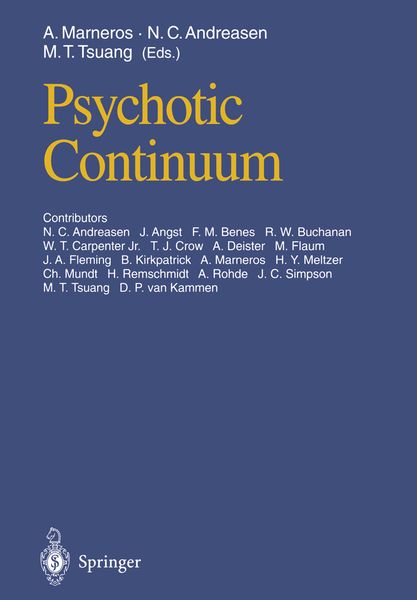
One of the most important questions of our previous common volumes about affective, schizoaffective, and schizophrenic disorders was the question of what connects and what separates psychotic disorders (Marneros and Tsuang, Schizo affective Psychoses, Springer-Verlag, 1986; Marneros and Tsuang Affective and Schizoaffective Disorders, Springer-Verlag, 1990; Marneros, Andreasen, and Tsuang, Negative and Positive Schizophrenia, Springer-Verlag 1993). The boundaries between various psychotic disorders are not always clearly defined. Some groups of psychotic disorders, such as schizoaffective disorders and all the other "atypical" psychoses, occupy a position between "typical" mental disorders, such as schizophrenia, and affective disorders. The question is: Do psychotic disorders form a continuum, or are they, despite their unclear boundaries, distinct entities? On what basis should we assume there is a continuity of psychotic disorders? Solely symptomatology? Or perhaps also a continuity in genetic predispositions? Or in biological, pharmacological, and other dimensions? Is the old idea of "Einheitspsychose" (unitary psychosis) really always wrong? The contributions contained in this new volume cannot provide a definite answer to the above questions. But they try to describe some relevant aspects of the problem, and to give some partial answers. Halle-Wittenberg, Germany A. MARNEROS Brockton, USA M. T. TSUANG Iowa, USA N. C. ANDREASEN October 1994 Contents Part I Psychotic Continuum: An Introduction A. MARNEROS . . . . . . . . . . . . . . . . . . . . . . . . . . . . . . . . . . . . . . . . . . . . . . . . . . . 3 Psychotic Continuum or Distinct Entities: Perspectives from Psychopathology CH. MUNDT. . . . . . . . . . . . . . . . . . . . . . . . . . . . . . . . . . . . . .. . . . . . . . . . . . . . 7 Psychotic Continuum Under Longitudinal Considerations A. MARNEROS, A. ROHDE, and A. DEISTER. . . . . . . . . . . . . . . . . . . . . . . . . . 17 Psychotic Continuum or Distinct Entities: Perspective from Psychopharmacology H. Y. MELTZER. . . . . . . . . . . . . . . . . . . . . . . . . . . . . . . . . . . . . . . . . . . . . . . . .
Portrait
Prof. Dr. med. Dr. phil. Helmut Remschmidt, geb. 1938 in Czernowitz/Rumänien, Studium der Medizin, Psychologie und Philosophie an den Universitäten Erlangen, Wien und Tübingen, ordentlicher Professor für Psychiatrie und Neurologie des Kindes- und Jugendalters an der Freien Universität Berlin von 1975-1980. Seit 1980 Direktor der Klinik für Kinder und Jugendpsychiatrie und -psychotherapie der Philipps-Universität Marburg. 1995-1999 Präsident der European Society for Child and Adolescent Psychiatry (ESCAP), von 1998-2004 Präsident der International Association for Child and Adolescent Psychiatry and Allied Professions (IACAPAP). Forschungsgebiete: Entwicklungspsychopathologie, psychiatrische Genetik, Essstörungen, Schizophrenieforschung, Therapie- und Evaluationsforschung. Neben anderen Auszeichnungen erhielt er 1999 den Max-Planck-Preis für internationale Kooperation.
Prof. Dr. med. Dr. h. c. Andreas Marneros, geb. 1946 auf Zypern, studierte Medizin in Thessaloniki. Seit 1973 an deutschen Universitäten tätig. 1980 Habilitation, 1983 Berufung zum Professor für Klinische Psychiatrie in Köln. 1985 Berufung auf den Lehrstuhl für Medizinische Psychologie und Allgemeine Psychopathologie an der Universität Bonn. Seit 1992 Lehrstuhlinhaber und Direktor der Klinik für Psychiatrie und Psychotherapie der Martin-Luther-Universität Halle-Wittenberg. Preisträger des Richard-von-Krafft-Ebing-Forschungspreises für originelle Forschung in forensischer Psychiatrie und des und des Emil-Kraepelin-Preises für seine Psychosenforschung. Gelistet in den Führenden Wissenschaftlern der deutschsprachigen Medizin".