• Produktbild: Equilibrium Problems and Variational Models
  • Produktbild: Equilibrium Problems and Variational Models
Band 68

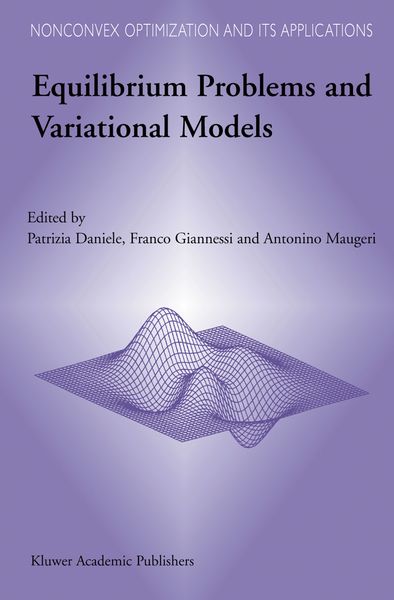
Equilibrium Problems and Variational Models

97,99 €

inkl. gesetzl. MwSt., Versandkostenfrei

Lieferung nach Hause

Beschreibung

Produktdetails

Einband

Taschenbuch

Erscheinungsdatum

17.09.2011

Herausgeber

P. Daniele + weitere

Verlag

Springer Us

Seitenzahl

446

Maße (L/B/H)

23,5/15,5/2,5 cm

Gewicht

692 g

Auflage

Softcover reprint of the original 1st ed. 2003

Sprache

Englisch

ISBN

978-1-4613-7955-3

Beschreibung

Produktdetails

Einband

Taschenbuch

Erscheinungsdatum

17.09.2011

Herausgeber

Verlag

Springer Us

Seitenzahl

446

Maße (L/B/H)

23,5/15,5/2,5 cm

Gewicht

692 g

Auflage

Softcover reprint of the original 1st ed. 2003

Sprache

Englisch

ISBN

978-1-4613-7955-3

Herstelleradresse

Springer-Verlag KG
Sachsenplatz 4-6
1201 Wien
AT

Email: ProductSafety@springernature.com

Kundinnen und Kunden meinen

0 Bewertungen

Informationen zu Bewertungen

Zur Abgabe einer Bewertung ist eine Anmeldung im Konto notwendig. Die Authentizität der Bewertungen wird von uns nicht überprüft. Wir behalten uns vor, Bewertungstexte, die unseren Richtlinien widersprechen, entsprechend zu kürzen oder zu löschen.

Die Bewertungen sind nach Format, Anzahl Sterne und Datum sortiert.

Verfassen Sie die erste Bewertung zu diesem Artikel

Helfen Sie anderen Kund*innen durch Ihre Meinung

Kundinnen und Kunden meinen

0 Bewertungen filtern

  • Produktbild: Equilibrium Problems and Variational Models
  • Produktbild: Equilibrium Problems and Variational Models
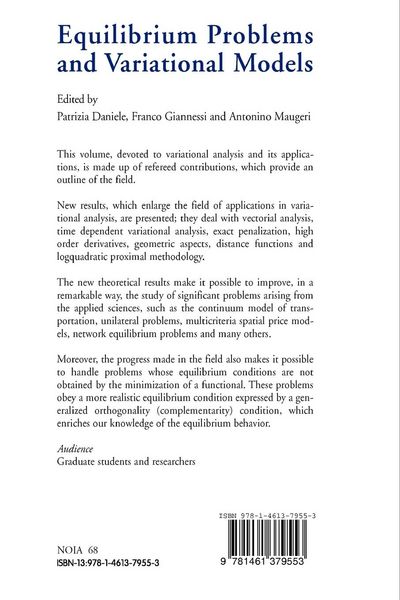
  • On Vector Quasi—Equilibrium Problems.- 1. Introduction.- 2. Preliminaries.- 3. Existence Results.- 4. Some Applications.- References.- The Log-Quadratic Proximal Methodology in Convex Optimization Algorithms and Variational Inequalities.- 1. Introduction.- 2. Lagrangians and Proximal Methods.- 2.1. The quadratic augmented Lagrangian.- 2.2. Proximal Minimization Algorithms.- 2.3. Entropic Proximal Methods and Modified Lagrangians.- 2.4. Difficulties with Entropic Proximal Methods.- 2.5. Toward Solutions to Difficulties.- 3. The Logarithmic-Quadratic Proximal Framework.- 3.1. The LQ-Function and its Conjugate: Basic Properties.- 3.2. The Logarithmic-Quadratic Proximal Minimization.- 4. The LQP in Action.- 4.1. Primal LQP for Variational Inequalities over Polyhedra.- 4.2. Lagrangian Methods for convex optimization and variational inequalities.- 4.3. Dual and Primal-Dual Decomposition schemes.- 4.4. Primal Decomposition: Block Gauss-Seidel Schemes for Linearly constrained Problems.- 4.5. Convex Feasibility Problems.- 4.6. Bundle Methods in Nonsmooth Optimization.- References.- The Continuum Model of Transportation Problem.- 1. Introduction.- 2. Calculus of the solution.- References.- The Economic Model for Demand—Supply Problems.- 1. Introduction.- 2. The first phase: formalization of the equilibrium.- 3. The second phase: formalization of the equilibrium.- 4. The dependence of the second phase on the first one.- 5. General model.- 6. Example.- References.- Constrained Problems of Calculus of Variations Via Penalization Technique.- 1. Introduction.- 2. Statement of the problem.- 3. An equivalent statement of the problem.- 4. Local minima.- 5. Penalty functions.- 6. Exact penalty functions.- 6.1. Properties of the function ?.- 6.2. Properties of the function G.- 6.3. The rate of descent of the function ?.- 6.4. An Exact Penalty function.- 7. Necessary conditions for an Extremum.- 7.1. Necessary conditions generated by classical variations.- 7.2. Discussion and Remarks.- References.- Variational Problems with Constraints Involving Higher—Order Derivatives.- 1. Introduction.- 2. Statement of the problem.- 3. An equivalent statement of the problem.- 4. Local minima.- 5. Properties of the function ?.- 5.1. A classical variation of z.- 5.2. The case z ? Z.- 5.3. The case z ? Z.- 6. Exact penalty functions.- 6.1. Properties of the function G.- 6.2. An Exact Penalty function.- 7. Necessary conditions for an Extremum.- References.- On the strong solvability of a unilateral boundary value problem for Nonlinear Parabolic Operators in the Plane.- 1. Introduction.- 2. Hypotheses and results.- 3. Preliminary results.- 4. Proof of the theorems.- References.- Solving a Special Class of Discrete Optimal Control Problems Via a Parallel Interior—Point Method.- 1. Introduction.- 2. Framework of the Method.- 3. Global convergence.- 4. A special class of discrete optimal control problems.- 5. Numerical experiments.- 6. Conclusions.- References.- Solving Large Scale Fixed Charge Network Flow Problems.- 1. Introduction.- 2. Problem Definition and Formulation.- 3. Solution Procedure.- 3.1. The DSSP.- 3.2. Local Search.- 4. Computational Results.- 5. Concluding Remarks.- References.- Variable Projection Methods for Large—Scale Quadratic Optimization in data Analysis Applications.- 1. Introduction.- 2. Large QP Problems in Training Support Vector Machines.- 3. Numerical Solution of Image Restoration Problem.- 4. A Bivariate Interpolation Problem.- 5. Conclusions.- References.- Strong solvability of boundary value problems in elasticity with Unilateral Constraints.- 1. Introduction.- 2. Basic assumptions and main results.- 3. Preliminary results.- 4. Proof of the theorems.- References.- Time Dependent Variational Inequalities — Some Recent Trends.- 1. Introduction.- 2. Time - an additional parameter in variational inequalities.- 2.1. Time-dependent variational inequalities and quasi-variational inequalities.- 2.2. Some classic results on the differentiability of the projection on closed convex subsets in Hilbert space.- 2.3. Time-dependent variational inequalities with memory terms.- 3. Ordinary Differential Inclusions with Convex Constraints: Sweeping Processes.- 3.1. Moving convex sets and systems with hysteresis.- 3.2. Sweeping processes and generalizations.- 4. Projected dynamical systems.- 4.1. Differentiability of the projection onto closed convex subsets revisited.- 4.2. Projected dynamical systems and stationarity.- 4.3. Well-posedness for projected dynamical systems.- 5. Some Asymptotic Results.- 5.1. Some classical results.- 5.2. An asymptotic result for full discretization.- 5.3. Some convergence results for continuous-time subgradient procedures for convex optimization.- References.- On the Contractibility of the Efficient and Weakly Efficient Sets in R2.- 1. Introduction.- 2. Preliminaries.- 3. Topological structure of the efficient sets of compact convex sets.- 4. Example.- References.- Existence Theorems for a Class of Variational Inequalities and Applications to a Continuous Model of Transportation.- 1. Introduction.- 2. Continuous transportation model.- 3. Existence Theorem.- References.- On Auxiliary Principle for Equilibrium Problems.- 1. Introduction.- 2. The auxiliary equilibrium problem.- 3. The auxiliary problem principle.- 4. Applications to variational inequalities and optimization problems.- 5. Concluding remarks.- References.- Multicriteria Spatial Price Networks: Statics and Dynamics.- 1. Introduction.- 2. The Multicriteria Spatial Price Model.- 3. Qualitative Properties.- 4. The Dynamics.- 5. The Discrete-Time Algorithm.- 6. Numerical Examples.- 7. Summary and Conclusions.- References.- Non regular data in unilateral variational problems.- 1. Introduction.- 2. The approach by truncation and approximation.- 3. Renormalized formulation.- 4. Multivalued operators and more general measures.- 5. Uniqueness and convergence.- References.- Equilibrium Concepts in Transportation Networks: Generalized Wardrop Conditions and Variational Formulations.- 1. Introduction.- 2. Equilibrium model in a traffic network.- References.- Variational Geometry and Equilibrium.- 1. Introduction.- 2. Variational Inequalities and Normals to Convex Sets.- 3. Quasi-Variational Inequalities and Normals to General Sets.- 4. Calculus and Solution Perturbations.- 5. Application to an Equilibrium Model with Aggregation.- References.- On the Calculation of Equilibrium in Time Dependent Traffic Networks.- 1. Introduction.- 2. Calculation of Equilibria.- 3. The algorithm.- 4. Applications and Examples.- 5. Conclusions.- References.- Mechanical Equilibrium and Equilibrium Systems.- 1. Introduction.- 2. Physical motivation.- 3. Statement of the mechanical force equilibrium problem.- 4. The principle of virtual work.- 5. Characterization of the constraints.- 6. Quasi-variational inequalities (QVI).- 7. Principle of virtual work in force fields under scleronomic and holonomic constraints.- 8. Dual form of the principle of virtual work in force field under scleronomic and holonomic constraints.- 9. Procedure for solving mechanical equilibrium problems.- 10. Existence of solutions.- References.- False Numerical Convergence in Some Generalized Newton Methods.- 1. Introduction.- 2. Some generalized Newton methods.- 3. False numerical convergence.- 4. An example.- 5. Avoiding false numerical convergence.- References.- Distance to the Solution Set of an Inequality with an Increasing Function.- 1. Introduction.- 2. Preliminaries.- 3. Distance to the solution set of the inequality with an arbitrary increasing function.- 4. Distance to the solution set of the inequality with an ICAR function.- 5. Inequalities with an increasing function defined on the entire space.- 6. Inequalities with a topical function.- References.- Transportation Networks with Capacity Constraints.- 1. Introduction.- 2. Wardrop’s generalized equilibrium condition.- 3. A triangular network.- 4. More about generalized equilibrium principle.- 5. Capacity constraints and paradox.- References.