
KI-Beratung Beta

  • Produktbild: Analysis of Biogeochemical Cycling Processes in Walker Branch Watershed
  • Produktbild: Analysis of Biogeochemical Cycling Processes in Walker Branch Watershed

Analysis of Biogeochemical Cycling Processes in Walker Branch Watershed

49,99 €

inkl. gesetzl. MwSt., Versandkostenfrei


Beschreibung

The Oak Ridge National Laboratory's Environmental Sciences Division initiated the Walker Branch Watershed Project on the Oak Ridge Reservation in east Tennessee in 1967, with the support of the U. S. Department of Energy's Office of Health and Environmental Research (DOE/OHER), to quantify land-water...

Beschreibung

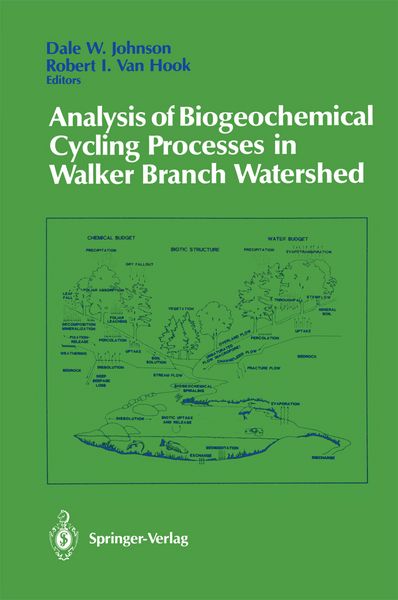
The Oak Ridge National Laboratory's Environmental Sciences Division initiated the Walker Branch Watershed Project on the Oak Ridge Reservation in east Tennessee in 1967, with the support of the U. S. Department of Energy's Office of Health and Environmental Research (DOE/OHER), to quantify land-water interactions in a forested landscape. It was designed to focus on three principal objectives: (1) to develop baseline data on unpolluted ecosystems, (2) to contribute to our knowledge of cycling and loss of chemical elements in natural ecosystems, and (3) to provide the understanding necessary for the construction of mathe matical simulation models for predicting the effects of man's activities on forested landscapes. In 1969, the International Biological Program's Eastern Deciduous Forest Biome Project was initiated, and Walker Branch Watershed was chosen as one of several sites for intensive research on nutrient cycling and biological productivity. This work was supported by the National Science Foundation (NSF). Over the next 4 years, intensive process-level research on primary productivity, decomposition, and belowground biological processes was coupled with ongoing DOE-supported work on the characterization of basic geology and hydrological cycles on the watershed. In 1974, the NSF's RANN Program (Research Applied to National Needs) began work on trace element cycling on Walker Branch Wa tershed because of the extensive data base being developed under both DOE and NSF support.

Produktdetails

Einband

Taschenbuch

Erscheinungsdatum

26.09.2011

Abbildungen

XVIII, 401 p.

Herausgeber Dale W. Johnson + weitere

Produktdetails

Einband

Taschenbuch

Erscheinungsdatum

26.09.2011

Abbildungen

XVIII, 401 p.

Herausgeber
Verlag Springer Us
Seitenzahl

401

Maße (L/B/H)

23,5/15,5/2,3 cm

Gewicht

639 g

Auflage

Softcover reprint of the original 1st ed. 1989

Sprache

Englisch

ISBN

978-1-4612-8134-4

Herstelleradresse

Springer-Verlag KG
Sachsenplatz 4-6
1201 Wien
AT

Email: ProductSafety@springernature.com

Noch keine Bewertungen vorhanden

Verfassen Sie die erste Bewertung zu diesem Artikel

Helfen Sie anderen Kundinnen und Kunden durch Ihre Meinung.

Kundinnen und Kunden meinen

Bewertungen (0)

  • Produktbild: Analysis of Biogeochemical Cycling Processes in Walker Branch Watershed
  • Produktbild: Analysis of Biogeochemical Cycling Processes in Walker Branch Watershed
  • 1 Introduction.- 2 Site Description.- 2.1 Location.- 2.2 Climate.- 2.3 Air Quality.- 2.4 Geology.- 2.5 Soils.- 2.6 Vegetation.- 2.7 Land-Use History.- References.- 3 Forest Meteorology.- 3.1 Introduction.- 3.2 Site Description.- 3.3 Characterization of Boundary Conditions.- 3.4 Canopy Radiation Transfers and Regimes.- 3.5 Canopy-Atmosphere Turbulent Exchange.- References.- 4 Atmospheric Chemistry, Deposition, and Canopy Interactions.- 4.1 Introduction.- 4.2 Methodology.- 4.3 Major Ions.- 4.4 Trace Metals.- References.- 5 Water.- 5.1 Introduction.- 5.2 Hydrologie Features.- 5.3 Hydrologie Monitoring.- 5.4 Annual Water Budget.- 5.5 Precipitation.- 5.6 Soil-Plant-Atmosphere Processes.- 5.7 Streamflow.- 5.8 Watershed Comparisons.- 5.9 Summary.- References.- 6 Carbon Dynamic and Productivity.- 6.1 Introduction.- 6.2 Forest Biomass and Productivity.- 6.3 Carbon Fluxes.- 6.4 Comparisons with Other Forests.- 6.5 Summary and Conclusions.- References.- 7 Terrestrial Nutrient Cycling.- 7.1 Introduction.- 7.2 Nutrient Cycles: Basic Characteristics.- 7.3 Perturbations.- 7.4 Comparison of Walker Branch Watershed with Other Forest Ecosystems.- 7.5 Summary and Conclusions.- References.- 8 Streams: Water Chemistry and Ecology.- 8.1 Introduction.- 8.2 Site Description.- 8.3 Stream Water Chemistry.- 8.4 Nutrient Limitation and Phosphorus Spiraling.- 8.5 Summary.- References.- 9 Modeling Chemical Transport, Uptake, and Effects in the Soil-Plant-Litter System.- 9.1 Introduction.- 9.2 Landscape Context.- 9.3 Modeling the Soil-Plant-Litter System.- 9.4 Model Applications.- 9.5 Pollutants and the Diurnal Cycle.- 9.6 Walker Branch Watershed Perspective.- 9.7 Summary.- References.- 10 Implications of Walker Branch Watershed Research.- References.