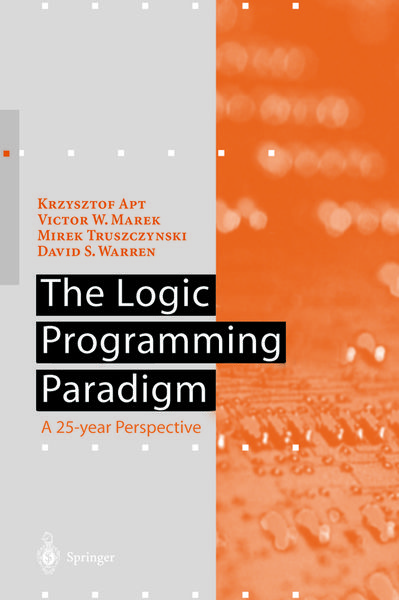
Produktbild: The Logic Programming Paradigm

The Logic Programming Paradigm A 25-Year Perspective

Aus der Reihe Artificial Intelligence

98,99 €

inkl. gesetzl. MwSt., Versandkostenfrei

Lieferung nach Hause

Beschreibung

Produktdetails

Einband

Taschenbuch

Erscheinungsdatum

19.09.2011

Herausgeber

Krzysztof R. Apt + weitere

Verlag

Springer Berlin

Seitenzahl

456

Maße (L/B/H)

23,5/15,5/2,6 cm

Gewicht

721 g

Auflage

Softcover reprint of the original 1st ed. 1999

Sprache

Englisch

ISBN

978-3-642-64249-4

Beschreibung

Produktdetails

Einband

Taschenbuch

Erscheinungsdatum

19.09.2011

Herausgeber

Verlag

Springer Berlin

Seitenzahl

456

Maße (L/B/H)

23,5/15,5/2,6 cm

Gewicht

721 g

Auflage

Softcover reprint of the original 1st ed. 1999

Sprache

Englisch

ISBN

978-3-642-64249-4

Herstelleradresse

Springer-Verlag KG
Sachsenplatz 4-6
1201 Wien
AT

Email: GPSR Kontakt

Noch keine Bewertungen vorhanden

Verfassen Sie die erste Bewertung zu diesem Artikel

Helfen Sie anderen Kundinnen und Kunden durch Ihre Meinung.

Kundinnen und Kunden meinen

Bewertungen (0)

  • Produktbild: The Logic Programming Paradigm
  • I. Computing and Programming.- 1 Concurrent and Agent Programming.- Logic Programming and Multi-Agent Systems: A Synergic Combination for Applications and Semantics.- 1 Introduction.- 2 Why and Which LP Languages for MAS Development?.- 3 A General Multi-Agent System Architecture.- 4 A Multi-Agent System Specification Language.- 5 Towards a Specification Methodology.- 6 Conclusions and Future Work.- Inference and Computation Mobility with Jinni.- 1 Introduction.- 2 The World of Jinni.- 3 Jinni as a Logic Programming Java Component.- 4 Basic Agent Programming with Jinni.- 5 What’s New in Jinni.- 6 Jinni’s Logical Engine.- 7 A Meta-circular Interpreter for Jinni.- 8 Mutual Agent/Host Security: the Bring Your Own Wine Principle.- 9 Application Domains.- 10 Conclusion.- Concurrent Logic/Constraint Programming: The Next 10 Years.- 1 Grand Challenges.- 2 Two Approaches to Addressing Novel Applications.- 3 Logic Programming vs. Concurrent Logic Programming.- 4 An Application Domain: Parallel/Network Programming.- 5 Experiences with Guarded Horn Clauses and KL1.- 6 Some Failures and Problems.- 7 Conclusions.- 2 Program Analysis and Methodology.- Formulas as Programs.- 1 Introduction.- 2 Computation Mechanism.- 3 Soundness and Completeness.- 4 Extensions.- 5 Relation to Other Approaches.- 6 Alma-0.- 7 Example: Partitioning a Rectangle into Squares.- 8 Current and Future Work.- 9 Appendix.- Link-time Optimization of Multi-Language Programs.- 1 Introduction.- 2 Challenges in Link Time Optimization.- 3 System Organization.- 4 Program Optimization.- 5 Performance Results.- 6 Discussion.- 7 Conclusions.- Horn Logic Denotations and Their Applications.- 1 Introduction.- 2 Logical Denotations.- 3 Provably Correct Compilation.- 4 Program Denotation and Verification.- 5 Specification, Implementation and Verification of DSL Programs.- 6 Semantic Porting.- 7 Other Applications.- 8 Related Work.- 9 Conclusions.- Global Analysis, Partial Specifications, and Assertions.- 1 Introduction.- 2 Overall Framework Architecture and Operation.- 3 The Assertion Language.- 4 Defining Properties.- 5 A Simple Run-time Checking Scheme.- 6 Compile-Time Checking.- 7 A Sample Debugging Session with the CIAO System.- 8 Some Practical Hints on Debugging with Assertions.- 9 A Preliminary Experimental Evaluation.- 10 Discussion.- A Code for Run-time Checking.- 3 Future of Declarative Programming.- Assessment of Some Issues in CL-Theory and Program Development.- 1 Introduction: on assessment.- 2 Implementation, analysis and transformation.- 3 “Algorithm = Logic + Control” revisited.- 4 Conclusions: future directions.- How Enterprises Use Functional Languages, and Why They Don’t.- 1 An Angry Half Dozen.- 2 Why No One Uses Functional Languages.- 3 Functional and Logic Programming.- 4 Continuous Mathematics.- Continuous Models of Computation for Logic Programs.- 1 Orientation.- 2 The Contention and a Caution.- 3 Long-term Expectations.- 4 Relationship to Prior Work.- 5 Continualizing Propositional Connectives.- 6 A Continuous-Time Example.- 7 A Fundamental Discrete-time System.- 8 Emergent Phenomena from Tuning.- The Logic Programming Paradigm in Numerical Computation.- 1 Introduction.- 2 Numerical Programs Need Verification.- 3 From Prolog to CLP(R).- 4 Sound CLP(R).- 5 Proving ND/ID Formulas.- 6 Related Work.- 7 Conclusions.- II. Knowledge Representation and Modeling.- 5 Constraints.- Computational Molecular Biology: A Promising Application Using LP and its Extensions.- 1 Introduction.- 2 A Minimalist Introduction to DNA and Protein Generation.- 3 Top-Down Description of Protein Generation from DNA.- 4 Grammars Defining DNA Components.- 5 Motivation for Introducing DAGs.- 6 Obtaining DAGs From NDFSA.- 7 Chromatic NDFSA and DAGs.- 8 Introducing “Criteria”.- 9 Alternation of Introns and Exons Using NDFSA.- 10 Related Approaches.- 11 Other Problems in Computational Molecular Biology.- 12 Areas in CS That Are Applicable in Molecular Biology.- 13 Some Comments About DNA Computing.- 14 Final Remarks.- Adding Constraints to Logic-based Formalisms.- 1 Introduction.- 2 Logic Formalisms.- 3 Constraints.- 4 Adding Constraints to Logic Formalisms.- 5 Constraints in Logic Formalisms.- 6 Conclusion.- 6 Machine Learning.- A Perspective on Inductive Logic Programming.- 1 Introduction.- 2 Inductive Logic Programming.- 3 The Methodology of Inductive Logic Programming.- 4 The Relation Between Inductive Logic Programming and Logic Programming.- 5 Research Directions for Inductive Logic Programming.- From Deduction to Induction: Logical Perspective.- 1 Introduction.- 2 Inverse Entailment.- 3 Subsumption and Entailment.- 4 Completion of the Algorithm.- 5 Abductive Inference in ILP.- 6 Conclusion and Future Research Directions.- 7 Answer Set Programming.- Action Languages, Answer Sets, and Planning.- 1 Introduction.- 2 Incomplete Information.- 3 Action Language A.- 4 Answer Sets and Histories.- 5 Computing Answer Sets.- 6 Causal Reasoning.- 7 Action Language C.- 8 From C to Logic Programming.- 9 Planning for Domains Described in C.- 10 Topics for Future Work.- 11 Conclusion.- Stable Models and an Alternative Logic Programming Paradigm.- 1 Introduction.- 2 Horn Logic Programming.- 3 Negation in Logic Programming.- 4 Stable Logic Programming.- 5 Expressive Power of SLP.- 6 Recursion Versus Constraints.- 7 Uniform Control in SLP.- 8 Conclusions and Future Directions.- 8 Database Systems.- Logic-Based User-Defined Aggregates for the Next Generation of Database Systems.- 1 Introduction.- 2 New Applications Require New Aggregates.- 3 User-Defined Aggregates: the State of the Art.- 4 Aggregates with Early Returns.- 5 Formal Semantics.- 6 Monotonic Aggregation.- 7 Implementation of Extended Aggregates.- 8 Applications of Monotone Aggregation.- 9 Applications to SQL Databases.- 10 Conclusions.- 9 Natural Language Processing.- The Logic of Language.- 1 Introduction.- 2 Some Basic Problems in Natural Language Processing.- 3 The Omnipresence of Logic in Language.- 4 Linguistically Principled Approaches to Natural Language Processing.- 5 A Computational Linguist’s Wishlist for Prolog.- 6 What Fashion of the Day Are We Losing To?.- 7 How Can Logic Programming Benefit from Regaining the Market?.- 8 Assumptive Logic Programming and Grammars.- 9 Controlling Virtual Worlds and Robots Through Natural Language.- 10 Concept Based Retrieval Through Natural Language.- 11 Database Initialization from Natural Language.- 12. Conclusion.