KI-Beratung Beta

Gutscheinbedingungen

**Gültig vom 23.11. bis 30.11.2026 | Gültig für nicht preisgebundene fremdsprachige Bücher | Einzelne Artikel können ausgeschlossen sein | Online auf www.bücher.de einlösbar | Click & Collect nur mit Online-Zahlung (Paypal/Kreditkarte) vorab | Nicht kombinierbar mit anderen Gutscheinen oder Preisaktionen | Nur einmal pro Einkauf einlösbar | Gutschein wird auf max. 500€ Bestellwert angerechnet | Keine Barauszahlung | Nicht gültig für Versandkosten und Services

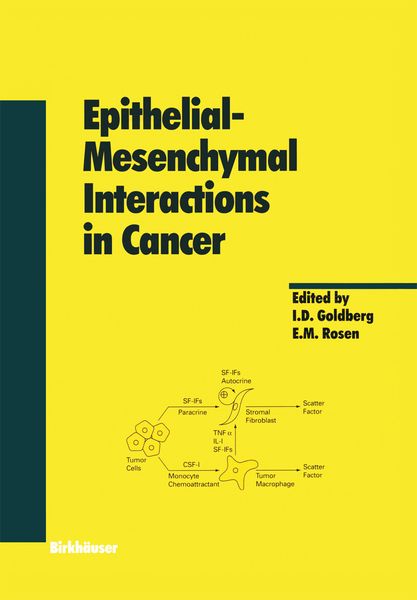
Produktbild: Epithelial—Mesenchymal Interactions in Cancer
Band 74

Epithelial—Mesenchymal Interactions in Cancer

Aus der Reihe Experientia Supplementum

49,99 €

inkl. gesetzl. MwSt., Versandkostenfrei


Beschreibung

gar discusses recent studies of the SF gene promoter that may be relevant to understanding the detailed molecular mechanism(s) by which soluble factors regulate SF production. Polverini and Nickoloff discuss another mechanism by which SF may enhance tumor growth, ie., stimulation of angiogenesis, the...

Beschreibung

gar discusses recent studies of the SF gene promoter that may be relevant to understanding the detailed molecular mechanism(s) by which soluble factors regulate SF production. Polverini and Nickoloff discuss another mechanism by which SF may enhance tumor growth, ie., stimulation of angiogenesis, the formation of new blood vessels from pre-existing microvessels. Angiogenesis is required for continued growth of most solid tumors, and provides a mechanism by which the stroma may continue to grow along with the tumor cells. Although endothelial cells are stromal cells, they express a number of epithelial characteristics including (i) epithelial-like tight junctions and junctional proteins; (ii) the ability to organize into flat tened tubular structures; (iii) the c-met receptor protein; and (iv) biologic responsiveness to SF. It is, perhaps, not surprising that vascular endothe lial cells may both produce and respond to SF in different situations. 'Epithelialness' may be defined in two ways: (i) expression of generic epithelial structures and proteins (eg., specialized junctions, junctional proteins [eg., cadherins, ZOl], cytokeratins); and (ii) production of specific differentiated products (eg., milk proteins by mammary epithelia, renin by renal tubular epithelia of the juxtaglomerular apparatus). Recent studies suggest that SF Ic-met signalling may mediate epithelia mesenchyme interconversion, in part by modifying some of the generic epithelial characteristics. Nusrat discusses the effects of SF on the epithelial junctional apparatus. Relatively little is known about whether and how SF regulates cell-specific differentiation.

Produktdetails

Einband

Taschenbuch

Erscheinungsdatum

21.09.2011

Abbildungen

350 p.

Herausgeber Itzhak D. Goldberg + weitere

Produktdetails

Einband

Taschenbuch

Erscheinungsdatum

21.09.2011

Abbildungen

350 p.

Herausgeber
Verlag Springer Basel
Seitenzahl

350

Maße (L/B/H)

24,4/17/1,8 cm

Gewicht

548 g

Auflage

Softcover reprint of the original 1st edition 1995

Sprache

Englisch

ISBN

978-3-0348-9893-5

Herstelleradresse

Springer-Verlag GmbH
Tiergartenstr. 17
69121 Heidelberg
DE

Email: ProductSafety@springernature.com

Noch keine Bewertungen vorhanden

Verfassen Sie die erste Bewertung zu diesem Artikel

Helfen Sie anderen Kundinnen und Kunden durch Ihre Meinung.

Kundinnen und Kunden meinen

Bewertungen (0)

  • Produktbild: Epithelial—Mesenchymal Interactions in Cancer
  • Epithelial-mesenchymal transitions in development and tumor progression.- Regulation of scatter factor (hepatocyte growth factor) production by tumor-stroma interaction.- Regulation of HGF and HGFR gene expression.- The role of scatter factor and the c-met proto-oncogene in angiogenic responses.- Modulation of intercellular junctions of epithelia by scatter factor (hepatocyte growth factor).- The Met-HGF/SF autocrine signaling mechanism is involved in sarcomagenesis.- Tumor cell interactions with the vascular endothelium and their role in cancer metastasis.- Stimulation and regulation of tumor cell motility in invasion and metastasis.- Tumor-stromal cytokine interactions in ovarian neoplasms.- Keratinocyte growth factor as a cytokine that mediates mesenchymal-epithelial interaction.- Stromal-epithelial interaction in type IV collagenase expression and activation: The role in cancer metastasis.- Angiogenesis as a component of epithelial-mesenchymal interactions.- Mammary tumor fibroblasts are phenotypically distinct from non-tumor fibroblasts.- Fibroblast subpopulations as accelerators of tumor progression: The role of migration stimulating factor.