Gutscheinbedingungen

**Gültig vom 20.07.2026 bis 22.07.2026 | Gültig für nicht preisgebundene fremdsprachige Bücher | Einzelne Artikel können ausgeschlossen sein | Nicht kombinierbar mit anderen Gutscheinen oder Preisaktionen | Nur einmal pro Einkauf einlösbar | Gutschein wird auf max. 500€ Bestellwert angerechnet | Keine Barauszahlung | Nicht gültig für Versandkosten und Services

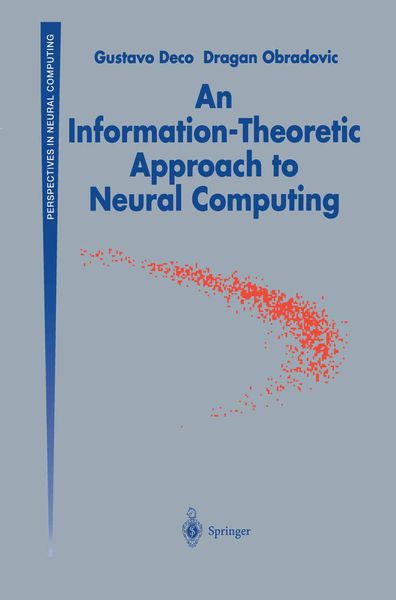
  • Produktbild: An Information-Theoretic Approach to Neural Computing
  • Produktbild: An Information-Theoretic Approach to Neural Computing

An Information-Theoretic Approach to Neural Computing

97,99 €

inkl. gesetzl. MwSt., Versandkostenfrei

Lieferung nach Hause

Beschreibung

Produktdetails

Einband

Taschenbuch

Erscheinungsdatum

17.09.2011

Verlag

Springer Us

Seitenzahl

262

Maße (L/B/H)

23,5/15,5/1,6 cm

Gewicht

429 g

Auflage

Softcover reprint of the original 1st ed. 1996

Sprache

Englisch

ISBN

978-1-4612-8469-7

Beschreibung

Produktdetails

Einband

Taschenbuch

Erscheinungsdatum

17.09.2011

Verlag

Springer Us

Seitenzahl

262

Maße (L/B/H)

23,5/15,5/1,6 cm

Gewicht

429 g

Auflage

Softcover reprint of the original 1st ed. 1996

Sprache

Englisch

ISBN

978-1-4612-8469-7

Herstelleradresse

Springer-Verlag KG
Sachsenplatz 4-6
1201 Wien
AT

Email: GPSR Kontakt

Noch keine Bewertungen vorhanden

Verfassen Sie die erste Bewertung zu diesem Artikel

Helfen Sie anderen Kundinnen und Kunden durch Ihre Meinung.

Kundinnen und Kunden meinen

Bewertungen (0)

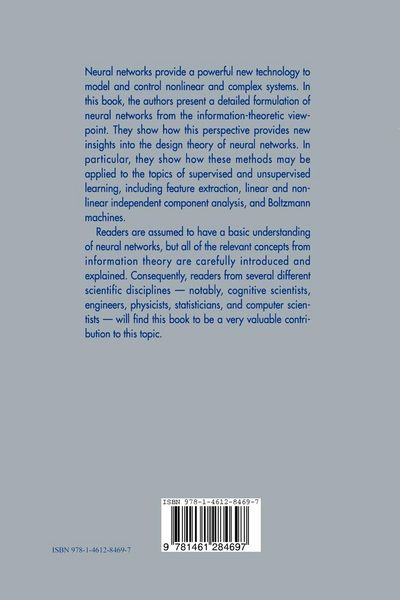
  • Produktbild: An Information-Theoretic Approach to Neural Computing
  • Produktbild: An Information-Theoretic Approach to Neural Computing
  • 1 Introduction.- 2 Preliminaries of Information Theory and Neural Networks.- 2.1 Elements of Information Theory.- 2.1.1 Entropy and Information.- 2.1.2 Joint Entropy and Conditional Entropy.- 2.1.3 Kullback-Leibler Entropy.- 2.1.4 Mutual Information.- 2.1.5 Differential Entropy, Relative Entropy and Mutual Information.- 2.1.6 Chain Rules.- 2.1.7 Fundamental Information Theory Inequalities.- 2.1.8 Coding Theory.- 2.2 Elements of the Theory of Neural Networks.- 2.2.1 Neural Network Modeling.- 2.2.2 Neural Architectures.- 2.2.3 Learning Paradigms.- 2.2.4 Feedforward Networks: Backpropagation.- 2.2.5 Stochastic Recurrent Networks: Boltzmann Machine.- 2.2.6 Unsupervised Competitive Learning.- 2.2.7 Biological Learning Rules.- I: Unsupervised Learning.- 3 Linear Feature Extraction: Infomax Principle.- 3.1 Principal Component Analysis: Statistical Approach.- 3.1.1 PCA and Diagonalization of the Covariance Matrix.- 3.1.2 PCA and Optimal Reconstruction.- 3.1.3 Neural Network Algorithms and PCA.- 3.2 Information Theoretic Approach: Infomax.- 3.2.1 Minimization of Information Loss Principle and Infomax Principle.- 3.2.2 Upper Bound of Information Loss.- 3.2.3 Information Capacity as a Lyapunov Function of the General Stochastic Approximation.- 4 Independent Component Analysis: General Formulation and Linear Case.- 4.1 ICA-Definition.- 4.2 General Criteria for ICA.- 4.2.1 Cumulant Expansion Based Criterion for ICA.- 4.2.2 Mutual Information as Criterion for ICA.- 4.3 Linear ICA.- 4.4 Gaussian Input Distribution and Linear ICA.- 4.4.1 Networks With Anti-Symmetric Lateral Connections.- 4.4.2 Networks With Symmetric Lateral Connections.- 4.4.3 Examples of Learning with Symmetric and Anti-Symmetric Networks.- 4.5 Learning in Gaussian ICA with Rotation Matrices: PCA.- 4.5.1 Relationship Between PCA and ICA in Gaussian Input Case.- 4.5.2 Linear Gaussian ICA and the Output Dimension Reduction.- 4.6 Linear ICA in Arbitrary Input Distribution.- 4.6.1 Some Properties of Cumulants at the Output of a Linear Transformation.- 4.6.2 The Edgeworth Expansion Criteria and Theorem 4.6.2.- 4.6.3 Algorithms for Output Factorization in the Non-Gaussian Case.- 4.6.4 Experimental Results of Linear ICA Algorithms in the Non-Gaussian Case.- 5 Nonlinear Feature Extraction: Boolean Stochastic Networks.- 5.1 Infomax Principle for Boltzmann Machines.- 5.1.1 Learning Model.- 5.1.2 Examples of Infomax Principle in Boltzmann Machine.- 5.2 Redundancy Minimization and Infomax for the Boltzmann Machine.- 5.2.1 Learning Model.- 5.2.2 Numerical Complexity of the Learning Rule.- 5.2.3 Factorial Learning Experiments.- 5.2.4 Receptive Fields Formation from a Retina.- 5.3 Appendix.- 6 Nonlinear Feature Extraction: Deterministic Neural Networks.- 6.1 Redundancy Reduction by Triangular Volume Conserving Architectures.- 6.1.1 Networks with Linear, Sigmoidal and Higher Order Activation Functions.- 6.1.2 Simulations and Results.- 6.2 Unsupervised Modeling of Chaotic Time Series.- 6.2.1 Dynamical System Modeling.- 6.3 Redundancy Reduction by General Symplectic Architectures.- 6.3.1 General Entropy Preserving Nonlinear Maps.- 6.3.2 Optimizing a Parameterized Symplectic Map.- 6.3.3 Density Estimation and Novelty Detection.- 6.4 Example: Theory of Early Vision.- 6.4.1 Theoretical Background.- 6.4.2 Retina Model.- II: Supervised Learning.- 7 Supervised Learning and Statistical Estimation.- 7.1 Statistical Parameter Estimation — Basic Definitions.- 7.1.1 Cramer-Rao Inequality for Unbiased Estimators.- 7.2 Maximum Likelihood Estimators.- 7.2.1 Maximum Likelihood and the Information Measure.- 7.3 Maximum A Posteriori Estimation.- 7.4 Extensions of MLE to Include Model Selection.- 7.4.1 Akaike’s Information Theoretic Criterion (AIC).- 7.4.2 Minimal Description Length and Stochastic Complexity.- 7.5 Generalization and Learning on the Same Data Set.- 8 Statistical Physics Theory of Supervised Learning and Generalization.- 8.1 Statistical Mechanics Theory of Supervised Learning.- 8.1.1 Maximum Entropy Principle.- 8.1.2 Probability Inference with an Ensemble of Networks.- 8.1.3 Information Gain and Complexity Analysis.- 8.2 Learning with Higher Order Neural Networks.- 8.2.1 Partition Function Evaluation.- 8.2.2 Information Gain in Polynomial Networks.- 8.2.3 Numerical Experiments.- 8.3 Learning with General Feedforward Neural Networks.- 8.3.1 Partition Function Approximation.- 8.3.2 Numerical Experiments.- 8.4 Statistical Theory of Unsupervised and Supervised Factorial Learning.- 8.4.1 Statistical Theory of Unsupervised Factorial Learning.- 8.4.2 Duality Between Unsupervised and Maximum Likelihood Based Supervised Learning.- 9 Composite Networks.- 9.1 Cooperation and Specialization in Composite Networks.- 9.2 Composite Models as Gaussian Mixtures.- 10 Information Theory Based Regularizing Methods.- 10.1 Theoretical Framework.- 10.1.1 Network Complexity Regulation.- 10.1.2 Network Architecture and Learning Paradigm.- 10.1.3 Applications of the Mutual Information Based Penalty Term.- 10.2 Regularization in Stochastic Potts Neural Network.- 10.2.1 Neural Network Architecture.- 10.2.2 Simulations.- References.