KI-Beratung Beta

Gutscheinbedingungen

**Gültig vom 23.11. bis 30.11.2026 | Gültig für nicht preisgebundene fremdsprachige Bücher | Einzelne Artikel können ausgeschlossen sein | Online auf www.bücher.de einlösbar | Click & Collect nur mit Online-Zahlung (Paypal/Kreditkarte) vorab | Nicht kombinierbar mit anderen Gutscheinen oder Preisaktionen | Nur einmal pro Einkauf einlösbar | Gutschein wird auf max. 500€ Bestellwert angerechnet | Keine Barauszahlung | Nicht gültig für Versandkosten und Services

Produktbild: Computers in Chess

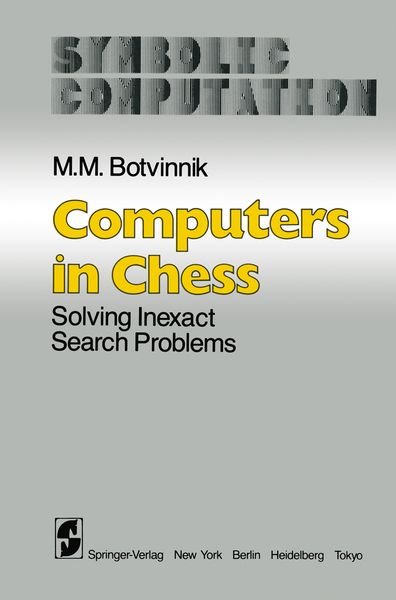
Computers in Chess Solving Inexact Search Problems

Aus der Reihe Symbolic Computation

49,99 €

inkl. gesetzl. MwSt., Versandkostenfrei


Beschreibung

Much water has flowed over the dam since this book went to press in Moscow. One might expect that PIONEER would have made substantial advances-unfortunately it has not. There are reasons: the difficulty of the problem, the disenchantment of the mathematicians (because of the delays and drawing out of...

Beschreibung

Much water has flowed over the dam since this book went to press in Moscow. One might expect that PIONEER would have made substantial advances-unfortunately it has not. There are reasons: the difficulty of the problem, the disenchantment of the mathematicians (because of the delays and drawing out of the work), and principally the insufficiency and some times complete lack of machine time. The general method used by PIONEER to solve complex multidimen sional search problems had already been formulated at that time. It was supposed that the successful completion of the chess program PIONEER-l would provide a sufficient validation for the method. We did not succeed in completing it. But, unexpectedly, PIONEER's method obtained a different kind of validation. Since our group of mathematicians works at the Institute for Electroen ergy, we were invited to solve some energy-related problems and were assigned the task of constructing a program that would plan the recondi tioning of the equipment in power stations-initially for one month. Until then, the technicians had been preparing such plans without the aid of computers. Although the chess program was not complete even after ten years, the program PIONEER-2 for computing the monthly repair schedule for the Interconnected Power System of Russian Central was completed in a few months. In mid-October of 1980 a medium-speed computer constructed the plan in 40 seconds. When, at the end of the month, the mathematician A.

Produktdetails

Einband

Taschenbuch

Erscheinungsdatum

26.09.2011

Abbildungen

XIV, 158 p.

Verlag Springer Us

Produktdetails

Einband

Taschenbuch

Erscheinungsdatum

26.09.2011

Abbildungen

XIV, 158 p.

Verlag Springer Us
Seitenzahl

158

Maße (L/B/H)

23,5/15,5/1 cm

Gewicht

277 g

Auflage

Softcover reprint of the original 1st ed. 1984

Übersetzt von

A. A. Brown

Sprache

Englisch

ISBN

978-1-4612-9736-9

Herstelleradresse

Springer-Verlag KG
Sachsenplatz 4-6
1201 Wien
AT

Email: ProductSafety@springernature.com

Noch keine Bewertungen vorhanden

Verfassen Sie die erste Bewertung zu diesem Artikel

Helfen Sie anderen Kundinnen und Kunden durch Ihre Meinung.

Kundinnen und Kunden meinen

Bewertungen (0)

  • Produktbild: Computers in Chess
  • 1 The General Statement.- Definition of an Inexact Task.- Inexact Tasks and Control Systems.- Two Methods for Solving Inexact Problems.- The Goal of the Game and the Scoring Function.- Goal and Prognosis (The Optimal Variation).- Multi-level Control Systems.- Types of Multi-level Systems.- Advantages of the General Goal.- The Method for Connecting the Optimal Variations of the Components for Types C and E Regimes.- Computer Programs and Humans.- The Expansion of Artifical Intelligence.- 2 Methods for Limiting the Search Tree.- Truncation.- The Goal of an Inexact Game.- The Scoring Function.- Breaking Off a Variation.- The Pruning of Branches.- The Horizon.- Two Trees: The Mathematical Model (MM).- The Stratification of the System.- Three General Limitation Principles.- Improving the Results of a Search.- 3 The Search for a Solution and Historical Experience.- The Search for a Solution by Association.- The Handbook Method of Searching.- 4 An Example of the Solution of an Inexact Problem (Chess).- A. The Search for a Move in an Original Situation.- B. The Use of Historical Experience.- 5 Three Endgame Studies (An Experiment).- 6 The Second World Championship.- KAISSA-CHESS 4.6.- Conclusions.- Appendix 1.- Fields of Play (by B. M. Stilman).- 1. The Formation of Fields and the Search Within Them.- 1.1. The Concept of a Field.- 1.2. The Search Procedure in the Initial Position.- 1.3. The Formation of Fields During the Search—An Example.- 1.4. Formation of a Field.- 1.5. Storage of Information about Sheaves of Trajectories in Computer Memory. Linked Lists.- 1.6. Information on the Trajectories of a Field.- 1.8. Computing the Length of a Denial Trajectory.- 1.9. Correction of the Sighting Method.- 1.10. The Pseudosearch.- 1.11. The Extent of the Climb Up a Branch in thePseudosearch.- 1.14. Freezing a Trajectory for Lack of a Connection to an Active One.- 1.15. Criteria for Freezing.- 1.16. The Algorithm for Freezing.- 1.18. Trajectory and Field.- 2. The Choice of Moves in an Ensemble of Fields (The Mathematical Model).- 2.1. The Goal of the Game and the Ending of a Variation.- 2.2. The Criteria for Breaking Off a Variation in the Search.- 2.3. Testing the Criteria for Ending a Variation.- 2.4. Pruning Branches by the Minimax Principle. On the Branch-and-Bound Method.- 2.5. Pruning Branches by the Worst Case Method.- 2.6. Priority of Moves in a Search.- 2.7. Analysis of the Trajectories of a Sheaf for Inclusion in the Search.- 2.8. Analysis of Trajectories for Forking.- 2.9. Retreat and Deblockade.- 2.10. Pruning in the Presence of Branching in a Sheaf of Trajectories.- 2.11. The Structure of the Search Tree.- 2.12. A New Content of Known Procedures.- Appendix 2 The Positional Estimate and Assignment of Priorities (by M. A. Tsfasman and B. M. Stilman).- Appendix 3 The Endgame Library in PIONEER (Using Historical Experience by the Handbook Method and the Outreach Method) (by A. D. YUDIN).- 3.1. Introduction.- 3.2. Formulation of the Problem.- 3.3. Configurations.- 3.4. The Boundary Effect. Decomposition Formulae.- 3.5. Symmetries.- 3.6. The Structure of the Library. Classes. Coding of the Information.- 3.7. Organization of the Information in the Form of Two-Dimensional Tables with Subordination of Entries.- 3.8. The Algorithm for Using the Endgame Library (The Search for Exact Coincidence).- 3.9. Examples of the Operation of the Subroutine for Using the Endgame Library.- 3.10. Outreach for a Library Position.- 3.11. The Search for Nearby Positions.- 3.12. Filter with Respect to the Pawn Structure.- 3.13. The “One Color-DifferentColor” Filter.- 3.14. Filters Within a Set of Positions.- 3.15. Finding a Group of Neighboring Positions.- 3.16. Implementation of the Outreach Method. Anti-outreach.- 3.17. Entry from the Move-Search Routine.- 3.18. Outreach and Exact Coincidence.- 3.19. The Potential for Wide Use of Library Rules in PIONEER.- 3.20. The Breakoff Criterion Based on the Rule of the Square.- 3.21. Conclusion.- Appendix An Associative Library of Fragments (by A. I. Reznitsky and A. D. Yudin).- References.- Glossary of Terms.- Index of Notation.