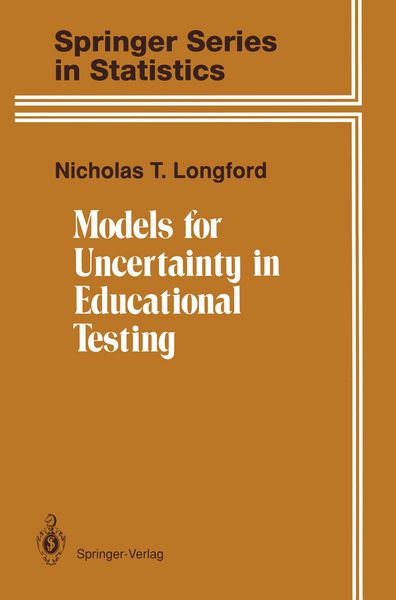
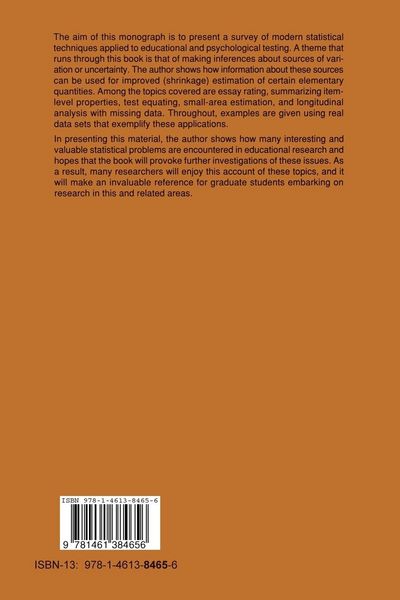
• Produktbild: Models for Uncertainty in Educational Testing
  • Produktbild: Models for Uncertainty in Educational Testing

Models for Uncertainty in Educational Testing

48,99 €

inkl. gesetzl. MwSt., Versandkostenfrei


Beschreibung

Produktdetails

Einband

Taschenbuch

Erscheinungsdatum

12.10.2011

Abbildungen

XIV, 285 p.

Verlag

Springer Us

Seitenzahl

285

Maße (L/B/H)

23,5/15,5/1,7 cm

Gewicht

464 g

Auflage

Softcover reprint of the original 1st edition 1995

Sprache

Englisch

ISBN

978-1-4613-8465-6

Beschreibung

Produktdetails

Einband

Taschenbuch

Erscheinungsdatum

12.10.2011

Abbildungen

XIV, 285 p.

Verlag

Springer Us

Seitenzahl

285

Maße (L/B/H)

23,5/15,5/1,7 cm

Gewicht

464 g

Auflage

Softcover reprint of the original 1st edition 1995

Sprache

Englisch

ISBN

978-1-4613-8465-6

Herstelleradresse

Springer-Verlag GmbH
Tiergartenstr. 17
69121 Heidelberg
DE

Email: ProductSafety@springernature.com

Noch keine Bewertungen vorhanden

Verfassen Sie die erste Bewertung zu diesem Artikel

Helfen Sie anderen Kundinnen und Kunden durch Ihre Meinung.

Kundinnen und Kunden meinen

Bewertungen (0)

  • Produktbild: Models for Uncertainty in Educational Testing
  • Produktbild: Models for Uncertainty in Educational Testing
  • 1 Inference about variation.- 1.1 Imperfection and variation.- 1.2 Educational measurement and testing.- 1.3 Statistical context.- 2 Reliability of essay rating.- 2.1 Introduction.- 2.2 Models.- 2.3 Estimation.- 2.4 Extensions.- 2.5 Diagnostic procedures.- 2.6 Examples.- 2.7 Standard errors.- 2.8 Summary.- 2.9 Literature review.- 3 Adjusting subjectively rated scores.- 3.1 Introduction.- 3.2 Estimating severity.- 3.3 Examinee-specific shrinkage.- 3.4 General scheme.- 3.5 More diagnostics.- 3.6 Examples.- 3.7 Estimating linear combinations of true scores.- 3.8 Summary.- Appendix. Derivation of MSE for the general adjustment scheme.- 4 Rating several essays.- 4.1 Introduction.- 4.2 Models.- 4.3 Estimation.- 4.4 Application.- 4.5 Choice of essay topics.- 4.6 Summary.- 5 Summarizing item-level properties.- 5.1 Introduction.- 5.2 Differential item functioning.- 5.3 DIF variance.- 5.4 Estimation.- 5.5 Examples.- 5.6 Shrinkage estimation of DIF coefficients.- 5.7 Model criticism and diagnostics.- 5.8 Multiple administrations.- 5.9 Conclusion.- 6 Equating and equivalence of tests.- 6.1 Introduction.- 6.2 Equivalent scores.- 6.3 Estimation.- 6.4 Application.- 6.5 Summary.- 7 Inference from surveys with complex sampling design.- 7.1 Introduction.- 7.2 Sampling design.- 7.3 Proficiency scores.- 7.4 Jackknife.- 7.5 Model-based method.- 7.6 Examples.- 7.7 Estimating proportions.- 7.8 Regression with survey data.- 7.9 Estimating many subpopulation means.- 7.10 Jackknife and model-based estimators.- 7.11 Summary.- 8 Small-area estimation.- 8.1 Introduction.- 8.2 Shrinkage estimation.- 8.3 Regression with survey data.- 8.4 Fitting two-level regression.- 8.5 Small-area mean prediction.- 8.6 Selection of covariates.- 8.7 Application.- 8.8 Summary and literature review.- 9 Cut scores forpass/fail decisions.- 9.1 Introduction.- 9.2 Models.- 9.3 Fitting logistic regression.- 9.4 Examples.- 9.5 Summary.- 10 Incomplete longitudinal data.- 10.1 Introduction.- 10.2 Informative missingness.- 10.3 Longitudinal analysis.- 10.4 EM algorithm.- 10.5 Application.- 10.6 Estimation.- 10.7 Summary.- References.