KI-Beratung Beta

  • Produktbild: Physics of Highly Charged Ions
  • Produktbild: Physics of Highly Charged Ions
Band 13

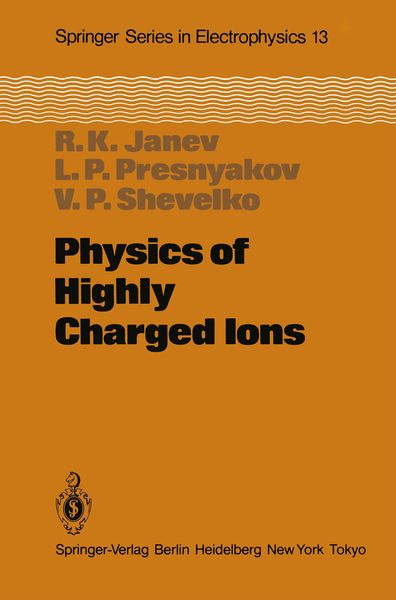
Physics of Highly Charged Ions

49,99 €

inkl. gesetzl. MwSt., Versandkostenfrei


Beschreibung

Produktdetails

Einband

Taschenbuch

Erscheinungsdatum

07.12.2011

Abbildungen

X, 332 p.

Verlag

Springer Berlin

Seitenzahl

332

Maße (L/B/H)

23,5/15,5/1,9 cm

Gewicht

528 g

Auflage

Softcover reprint of the original 1st ed. 1985

Sprache

Englisch

ISBN

978-3-642-69197-3

Beschreibung

Produktdetails

Einband

Taschenbuch

Erscheinungsdatum

07.12.2011

Abbildungen

X, 332 p.

Verlag

Springer Berlin

Seitenzahl

332

Maße (L/B/H)

23,5/15,5/1,9 cm

Gewicht

528 g

Auflage

Softcover reprint of the original 1st ed. 1985

Sprache

Englisch

ISBN

978-3-642-69197-3

Herstelleradresse

Springer-Verlag KG
Sachsenplatz 4-6
1201 Wien
AT

Email: ProductSafety@springernature.com

Noch keine Bewertungen vorhanden

Verfassen Sie die erste Bewertung zu diesem Artikel

Helfen Sie anderen Kundinnen und Kunden durch Ihre Meinung.

Kundinnen und Kunden meinen

Bewertungen (0)

  • Produktbild: Physics of Highly Charged Ions
  • Produktbild: Physics of Highly Charged Ions
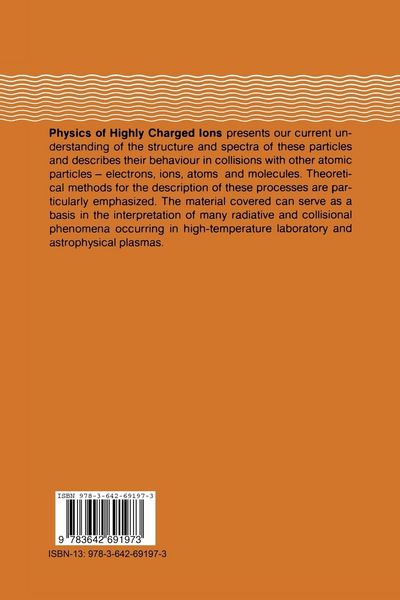
  • 1. Introduction.- 1.1 General Overview.- 1.2 Basic Features of Highly Charged Ions and Their Interactions.- 1.3 Highly Charged Ions in Astrophysics.- 1.4 Highly Charged Ions in Controlled Thermonuclear Fusion Research.- 1.5 Highly Charged Ions in Accelerator-Based Physics and Other Research Fields.- 1.6 Scope of the Book.- 2. Structure and Spectra of Highly Charged Ions.- 2.1 General Properties of the Spectra.- 2.2 Satellites of the Spectral Lines.- 2.3 Classification of the States and Spectral Lines of Multiply Charged Ions.- 2.4 Relativistic and Radiative Effects.- 2.5 Decay of Excited Ionic States. Radiation and Autoionization.- 2.6 Static and Dynamic Dipole Polarizabilities of Multiply Charged Ions.- 3. Radiative Processes in the Continuous Spectrum.- 3.1 Bremsstrahlung.- 3.2 Photoionization and Photorecombination.- 3.3 Dielectronic Recombination.- 3.4 Autoionization.- 4. Electron Collisions with Highly Charged Ions: General Theory and Excitation Processes.- 4.1 Introductory Remarks.- 4.2 Basic Equations.- 4.3 Effective-Range Theory for Attractive Coulomb Field.- 4.4 Quantum Defect Method. The Seaton Theory.- 4.5 Correct Asymptotic Expansion. Influence of Dielectronic Recombination.- 4.6 Results of Calculations and Experimental Data.- 5. Electron-Impact Ionization of Highly Charged Ions.- 5.1 One-Electron Ionization. General Remarks.- 5.2 Exchange Effects in Ionization. The Peterkop Theory.- 5.3 Threshold Behaviour of the Cross Section.- 5.4 Quantum-Mechanical Methods for Ionization Cross Section Calculations.- 5.5 Classical and Semi-Empirical Formulae.- 5.6 Excitation-Autoionization.- 5.7 Experimental Data and Comparison with Theoretical Calculations.- 5.8 Analytic Approximations for the Quantum-Mechanical Cross Sections.- 6. Collisions of Atoms with Highly ChargedIons: General Theoretical Description.- 6.1 Two-Coulomb-Centre Problem.- 6.2 Close-Coupling Methods.- 6.3 Perturbation Methods.- 6.3.5 Second-Order and Related Approximations.- 6.4 Classical Descriptions.- 7. Collisions of Atoms (Ions, Molecules) with Highly Charged Ions: Charge-Transfer Processes.- 7.1 General Considerations.- 7.2 Charge Exchange at Low Energies.- 7.3 Electron Capture at Intermediate Energies.- 7.4 Electron Capture at High Energies.- 7.5 General Features of Single-Charge-Transfer Cross Sections.- 7.6 Single-Charge Transfer in Ion-Ion and Ion-Molecule Collisions.- 7.7 Multiple-Charge Transfer.- 8. Collisions of Atoms (Ions) with Highly Charged Ions: Excitation and Ionization.- 8.1 Basic Electron Transition Mechanisms.- 8.2 Excitation Processes.- 8.3 Single-Electron Ionization.- 8.4 Electron Loss and Stripping Processes.- 9. Auger, Inner-Shell and Related Processes.- 9.1 Collisional Auger Processes Involving Outer Shells.- 9.2 Inner-Shell Processes.- 9.3 Some Aspects of Quasi-Molecule and Quasi-Atom Formation in Heavy Ion Collisions.- 10. Rate Coefficients of Elementary Processes.- 10.1 Energy (Velocity) Distribution Function.- 10.2 Electron-Impact Excitation.- 10.3 Electron-Impact Ionization.- 10.4 Photorecombination.- 10.5 Dielectronic Recombination.- 10.6 Charge Transfer.- References.