KI-Beratung Beta

Gutscheinbedingungen

**Gültig vom 23.11. bis 30.11.2026 | Gültig für nicht preisgebundene fremdsprachige Bücher | Einzelne Artikel können ausgeschlossen sein | Online auf www.bücher.de einlösbar | Click & Collect nur mit Online-Zahlung (Paypal/Kreditkarte) vorab | Nicht kombinierbar mit anderen Gutscheinen oder Preisaktionen | Nur einmal pro Einkauf einlösbar | Gutschein wird auf max. 500€ Bestellwert angerechnet | Keine Barauszahlung | Nicht gültig für Versandkosten und Services

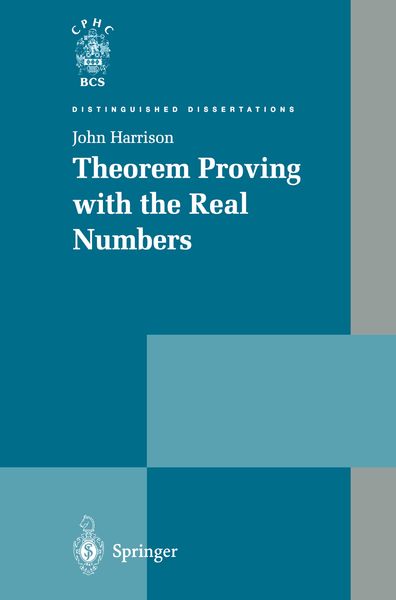
  • Produktbild: Theorem Proving with the Real Numbers
  • Produktbild: Theorem Proving with the Real Numbers

Theorem Proving with the Real Numbers

106,99 €

inkl. gesetzl. MwSt., Versandkostenfrei


Beschreibung

This book discusses the use of the real numbers in theorem proving. Typ ically, theorem provers only support a few 'discrete' datatypes such as the natural numbers. However the availability of the real numbers opens up many interesting and important application areas, such as the verification of float...

Beschreibung

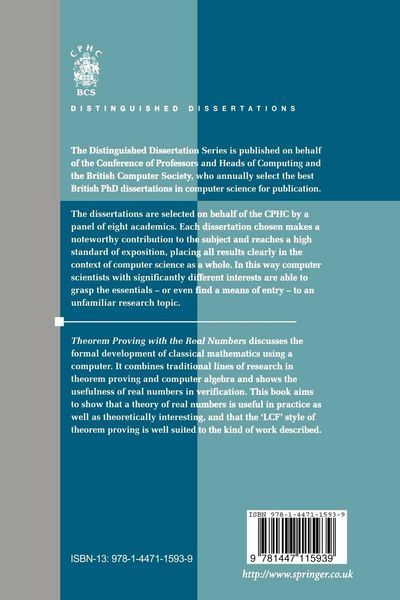
This book discusses the use of the real numbers in theorem proving. Typ ically, theorem provers only support a few 'discrete' datatypes such as the natural numbers. However the availability of the real numbers opens up many interesting and important application areas, such as the verification of float ing point hardware and hybrid systems. It also allows the formalization of many more branches of classical mathematics, which is particularly relevant for attempts to inject more rigour into computer algebra systems. Our work is conducted in a version of the HOL theorem prover. We de scribe the rigorous definitional construction of the real numbers, using a new version of Cantor's method, and the formalization of a significant portion of real analysis. We also describe an advanced derived decision procedure for the 'Tarski subset' of real algebra as well as some more modest but practically useful tools for automating explicit calculations and routine linear arithmetic reasoning. Finally, we consider in more detail two interesting application areas. We discuss the desirability of combining the rigour of theorem provers with the power and convenience of computer algebra systems, and explain a method we have used in practice to achieve this. We then move on to the verification of floating point hardware. After a careful discussion of possible correctness specifications, we report on two case studies, one involving a transcendental function.

Produktdetails

Einband

Taschenbuch

Erscheinungsdatum

20.11.2011

Abbildungen

XII, 186 p.

Verlag Springer London

Produktdetails

Einband

Taschenbuch

Erscheinungsdatum

20.11.2011

Abbildungen

XII, 186 p.

Verlag Springer London
Seitenzahl

186

Maße (L/B/H)

23,5/15,5/1,2 cm

Gewicht

312 g

Auflage

Softcover reprint of the original 1st ed. 1998

Sprache

Englisch

ISBN

978-1-4471-1593-9

Herstelleradresse

Springer-Verlag GmbH
Europaplatz 3
69115 Heidelberg
DE

Email: ProductSafety@springernature.com

Noch keine Bewertungen vorhanden

Verfassen Sie die erste Bewertung zu diesem Artikel

Helfen Sie anderen Kundinnen und Kunden durch Ihre Meinung.

Kundinnen und Kunden meinen

Bewertungen (0)

  • Produktbild: Theorem Proving with the Real Numbers
  • Produktbild: Theorem Proving with the Real Numbers
  • 1. Introduction.- 1.1 Symbolic computation.- 1.2 Verification.- 1.3 Higher order logic.- 1.4 Theorem proving vs. model checking.- 1.5 Automated vs. interactive theorem proving.- 1.6 The real numbers.- 1.7 Concluding remarks.- 2 Constructing the Real Numbers.- 2.1 Properties of the real numbers.- 2.2 Uniqueness of the real numbers.- 2.3 Constructing the real numbers.- 2.4 Positional expansions.- 2.5 Cantor’s method.- 2.6 Dedekind’s method.- 2.7 What choice?.- 2.8 Lemmas about nearly-multiplicative functions.- 2.9 Details of the construction.- 2.10 Adding negative numbers.- 2.11 Handling equivalence classes.- 2.12 Summary and related work.- 3. Formalized Analysis.- 3.1 The rigorization and formalization of analysis.- 3.2 Some general theories.- 3.3 Sequences and series.- 3.4 Limits, continuity and differentiation.- 3.5 Power series and the transcendental functions.- 3.6 Integration.- 3.7 Summary and related work.- 4. Explicit Calculations.- 4.1 The need for calculation.- 4.2 Calculation with natural numbers.- 4.3 Calculation with integers.- 4.4 Calculation with rationals.- 4.5 Calculation with reals.- 4.6 Summary and related work.- 5. A Decision Procedure for Real Algebra.- 5.1 History and theory.- 5.2 Real closed fields.- 5.3 Abstract description of the algorithm.- 5.4 The HOL Implementation.- 5.5 Optimizing the linear case.- 5.6 Results.- 5.7 Summary and related work.- 6. Computer Algebra Systems.- 6.1 Theorem provers vs. computer algebra systems.- 6.2 Finding and checking.- 6.3 Combining systems.- 6.4 Applications.- 6.5 Summary and related work.- 7. Floating Point Verification.- 7.1 Motivation.- 7.2 Floating point error analysis.- 7.3 Specifying floating point operations.- 7.4 Idealized integer and floating point operations.- 7.5 A square root algorithm.- 7.6 ACORDIC natural logarithm algorithm.- 7.7 Summary and related work.- 8. Conclusions.- 8.1 Mathematical contributions.- 8.2 The formalization of mathematics.- 8.3 The LCF approach to theorem proving.- 8.4 Computer algebra systems.- 8.5 Verification applications.- 8.6 Concluding remarks.- A. Logical foundations of HOL.- B. Recent developments.